Product Craft
User Research for AI: Uncovering Needs & Validating Experiences
User research for AI products isn't just a specialized skill; it’s a critical discipline that fundamentally differs from traditional product research. The core question for AI PMs isn't just 'Is this usable?' but 'Is this trustworthy? Is it helpful? And why did it do that?' My experience across streaming, fintech, and healthcare has shown me that without a dedicated approach to understanding user mental models, managing expectations, and validating the dynamic outputs of intelligent systems, even the most technically brilliant AI will fail to deliver real value. We need to move beyond traditional usability testing and embrace methods that probe deeper into trust, explainability, and the psychological contract users form with AI.
The stakes are higher with AI. A recommendation system that sometimes misses the mark is one thing; an AI diagnostic tool that misinterprets critical data is another. Effective user research in AI is about uncovering nuanced needs, validating the often-opaque behaviors of intelligent systems, and mitigating risks that are unique to this domain. It’s about building products that users not only adopt but truly trust and integrate into their lives.
Why is User Research for AI Different from Traditional Product Research?
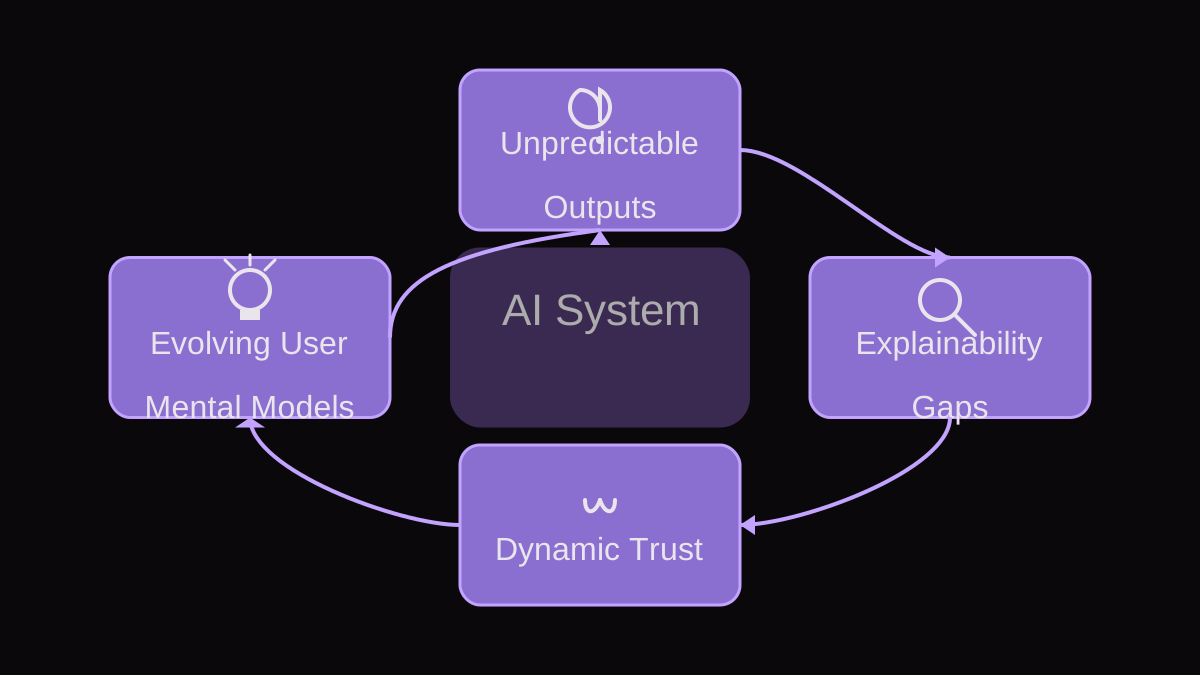
When I transitioned into AI product management, I quickly realized that the foundational principles of user research remained, but their application and emphasis shifted dramatically. We're no longer just observing interactions with a static interface; we're observing a dynamic relationship with an evolving, often opaque entity. Here’s why the difference matters:
- Unpredictable and Dynamic Outputs: Unlike traditional software with deterministic logic, AI systems can produce varied outputs for similar inputs, or change their behavior over time as they learn. This makes validating expected behavior incredibly challenging. Users need to understand the 'why' behind these variations, or trust erodes quickly.
- Explainability Gaps: Users don't just want to know 'what' the AI did, but 'why.' A recommendation engine suggests a movie, but why that specific one? A financial AI flags a transaction, but on what basis? My work in fintech especially highlighted the critical need for transparency. Without sufficient explanation, users will distrust or reject the AI, regardless of its accuracy.
- Bias and Fairness Implications: AI systems learn from data, and if that data is biased, the AI will perpetuate and amplify those biases. This isn't just an ethical concern; it’s a product failure. Research must proactively uncover how an AI might perform differently, or unfairly, for various user groups. In healthcare, the impact of biased AI can be life-threatening.
- Evolving User Mental Models: Users approach AI with a mix of awe, skepticism, and often, unrealistic expectations. Their understanding of the AI's capabilities and limitations changes as they interact with it. Our research needs to track these evolving mental models and address discrepancies before they lead to frustration or abandonment.
- Ethical and Trust Considerations: The decision-making autonomy of AI introduces entirely new ethical dimensions. Who is responsible when an AI makes a mistake? How much control should users have? My experience in healthcare product management constantly reinforces that trust isn't a feature; it's the foundation upon which all AI products must be built.
What Research Methods Are Best Suited for Intelligent Systems?
Given these unique challenges, a traditional interview or usability test often isn't enough. We need to employ a richer toolkit. Here are some methods I've found particularly effective:
- Contextual Inquiry: Go where your users are and observe them interacting with the AI in their natural environment. This helps uncover unspoken needs, workflow friction, and how the AI integrates (or fails to integrate) into their real-world tasks. For an AI-powered personal assistant, observing daily routines can reveal critical moments for intervention or non-intervention.
- Think-Aloud Protocols (AI-Adapted): While users interact with an AI prototype, ask them to vocalize their thoughts, expectations, and interpretations of the AI's output. Crucially, prompt them with questions like 'What do you think the AI is doing now?' or 'Why do you think it suggested that?' This helps surface their mental models and explainability gaps.
- Wizard of Oz Testing: Before building complex AI, simulate its behavior with a human 'wizard' behind the scenes. This allows you to test user interactions, validate conversational flows, and understand user expectations without investing heavily in AI development. It's invaluable for validating the core value proposition and interaction design.
- AI Role-Playing: Ask users to role-play as the AI, responding to prompts as they imagine the AI would. Then, have them explain their reasoning. This can be surprisingly effective for uncovering user expectations about AI capabilities, limitations, and desired levels of explanation.
- Co-Creation Workshops: Bring users into the design process to actively shape the AI's features, behaviors, and even its 'personality.' This fosters a sense of ownership and helps align the AI's development with genuine user needs and ethical considerations. It’s particularly powerful for defining acceptable levels of autonomy and intervention.
- Longitudinal Studies: Because AI systems learn and users adapt, one-off studies only provide a snapshot. Implement longer-term studies where users interact with the AI over weeks or months. This reveals how trust evolves, how usage patterns change, and how the AI's learning impacts user satisfaction and utility over time. This is critical for understanding the true ROI of AI.
- Expectation-Setting Interviews: Conduct interviews specifically designed to probe user expectations before, during, and after initial AI interaction. Ask about perceived capabilities, potential risks, and desired controls. This helps you proactively manage the 'AI hype cycle' and design features that bridge the gap between expectation and reality.
How to Apply the AI Trust & Utility Rubric
To systematically evaluate AI products, I developed what I call the AI Trust & Utility Rubric. This framework provides a structured way to assess user experience findings, ensuring we’re not just looking at surface-level usability but digging into the deeper, AI-specific dimensions. It’s a decision rubric with numbered criteria you can apply tomorrow to guide your research questions and analyze your findings.
- 1. Predictability & Consistency: Does the AI behave as expected? Is its output stable over time and across similar inputs? Users need a baseline of reliability. If the AI is wildly inconsistent, trust collapses. Your research should test edge cases and repeated interactions.
- 2. Explainability & Transparency: Can the user understand why the AI made a decision or recommendation? Is the level of explanation appropriate for the context? This doesn't mean revealing the algorithm's entire inner workings, but providing sufficient context for the user to make an informed decision or accept the AI's output. In healthcare, this is non-negotiable.
- 3. Perceived Value & Utility: Does the AI genuinely solve a problem or enhance a task? Is the effort to use it justified by the benefit? This is foundational. If the AI doesn’t deliver tangible value, no amount of trust or explainability will save it. Research must confirm real-world problem-solving.
- 4. Control & Agency: Does the user feel in control? Can they override, correct, or refine the AI's actions? Users need to feel empowered, not subservient. Providing clear 'undo,' 'edit,' or 'tell me more' options is crucial. Your research should observe how users try to exert control.
- 5. Bias & Fairness Mitigation: Does the AI produce equitable outcomes across diverse user groups? Does it avoid perpetuating harmful stereotypes? This criterion is paramount for ethical AI. Research must actively seek out and test for disparate impacts on different demographics, ensuring fairness is built-in, not bolted on.
- 6. Adaptability & Learning: Does the AI improve with user interaction? Is its learning curve understandable to the user? Users often expect AI to 'get smarter.' Research should explore if users perceive this learning, if they understand how to 'teach' the AI, and if this adaptation aligns with their goals.
To apply this rubric, frame your research questions around these criteria. For instance, instead of 'Is the recommendation clear?', ask 'Can the user explain why this recommendation was made, reflecting on the AI's logic (Explainability)?' Or, 'Do users from different backgrounds perceive the AI's suggestions as equally fair and relevant (Bias & Fairness)?' Use the rubric to categorize your qualitative findings and identify areas for improvement, helping you prioritize your AI product roadmap.
Walkthrough: Researching an AI-Powered Healthcare Assistant
Let’s walk through a concrete example. Imagine we're building an AI-powered assistant designed to help patients manage chronic conditions like diabetes or hypertension, offering personalized insights based on their health data, diet, and activity levels. This is a high-stakes environment where trust is paramount.
- 1. Define Research Goals: Our primary goals are to understand how patients currently manage their condition, their comfort level with an AI interpreting sensitive health data, and their trust in AI-generated health recommendations. We also want to identify critical points where human oversight is essential and potential biases in advice.
- 2. Method Selection: We'll use a multi-pronged approach. Contextual inquiry will reveal how patients log data, interact with doctors, and manage their condition daily. Wizard of Oz testing will simulate the AI's recommendation engine without full development, allowing us to test various forms of advice and explanations. Finally, longitudinal diary studies will track patient trust and adherence over several weeks as they hypothetically interact with the AI.
- 3. Pilot Study & Iteration: We'd recruit a small group (3-5 patients) to run through our research protocol. This helps us refine interview questions, ensure the Wizard of Oz simulation feels realistic, and check for any ambiguities in our diary prompts. For example, we might discover that asking 'Did you trust the AI's advice?' is too direct, and instead, we need to ask 'How did you feel about the AI's advice?' and 'What information would have made you more confident?'
- 4. Data Collection: For contextual inquiry, we observe patients in their homes, noting how they use existing tools and manage their daily health routines. During Wizard of Oz sessions, we'd present simulated health data and have the 'wizard' provide AI-like recommendations, probing patients' reactions and understanding. The diary studies would involve patients journaling their interactions with a mock-up of the AI, recording their feelings, actions taken, and the perceived usefulness of the advice.
- 5. Analysis using the AI Trust & Utility Rubric: After collecting data from 15-20 patients, we'd map our findings against the rubric. For instance:
- * Predictability: We might find patients are confused when the AI gives different advice for similar glucose readings, revealing a need for clearer contextualization.
- Explainability: Many express confusion about why* the AI recommends a specific type of exercise, highlighting a gap in explanation around the underlying physiological models.
- * Utility: Patients value the AI summarizing their trends but find its specific meal suggestions impractical for their cultural diet, indicating a utility mismatch.
- * Control: Patients want an easy way to 'disagree' with advice or add personal context that the AI might have missed, affirming the need for robust override mechanisms.
- * Bias & Fairness: We might notice that the AI's default dietary advice doesn't account for vegetarian diets or specific cultural food practices, revealing a potential bias that could alienate certain patient groups.
- * Adaptability: Patients expect the AI to 'remember' their preferences and past choices, indicating a strong desire for perceived learning.
- 6. Actionable Insights: Based on this analysis, we’d generate specific recommendations: prioritize developing a 'Why this recommendation?' feature, allow users to flag advice as 'not relevant,' implement more diverse dietary models, and design clear feedback loops for the AI to learn from user input. This ensures our AI isn't just technologically advanced but deeply empathetic and trusted.
Common Mistakes in AI User Research & How to Avoid Them
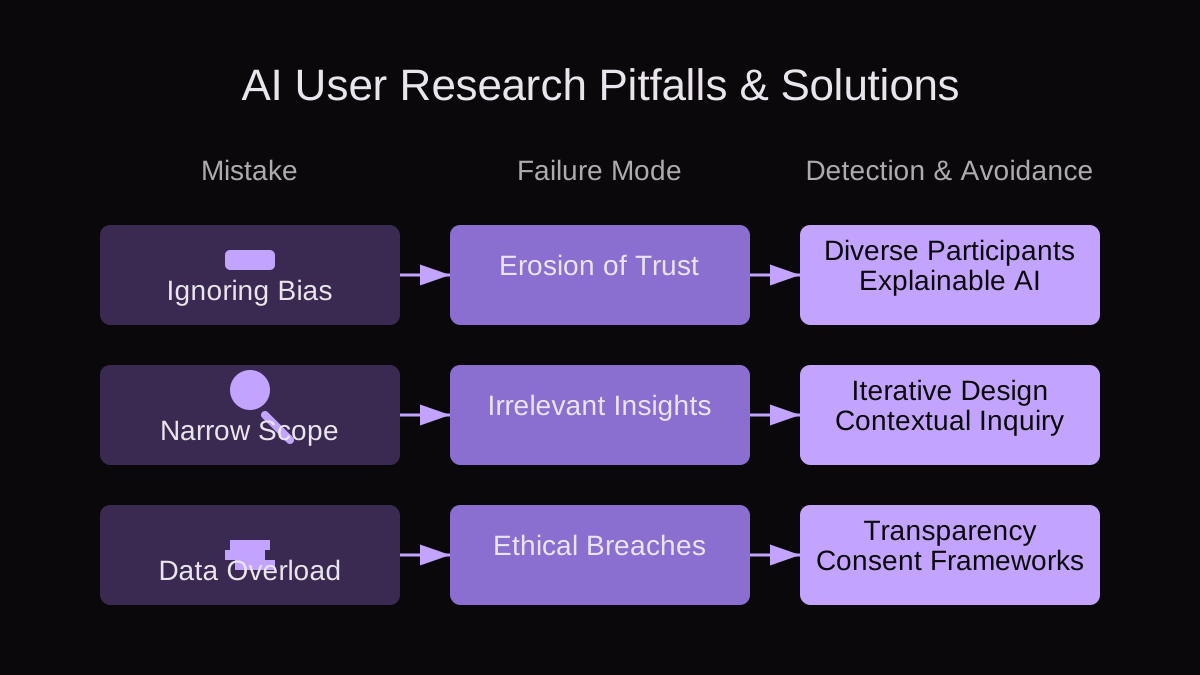
Even with the right intentions, AI user research can stumble. I’ve seen these pitfalls repeatedly, and learning to detect and avoid them is crucial for building impactful AI products.
- Mistake 1: Treating AI as a Black Box. Failure Mode: You get usability feedback on the UI, but no insight into why the AI's behavior is confusing or mistrusted. Users can't explain why they don't like a recommendation, just that they don't. Detection & Avoidance: Actively probe mental models. Ask 'What do you think the AI is doing here?' or 'How do you expect it to arrive at this conclusion?' Design your research to surface the user's internal model of the AI, then compare it to the AI's actual behavior.
- Mistake 2: Over-indexing on Accuracy, Under-indexing on Trust. Failure Mode: You build an AI that is 99% accurate by technical metrics, but users don't adopt it because they don't trust it, or its errors are catastrophic. Detection & Avoidance: Integrate trust as a first-class metric in your research. Use the AI Trust & Utility Rubric. Conduct qualitative studies specifically on trust perception, perceived reliability, and the comfort level with AI autonomy. Remember, a perfectly accurate AI that's not trusted is a failed product.
- Mistake 3: Ignoring Bias in Datasets & Outputs. Failure Mode: Your AI performs exceptionally for one demographic but poorly, or even harmfully, for another. This leads to alienating users, negative press, and potentially ethical or legal repercussions. Detection & Avoidance: Proactively recruit diverse participant pools, ensuring representation across demographics, technical literacy, and use cases. Actively look for differential impacts in your findings. If your AI handles sensitive data (like in healthcare or fintech), consider bias audits as part of your research plan.
- Mistake 4: Static Research for Dynamic Systems. Failure Mode: You conduct a one-time study, launch your AI, and then find that as the AI learns or the user's expectations shift, your initial insights become irrelevant. Detection & Avoidance: Embrace longitudinal studies and continuous feedback loops. AI products are never 'done.' Implement in-product feedback mechanisms, conduct regular pulse checks, and schedule follow-up qualitative studies months after launch to understand evolving user relationships with the AI.
- Mistake 5: Not Setting User Expectations. Failure Mode: Users come to your AI product with unrealistic expectations, leading to immediate disappointment and abandonment when it doesn't perform like science fiction. Detection & Avoidance: Use your research to understand existing user expectations before product launch. Then, design your onboarding, messaging, and interface elements to clearly communicate the AI's capabilities and limitations. Progressive disclosure, where complex AI features are revealed gradually, can also help manage expectations and build confidence over time.
Key Takeaways
- AI user research is a distinct discipline that requires a specialized approach beyond traditional product research.
- Focus on understanding user mental models, managing expectations, and building trust, explainability, and fairness into your AI products.
- Leverage methods like Contextual Inquiry, Wizard of Oz, AI Role-Playing, and Longitudinal Studies to uncover deeper insights specific to intelligent systems.
- Apply the AI Trust & Utility Rubric (Predictability, Explainability, Utility, Control, Bias, Adaptability) to systematically evaluate AI user experiences.
- Proactively address common pitfalls like treating AI as a black box, neglecting trust, ignoring bias, and conducting static research.
- Effective user research for AI is an ongoing process, crucial for building intelligent systems that are not just functional, but truly helpful, ethical, and trusted.