AI Product
Building Responsible AI Products: A PM's Ethical Framework
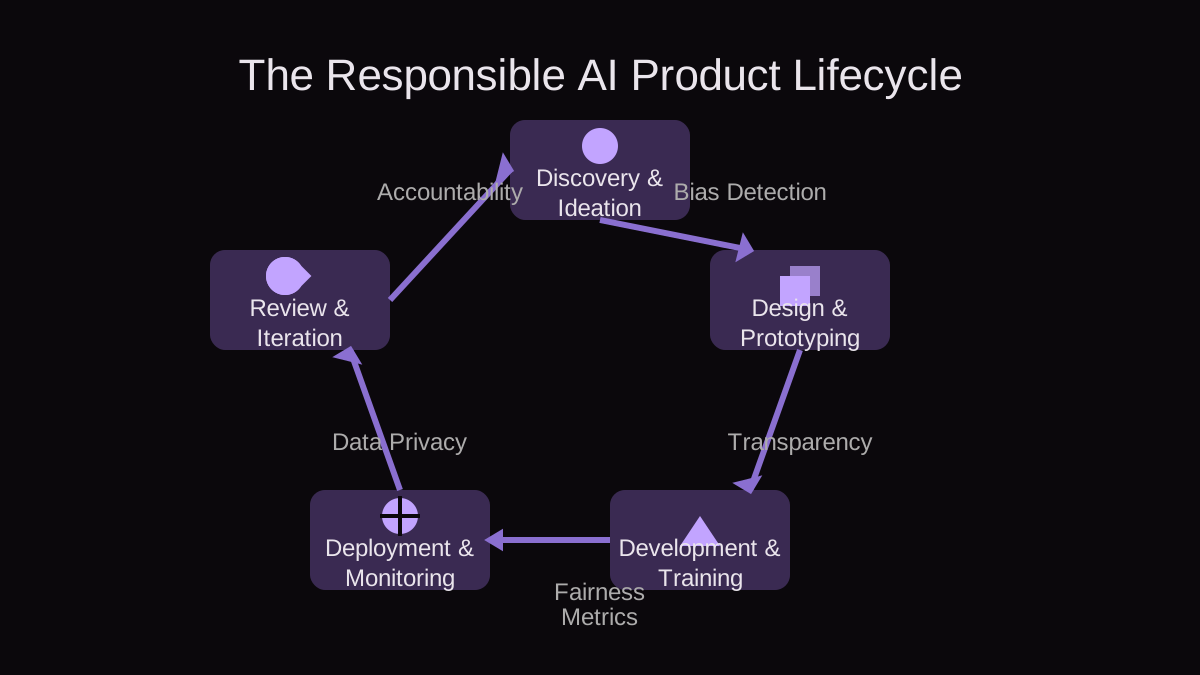
Building responsible AI products requires product managers to embed ethical considerations into every stage of the development lifecycle, from ideation to deployment and beyond. It is not an optional add-on or a checkbox exercise, but a fundamental pillar of sustainable product success. My experience across fintech, healthcare, and streaming has consistently shown that neglecting ethical concerns leads to eroded user trust, regulatory hurdles, and ultimately, product failure. We need a structured approach to navigate these complexities proactively.
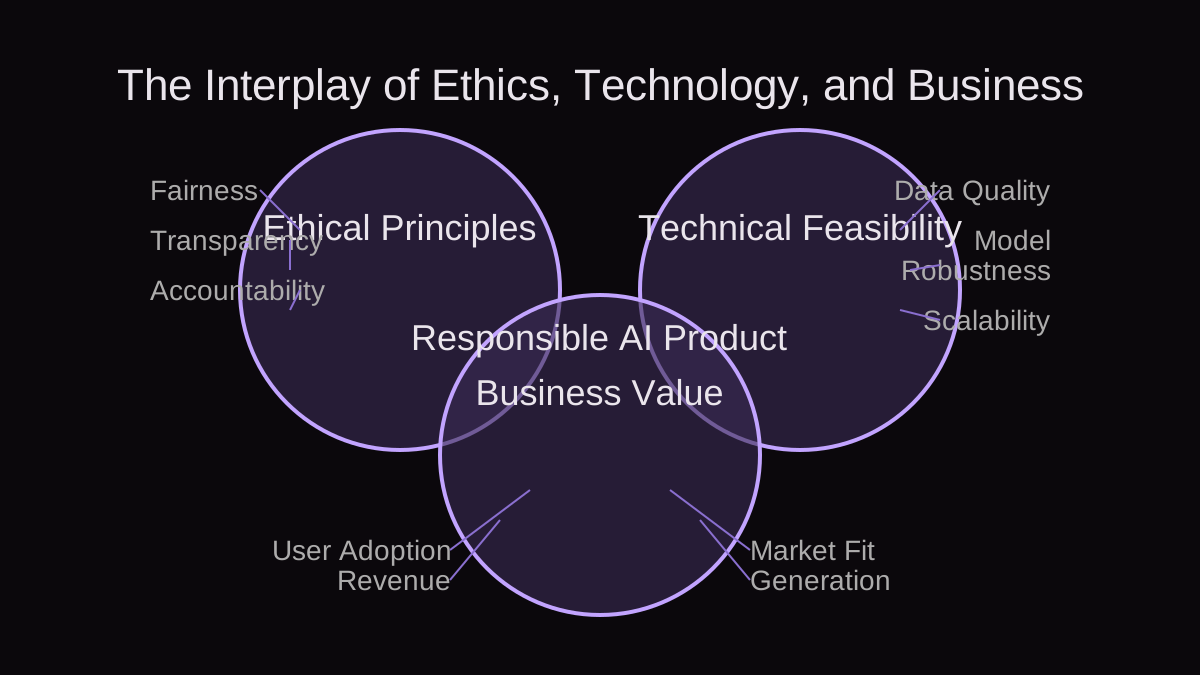
The role of the AI Product Manager is pivotal. We sit at the intersection of technology, business, and user needs, making us the primary advocates for ethical design and deployment. We define the problem, scope the solution, and articulate success metrics. This unique position gives us the power—and the responsibility—to champion ethical development, ensuring that our AI innovations serve humanity positively and equitably.
Why is Responsible AI a Product Manager's Responsibility?
As AI Product Managers, we are not just feature definers; we are system architects, tasked with understanding the full impact of our products. Unlike traditional software, AI systems can exhibit emergent behaviors, propagate biases, and make decisions with profound societal implications. If we fail to consider the ethical dimensions, the consequences can range from reputational damage and user backlash to significant financial losses and legal penalties. When an AI product breaks due to ethical oversights, it is often because its core design choices, data sources, or deployment strategies were not sufficiently vetted for fairness, transparency, or accountability. This directly falls under the PM's purview, as we shape these very elements.
Our influence spans the entire product journey. We define the initial problem space, which dictates the data we collect and the models we build. We set the success metrics, which can inadvertently incentivize unethical behavior if not carefully crafted. We oversee user experience, where transparency and control are paramount. And ultimately, we are accountable for the product's impact in the real world. Delegating ethical concerns solely to data scientists or legal teams misses the point; ethics must be an integrated product requirement, managed and prioritized just like performance or scalability.
- Data Sourcing and Annotation: PMs approve data acquisition strategies and ensure responsible labeling practices.
- Model Deployment and Inference: We decide how AI outputs are used, whether as recommendations, automated decisions, or aids to human judgment.
- User Experience and Interaction: PMs design the interfaces that explain AI decisions and provide user recourse.
- Success Metrics and KPIs: We define what 'good' looks like, influencing whether the system prioritizes profit over fairness, or efficiency over privacy.
- Stakeholder Communication: PMs are the voice of the product, responsible for communicating its capabilities and limitations transparently to users, executives, and regulators.
The Ethical AI Product Blueprint: A Decision Framework for PMs
To systematically address ethical considerations, I propose 'The Ethical AI Product Blueprint'—a practical decision framework. This isn't a one-time checklist but a rubric to be revisited at every major milestone, from concept to post-launch iteration. It helps us ask the right questions and push for the necessary safeguards.
- 1. Problem & Impact Assessment: What specific problem are we solving, and for whom? Who benefits from this solution, and who could be inadvertently or disproportionately harmed? What are the potential social, economic, or psychological impacts, both positive and negative, if this product succeeds or fails? Why this matters: Early identification of stakeholders and potential harms helps you design mitigations from the start, avoiding costly redesigns or public relations crises later. Failing to do this can lead to products that solve a niche problem for some while creating larger problems for others.
- 2. Data Sourcing & Bias Audit: Where does the data come from? Is it representative of the target user base? What potential historical, societal, or collection biases might exist within the dataset? How will we actively identify, measure, and mitigate these biases throughout data preprocessing and model training? Why this matters: Data is the foundation of AI. Biased data leads to biased models. A PM needs to understand the provenance and limitations of the data, pushing for diverse and representative datasets. Ignoring this guarantees an unfair product that amplifies existing inequalities.
- 3. Model Transparency & Explainability: To what extent can we explain how the model arrives at its decisions or recommendations? Is this explanation understandable to end-users, domain experts (e.g., clinicians, loan officers), and regulators? What level of explainability is legally or ethically required for this specific use case? Why this matters: Trust is built on understanding. For critical applications, 'black box' AI is unacceptable. PMs must balance model performance with the need for interpretability, ensuring users can comprehend and trust the AI's logic, especially when it impacts their lives.
- 4. Fairness & Equity Metrics: How do we define 'fair' for this product? What quantitative metrics will we use to measure fairness across different demographic groups, socioeconomic statuses, or other relevant protected characteristics? How will we monitor and address disparities in performance (e.g., accuracy, false positive/negative rates) for different user segments? Why this matters: Fairness is not a single concept; it's often a balance of competing definitions. PMs must work with data scientists and domain experts to select appropriate fairness metrics that align with the product's goals and societal values. Without explicit metrics, fairness remains an unmeasurable aspiration.
- 5. User Control & Recourse: Do users have meaningful control over their data and how the AI interacts with them? Is there a clear, accessible process for users to understand, challenge, or appeal AI-driven decisions? How can users opt-out or provide feedback that directly influences model behavior? Why this matters: Empowering users fosters trust and provides a vital feedback loop. When an AI makes a mistake, users need a path to recourse. Neglecting this can lead to frustration, disengagement, and a sense of powerlessness among users.
- 6. Security & Privacy by Design: Are data security and user privacy built into the product and system architecture from the outset, not as an afterthought? What sensitive information is collected, stored, and processed? How do we ensure compliance with relevant data protection regulations (e.g., GDPR, HIPAA, CCPA)? Why this matters: Data breaches and privacy violations are catastrophic for user trust and company reputation. PMs must champion a 'privacy by design' approach, working with security and legal teams to embed robust protections from the earliest stages of development.
- 7. Accountability & Governance: Who is ultimately responsible when the AI makes an erroneous or harmful decision? What are the internal oversight mechanisms, audit trails, and review processes for AI outputs? Is there a clear escalation path for ethical dilemmas or adverse events? Why this matters: Ambiguity around accountability creates a vacuum where ethical lapses can thrive. PMs need to work with leadership to define clear roles, responsibilities, and governance structures. This includes establishing human oversight, defining thresholds for intervention, and ensuring auditability.
Worked Example: Applying the Blueprint to a Healthcare AI Product
Let's walk through a concrete scenario: developing an AI-powered tool for hospitals to predict the risk of patient readmission within 30 days of discharge. The goal is to flag high-risk patients so care teams can provide targeted interventions, improving patient outcomes and reducing healthcare costs.
1. Problem & Impact Assessment: Our primary goal is to reduce preventable readmissions. However, we must consider potential harms: if the model disproportionately flags certain demographic groups as 'high risk' due to historical biases in healthcare data, it could lead to over-intervention or stigmatization for those groups. Conversely, if it under-flags others, they might miss critical support. We identify patients, care teams, and hospital administration as key stakeholders. The PM must ensure the product doesn't exacerbate existing health disparities.
2. Data Sourcing & Bias Audit: The model will be trained on electronic health record (EHR) data, including demographics, diagnoses, medications, and past readmission history. A critical PM question: Does this historical data contain biases? For instance, if certain socioeconomic groups have historically received less comprehensive care or have different documentation patterns, the model might learn these biases. The PM would push for a thorough bias audit of the dataset, examining feature distributions across race, ethnicity, and income, looking for proxy variables that correlate with protected attributes, and working with data scientists to apply re-weighting or other bias mitigation techniques.
3. Model Transparency & Explainability: A simple 'risk score' isn't enough for clinicians. They need to understand the underlying factors contributing to a patient's high-risk prediction to make informed clinical judgments. The PM would prioritize explainability, requiring the model to surface key contributing features (e.g., 'patient has multiple chronic conditions', 'lack of stable housing indicated in notes', 'recent ER visit'). This allows clinicians to validate the prediction and override it if necessary, preventing a 'black box' dictating patient care.
4. Fairness & Equity Metrics: How do we define fairness here? Is it equal accuracy for all demographic groups? Or equal false positive rates (incorrectly flagged as high risk) across groups? Or equal false negative rates (missed high-risk patients)? The PM, in collaboration with clinicians and ethicists, must define these. For instance, we might prioritize minimizing false negatives for underrepresented groups to ensure they receive adequate support, even if it means a slightly higher false positive rate. We would track these metrics post-deployment to ensure equitable performance.
5. User Control & Recourse: Patients often aren't 'users' in the direct sense but are profoundly impacted. The PM ensures that the tool is strictly for clinical decision support, not automated decision-making. Clinicians must always have the final say. For patients, the PM would ensure clear communication from care teams about how risk assessments are made and what interventions are offered. An appeals process for patients or their advocates to challenge care plans, even if not directly challenging the AI score, would be a core requirement.
6. Security & Privacy by Design: Healthcare data is highly sensitive. The PM must ensure the product adheres to HIPAA regulations and other privacy standards from day one. This means strict data access controls, anonymization or pseudonymization techniques for training data, robust encryption, and secure audit trails for every access and decision. Privacy impact assessments would be mandatory, and the product would be designed to only access the minimum necessary data.
7. Accountability & Governance: The PM would establish clear protocols: who owns the model's performance? Who is responsible if a patient is harmed due to a model error or bias? A clinical review board would oversee the model's ongoing performance, with clear guidelines for when human override is necessary. Regular audits of model predictions and outcomes, with defined escalation paths for identified issues, would be implemented. The PM champions these governance structures to ensure continuous oversight and accountability.
This step-by-step application of The Ethical AI Product Blueprint forces a comprehensive consideration of ethical dimensions, transforming abstract principles into actionable product requirements and development practices.
Common Pitfalls in Responsible AI Development (and How to Avoid Them)
Even with good intentions, teams can stumble. Understanding common failure modes helps us proactively build more robust and ethical AI products.
- Failure Mode 1: "Ethics as an Afterthought" - Integrating ethical review only at the very end of the product lifecycle, often just before launch.
- Detect: You find yourself scrambling to fix bias issues in production, legal counsel raises red flags late in the game, or user testing reveals unexpected discriminatory outcomes. Ethical considerations are treated as a separate, optional gate.
- Avoid: Embed ethical discussions and reviews into every sprint and every phase of the product lifecycle. Use the Ethical AI Product Blueprint from the ideation phase. Designate an 'ethics champion' within the product team who ensures these discussions are ongoing and documented. Make ethical impact assessments a mandatory part of your product requirement documents (PRDs) and design reviews.
- Failure Mode 2: "Blind Spot Bias" - Assuming your team's perspective covers all potential biases and impacts, leading to a lack of diverse viewpoints in design and testing.
- Detect: Your product performs well for your primary user base (often mirroring your team's demographics) but fails or causes harm for marginalized or underrepresented groups. User research participants are homogenous, or feedback channels aren't inclusive.
- Avoid: Actively build diverse product teams. Prioritize inclusive user research, seeking out participants from a broad spectrum of demographics, abilities, and backgrounds. Implement 'red-teaming' exercises where external or internal teams actively try to break or exploit the AI in ethically problematic ways. Conduct formal bias audits on datasets and model outputs across different demographic slices. Engage with ethicists or advocacy groups for external perspectives.
- Failure Mode 3: "Over-reliance on Technical Fixes" - Believing that algorithmic solutions alone can solve complex ethical or societal problems without considering human oversight or policy.
- Detect: You focus solely on optimizing fairness metrics within the model, but neglect the real-world context of deployment. There's no clear human-in-the-loop process, or the human oversight is tokenistic. The team believes a perfect algorithm can eliminate all ethical dilemmas.
- Avoid: Recognize that AI operates within a larger human and societal context. Combine technical solutions (like debiasing algorithms) with robust human-in-the-loop processes, clear escalation paths, and strong policy safeguards. Design for human oversight and intervention. Understand that AI augments human decision-making; it rarely replaces the need for human judgment, empathy, and accountability, especially in high-stakes domains.
- Failure Mode 4: "Scope Creep on Ethics" - Getting bogged down by abstract philosophical debates, hindering practical progress and delaying product launch due to unresolved ethical dilemmas.
- Detect: Endless meetings discussing the theoretical implications of AI without concrete action items. Project timelines extend significantly due to an inability to make practical decisions about ethical trade-offs. The team feels paralyzed by the vastness of ethical considerations.
- Avoid: Use structured frameworks like the Ethical AI Product Blueprint to guide actionable discussions. Prioritize the most impactful and probable ethical risks for your specific product and context. Accept that not every ethical problem has a perfect solution, but every problem requires a responsible and transparent approach. Document trade-offs and decisions clearly, enabling iteration and learning. Focus on 'good enough for now, safe to iterate' rather than striving for an unattainable 'perfectly ethical' product.
Key Takeaways
- As AI Product Managers, ethical development is not optional; it's a core responsibility that drives trust and long-term product success.
- Proactively integrate ethical considerations from ideation through deployment, rather than treating them as an afterthought.
- Utilize 'The Ethical AI Product Blueprint' to systematically assess potential harms, biases, and governance needs at every stage.
- Prioritize data sourcing and bias audits, understanding that biased data leads to biased models.
- Champion transparency and explainability, ensuring users and stakeholders can understand and trust AI decisions.
- Design for user control and clear recourse mechanisms, empowering users and fostering trust.
- Implement 'privacy by design' and robust security measures to protect sensitive data.
- Establish clear accountability and governance structures for continuous oversight of AI systems.
- Actively avoid common pitfalls like 'ethics as an afterthought' or 'blind spot bias' by fostering diverse teams and inclusive processes.
- Remember that responsible AI is an ongoing journey of learning and iteration, requiring a balance of technical solutions, human oversight, and thoughtful policy.