AI Product
RAG vs. Fine-tuning: A PM's Definitive Guide to LLM Customization
Listen — audio summary in Nehal Vyas's voice
Transcript
Hello everyone! I'm Nehal, and today I want to chat about a critical decision AI Product Managers face: how to best customize Large Language Models for our products. It often comes down to Retrieval-Augmented Generation, or RAG, versus fine-tuning. In my recent blog post, 'RAG vs. Fine-tuning: A PM's Definitive Guide,' I dive into these two powerful techniques. RAG is fantastic for infusing LLMs with dynamic, external, and up-to-date factual knowledge without altering the core model. It's your best bet for reducing hallucinations, providing explainable answers, and handling frequently updated information quickly and cost-effectively. Fine-tuning, in contrast, deeply embeds specific behaviors, styles, or domain-specific language by modifying the model's internal weights. This is ideal when your product needs a very specific brand voice, specialized task performance, or consistent output patterns that require deep customization. Choosing between them hinges on your product's primary goal, data characteristics, and resource availability. I explore the 'when, why, and how' for each method in detail. I invite you to read the full article on hinehal.com to equip yourself with actionable insights for your product strategy.
As AI Product Managers, one of the most critical decisions we face when leveraging Large Language Models is how to best adapt them to our specific product needs. The debate often centers around Retrieval-Augmented Generation, or RAG, and fine-tuning. Both are powerful techniques for customizing LLMs, but they address fundamentally different problems and come with distinct trade-offs. In essence, RAG excels at infusing LLMs with dynamic, external, and up-to-date factual knowledge without altering the core model, making it ideal for information retrieval tasks. Fine-tuning, on the other hand, is about deeply embedding specific behaviors, styles, or domain-specific language into the model's weights, best suited for adapting the model's inherent generation patterns and improving task performance on niche datasets. Choosing correctly depends on your product's primary goal, data characteristics, update frequency requirements, and resource constraints.
My goal here is to equip you with a practitioner's understanding, moving beyond surface-level definitions to actionable insights on when, why, and how to apply each method effectively in your product strategy.
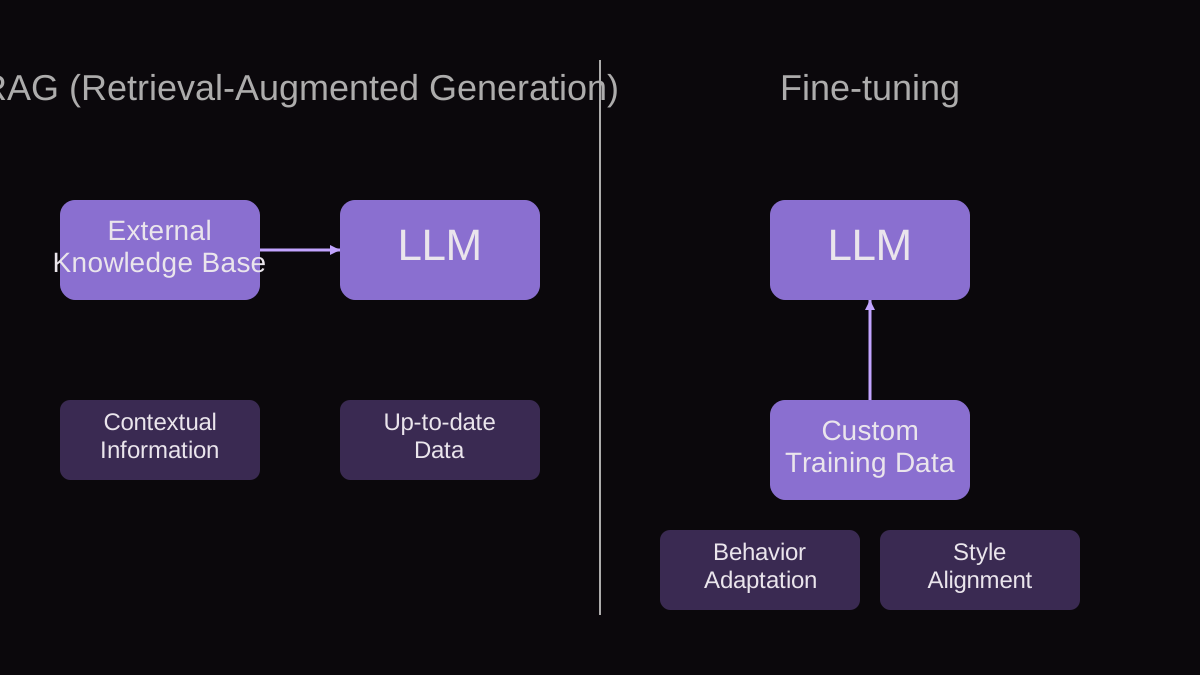
What is RAG and When Should You Use It?
Retrieval-Augmented Generation (RAG) is a technique that enhances an LLM's ability to generate responses by first retrieving relevant information from an external knowledge base and then using that information to inform the LLM's output. Think of it as giving the LLM an open book test; it doesn't need to memorize everything, but it knows how to find the right page when asked a question. The process typically involves a user query, which is used to search a vector database containing embeddings of your proprietary or external documents. The most relevant document chunks are then retrieved and included directly in the prompt sent to the LLM, providing it with up-to-date and specific context for its answer.
From a product management perspective, RAG offers compelling advantages. Its primary benefit is providing factual accuracy and reducing hallucinations, especially when dealing with domain-specific or rapidly changing information. Since the external knowledge base can be updated independently of the LLM, RAG solutions are inherently more agile in incorporating new information without costly model retraining. This makes it significantly cheaper and faster to maintain up-to-date knowledge. Furthermore, RAG responses are often more explainable; you can typically point to the source documents from which the information was retrieved, a huge win for transparency and auditability, particularly in regulated industries like healthcare or finance. The data required for RAG is your knowledge base itself, not specially formatted training data, which lowers the barrier to entry significantly.
- When your product needs access to frequently updated or proprietary factual information (e.g., company policies, real-time market data, specific product documentation).
- When explainability and traceability of information sources are critical (e.g., customer support, legal research, medical Q&A).
- When hallucination tolerance is very low for factual statements.
- When your budget or timeline does not allow for extensive data collection and model retraining cycles.
- When your knowledge base is large and diverse, and you need the LLM to synthesize information from various sources efficiently.
However, RAG is not a silver bullet. It breaks down when the retrieval mechanism is poor. If your embeddings are not well-suited to your data, or your chunking strategy is flawed, the LLM will receive irrelevant or insufficient context, leading to poor answers. This is often called the 'garbage in, garbage out' problem of retrieval. Additionally, RAG relies on the context window limits of the LLM; if the retrieved documents are too long or too numerous, the LLM might struggle to process all the information effectively, or simply truncate it. Another failure mode occurs when the external documents contain conflicting or ambiguous information, making it difficult for the LLM to determine the correct answer. As PMs, we need to focus heavily on the quality of the vector store, the retrieval algorithms, and the document processing pipeline to ensure RAG's success.
What is Fine-tuning and When Should You Choose It?
Fine-tuning involves taking a pre-trained Large Language Model and further training it on a smaller, task-specific dataset. Unlike RAG, which provides external context, fine-tuning actually modifies the model's internal weights and biases. This process adapts the LLM's underlying behavior, style, tone, and even its understanding of specific domain terminology. There are different levels of fine-tuning, from full fine-tuning (adjusting all parameters) to more parameter-efficient techniques like LoRA (Low-Rank Adaptation) or QLoRA, which only modify a small subset of parameters. Regardless of the method, the goal is to make the LLM behave more like a specialist in your specific task or domain.
For product managers, fine-tuning offers deep customization that RAG cannot. It can significantly improve the model's performance on highly specialized tasks, leading to more accurate, relevant, and consistent outputs in a particular style. If your product requires the LLM to adopt a very specific brand voice, generate code in a particular framework, summarize text in a proprietary format, or classify inputs with nuanced domain understanding, fine-tuning is often the superior choice. Because the knowledge is baked into the model's weights, responses can sometimes be faster as there's no external retrieval step required, and the model can exhibit a more profound 'understanding' of the patterns it was trained on, potentially reducing certain types of hallucinations related to style or format.
- When your product requires the LLM to adopt a very specific brand voice, tone, or writing style (e.g., marketing copy generation, personalized content creation).
- When you need the LLM to perform specific, complex tasks (e.g., code generation in a proprietary language, highly structured data extraction, summarization into a predefined template).
- When you have a large volume of high-quality, task-specific labeled data that aligns perfectly with your desired output.
- When latency is a critical performance metric, and the overhead of real-time retrieval is unacceptable.
- When the 'knowledge' you want to infuse is more about behavior, style, or specific patterns rather than dynamic facts.
The major drawbacks of fine-tuning are its cost and complexity. It requires significant computational resources for training and a substantial amount of high-quality, labeled training data, which can be expensive and time-consuming to collect and curate. If your domain knowledge changes frequently, fine-tuning becomes a maintenance burden, as you'd need to re-fine-tune the model regularly. There's also the risk of 'catastrophic forgetting,' where the model unlearns some of its general capabilities while specializing in a new task. Furthermore, fine-tuned models can still hallucinate, especially if the training data is insufficient or biased, or if asked questions outside the scope of its fine-tuning. For PMs, this means carefully weighing the investment in data and compute against the gains in specialization and understanding the lifecycle management of fine-tuned models.
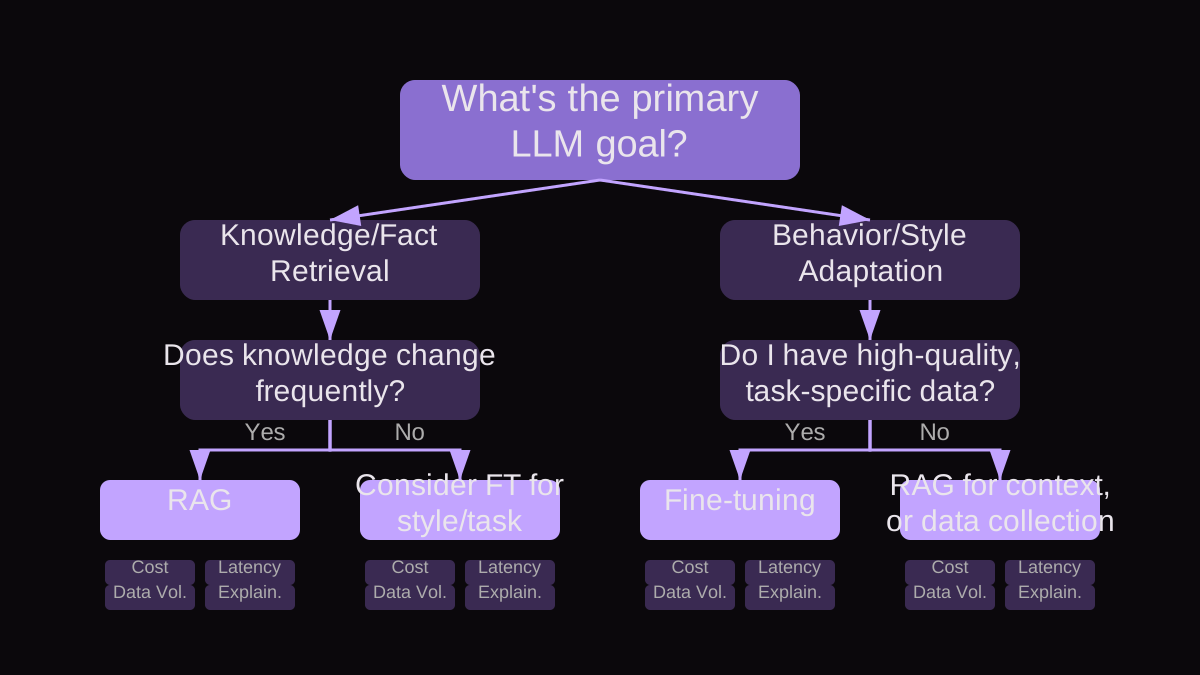
The Product Manager's LLM Customization Rubric
To systematically approach the RAG vs. fine-tuning decision, I've developed a simple rubric. This framework helps you score your product's specific needs against key criteria, leading you to the most suitable customization strategy. For each point, consider whether your product leans more towards the RAG-favorable or fine-tuning-favorable characteristic.
- 1. Nature of Information: Is the information primarily factual and external, requiring retrieval (RAG), or is it about adopting a specific style, tone, or complex inferential task (Fine-tuning)? If you need to answer questions based on a specific set of documents, RAG is stronger. If you need the model to generate creative content in a brand voice, fine-tuning is better.
- 2. Frequency of Knowledge Updates: How often does the underlying knowledge change? If it's real-time or frequently updated (daily/weekly), RAG is almost always preferred due to its agility. If the core knowledge changes infrequently (monthly/quarterly or less), fine-tuning becomes more viable, though still requiring re-training.
- 3. Required Tone and Style Consistency: Is a general, conversational tone sufficient, or does the output absolutely need to adhere to a very specific, consistent brand voice, jargon, or formatting? High consistency points towards fine-tuning, as it deeply ingrains these patterns into the model's generation process.
- 4. Data Availability and Quality: Do you have a large, clean, and well-labeled dataset specifically for the task or style you want to achieve? Fine-tuning is data-hungry. If your data is unstructured documents for retrieval, RAG is the path. If you have thousands of examples of desired input-output pairs, fine-tuning is feasible.
- 5. Cost and Latency Constraints: What are your budget for compute and data labeling, and what are your real-time response requirements? RAG generally has lower upfront training costs but incurs per-query retrieval costs and potential latency. Fine-tuning has higher upfront training costs but can offer faster inference once deployed, as it doesn't always need an external call.
- 6. Explainability and Auditability: Is it critical to show the user or an auditor exactly where the information came from? RAG, by design, allows for source attribution. Fine-tuning models, while capable of producing accurate answers, do so from their learned weights, making direct source tracing much harder.
- 7. Hallucination Tolerance: How critical is it to avoid generating plausible but false information? For factual accuracy, RAG helps ground the LLM in truth. While fine-tuning can reduce hallucinations for patterns it has learned, it doesn't inherently prevent factual errors unless those facts are explicitly encoded and reinforced in the training data, which is not its primary strength.
Worked Example: Choosing for a Healthcare AI Assistant
Let's walk through a realistic scenario. Imagine you're the AI PM for a new product: a specialized AI assistant for nurses within a large hospital network. This assistant needs to perform two main functions:
- 1. Protocol Lookup: Answer specific questions about hospital protocols, drug dosages, and patient care guidelines.
- 2. Patient Note Summarization: Summarize patient encounter notes into a standardized, concise format for shift handovers, adhering to specific clinical terminology and a professional, objective tone.
Let's apply our LLM Customization Rubric:
Function 1: Protocol Lookup
- 1. Nature of Information: Highly factual, external (hospital's official documents). Leans RAG.
- 2. Frequency of Knowledge Updates: Protocols and drug guidelines can change frequently due to new research, regulations, or internal policy updates. Leans RAG.
- 3. Required Tone and Style Consistency: Professional, direct, informative. General LLM capability is likely sufficient, with grounding in facts. Leans RAG.
- 4. Data Availability and Quality: Hospital has thousands of well-structured PDF and Word documents containing protocols. No need for labeled Q&A pairs. Leans RAG.
- 5. Cost and Latency Constraints: Answers need to be quick for clinical use, but accuracy is paramount. Retrieval latency is acceptable for the benefit of accuracy. Leans RAG.
- 6. Explainability and Auditability: Absolutely critical. Nurses need to know the source of information for patient safety and compliance. Leans RAG.
- 7. Hallucination Tolerance: Extremely low. Factual errors could be life-threatening. Leans RAG.
Conclusion for Protocol Lookup: A RAG-based solution is clearly the superior choice here. We would build a robust vector database of all hospital protocols and guidelines, ensuring excellent retrieval quality. This allows the system to provide accurate, up-to-date, and attributable information without the need to retrain a model every time a protocol is updated.
Function 2: Patient Note Summarization
- 1. Nature of Information: Interpretive, requiring specific summarization style and adherence to clinical format. Not just retrieving facts, but transforming them. Leans Fine-tuning.
- 2. Frequency of Knowledge Updates: The core task of summarization and the desired output format are relatively stable. The 'knowledge' here is a skill, not dynamic facts. Leans Fine-tuning.
- 3. Required Tone and Style Consistency: Very high. Summaries must be concise, objective, use specific medical terminology, and follow a precise structure (e.g., SOAP notes, problem-oriented). Leans Fine-tuning.
- 4. Data Availability and Quality: The hospital has a large archive of historical patient notes and expertly written summaries. This provides an excellent dataset of input (raw notes) and desired output (summaries). Leans Fine-tuning.
- 5. Cost and Latency Constraints: Summaries need to be generated efficiently. A fine-tuned model could offer faster inference than a RAG approach attempting to retrieve summary examples. Initial training cost is higher, but ongoing maintenance is less frequent. Leans Fine-tuning.
- 6. Explainability and Auditability: While the summary itself is the output, the source is the patient note. The 'why' behind the summary's structure is a learned behavior. Fine-tuning helps ensure this behavior is consistent. Leans Fine-tuning.
- 7. Hallucination Tolerance: Low for factual content within the summary, but also low for stylistic and formatting errors. Fine-tuning reduces errors in adhering to the desired format. Leans Fine-tuning.
Conclusion for Patient Note Summarization: Fine-tuning is the optimal approach. We would fine-tune an LLM on a large dataset of raw patient notes and their corresponding expert-written summaries. This would teach the model the specific style, format, and summarization logic required for handover notes, leading to highly consistent and clinically appropriate outputs.
This example highlights that many real-world AI products will likely benefit from a hybrid approach, leveraging RAG for dynamic factual retrieval and fine-tuning for specific task-oriented behavior and style adherence. As PMs, understanding these nuances allows us to design more robust and effective AI solutions.
Common Mistakes AI PMs Make with RAG and Fine-tuning
Even with a clear understanding, product managers can fall into common traps. Recognizing these pitfalls and knowing how to avoid them is crucial for successful AI product development.
Mistake 1: Treating RAG as a 'Magic Bullet' for All Knowledge
- Failure Mode: Assuming RAG will solve all knowledge-related problems, even when the LLM needs to learn a new skill or style, not just retrieve facts. This often leads to poor responses if the underlying LLM lacks the ability to synthesize or adapt, or if the retrieved context is too generic.
- Detection/Avoidance: Clearly define if the problem is 'lack of information' (RAG) or 'lack of skill/style' (fine-tuning). Monitor user feedback for answers that are factually correct but stylistically inappropriate or fail to follow specific instructions beyond simple Q&A. Ensure your retrieval strategy is truly pulling relevant, focused information, not just broad documents.
Mistake 2: Underestimating Fine-tuning Data Requirements
- Failure Mode: Believing a small, hand-labeled dataset will be sufficient to significantly alter an LLM's behavior or imbue it with deep domain expertise. This often results in overfitting, where the model performs well on the training data but poorly on unseen examples, or 'catastrophic forgetting,' where the model loses its general capabilities for minimal gain.
- Detection/Avoidance: Plan for substantial data collection and annotation efforts, often thousands or tens of thousands of high-quality examples. Start with clear, measurable evaluation metrics. If initial fine-tuning on a small dataset yields poor generalization on a held-out test set, the problem is likely data quantity or quality. Explore parameter-efficient fine-tuning (PEFT) methods like LoRA to reduce data needs and costs, but still respect the underlying requirement for representative data.
Mistake 3: Ignoring the 'Freshness' Problem with Fine-tuning
- Failure Mode: Fine-tuning an LLM with factual information that changes frequently. The knowledge becomes 'baked in' at the time of training. When the underlying facts change, the fine-tuned model will continue to provide outdated or incorrect information, leading to user distrust and product obsolescence.
- Detection/Avoidance: Use the 'Frequency of Knowledge Updates' criterion in the rubric. If facts are dynamic, RAG is almost always preferred. If you must fine-tune for a specific factual domain, ensure those facts are exceptionally stable, or build a rigorous, costly, and frequent re-fine-tuning pipeline to keep the model updated, which often negates the benefits.
Mistake 4: Not Considering a Hybrid Approach
- Failure Mode: Forcing a complex product problem into either a pure RAG or pure fine-tuning solution, even when the problem has facets that would benefit from both. This leads to suboptimal performance, increased development effort trying to make one method stretch, or unmet user needs.
- Detection/Avoidance: Use the LLM Customization Rubric comprehensively for each distinct function of your AI product. If some functions lean RAG and others fine-tuning, embrace a hybrid architecture. For instance, RAG for dynamic factual retrieval, combined with a fine-tuned LLM that specializes in a particular style or task. Many sophisticated AI products today successfully blend these techniques.
Mistake 5: Neglecting Robust Evaluation Metrics
- Failure Mode: Implementing RAG or fine-tuning without clear, measurable success criteria. Without proper evaluation, it's impossible to know if your customization improved performance, degraded it, or introduced new biases. This leads to aimless iteration and an inability to justify development costs.
- Detection/Avoidance: Before starting, define specific quantitative and qualitative metrics. For RAG, metrics might include retrieval accuracy (precision/recall of relevant documents), faithfulness (how much the LLM's answer aligns with retrieved docs), and relevance. For fine-tuning, task-specific metrics (e.g., F1-score for classification, BLEU/ROUGE for generation, human evaluation for style) are essential. Implement A/B testing frameworks to compare baseline LLM performance with customized versions.
Key Takeaways
- RAG (Retrieval-Augmented Generation) is ideal for injecting LLMs with dynamic, external, and up-to-date factual knowledge, prioritizing explainability and reducing factual hallucinations.
- Fine-tuning is best for deeply embedding specific behaviors, styles, tones, or domain-specific language into the LLM's core model, enhancing task-specific performance and consistency.
- The choice between RAG and fine-tuning hinges on the nature of information, its update frequency, required style consistency, data availability, cost constraints, and desired explainability.
- Many complex AI product challenges are best solved with a hybrid approach, combining RAG for dynamic knowledge with fine-tuning for specialized behaviors.
- Always prioritize high-quality data, whether for your RAG knowledge base or your fine-tuning dataset, as it is the foundation of any effective LLM customization.
- Utilize a structured decision framework like the 'Product Manager's LLM Customization Rubric' to systematically evaluate your product's needs and guide your strategy.
- Implement robust evaluation metrics from the outset to objectively measure the impact of your customization efforts and avoid common pitfalls.