AI Product
Prototyping AI Experiences: From Mockups to MVPs for PMs
As AI Product Managers, our goal isn't just to build features; it's to create intelligent experiences that deliver tangible value. Prototyping AI experiences effectively means moving beyond traditional static mockups to interactive, data-driven simulations and early versions that validate both user value and technical feasibility. This approach allows us to de-risk AI initiatives, gather critical feedback on model behavior, and iterate rapidly before committing significant engineering resources to a full-scale solution.
The unique nature of AI—its reliance on data, probabilistic outputs, and potential ethical implications—demands a prototyping strategy distinct from conventional software. We need methods to test hypotheses about user interaction with an intelligent system, understand how data impacts outcomes, and anticipate potential failure modes, all while maintaining a lean, agile development process. This guide will walk you through actionable strategies for PMs to navigate this complex landscape.
Why Does AI Prototyping Demand a Different Approach?
Traditional software prototyping often focuses on user interface, interaction flows, and functional completeness. With AI, those elements are still crucial, but they’re just the tip of the iceberg. We're dealing with systems whose core functionality is driven by data, machine learning models, and complex algorithms. This introduces several layers of uncertainty and complexity that traditional methods struggle to address.
First, AI systems are inherently probabilistic. Unlike a button that always performs the same action, an AI model might generate different outputs based on subtle shifts in input data. This variability needs to be understood and managed in the user experience. Second, data is both the fuel and the constraint. Prototyping must account for data availability, quality, bias, and privacy implications from day one. You can mock up a perfect UI, but if the underlying data doesn't exist or is flawed, your AI won't deliver. Third, ethical considerations are paramount. AI can inadvertently perpetuate biases, make unfair decisions, or erode trust. Prototyping offers an early opportunity to identify and mitigate these risks, often through testing with diverse user groups and carefully chosen datasets.
Finally, the build process itself is different. Training a robust model, deploying it, and setting up the necessary MLOps infrastructure is a significant undertaking. We can't afford to discover fundamental design flaws or a lack of user value late in the development cycle. AI prototyping is about de-risking these investments by validating core hypotheses cheaply and quickly, often by simulating intelligent behavior before building it.
From Concept to Coded Experience: The AI Prototyping Spectrum
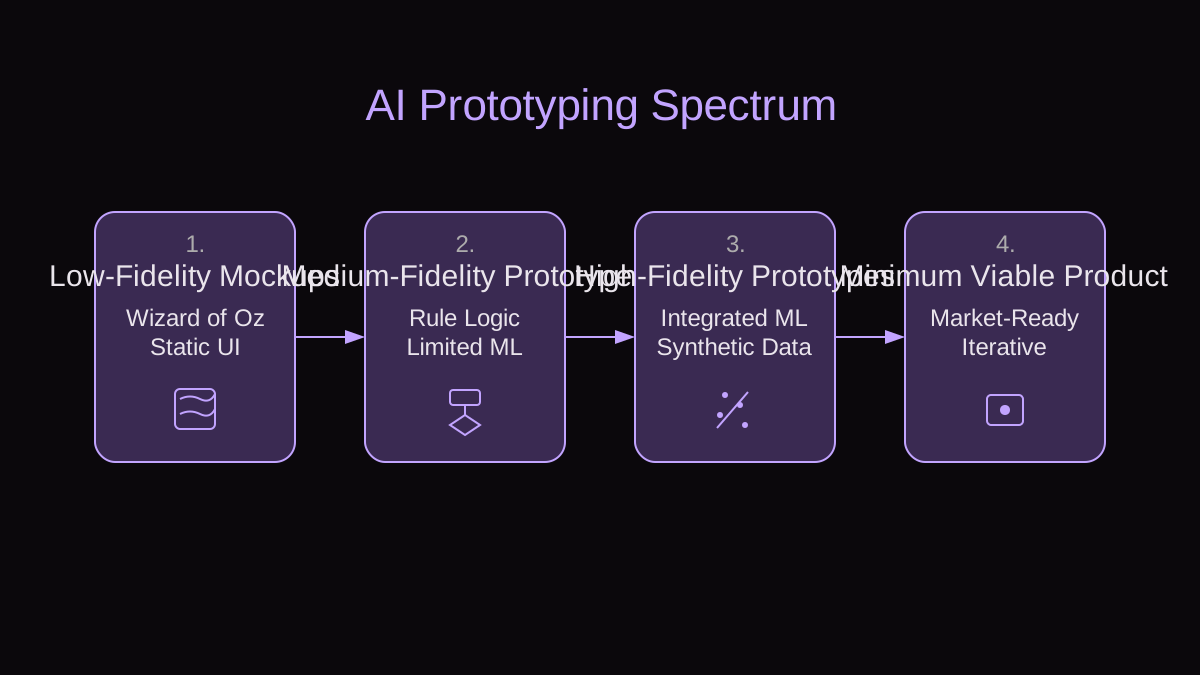
The journey from an AI concept to a working MVP isn't linear, but rather a spectrum of increasing fidelity and technical complexity. Each stage serves a distinct purpose, aimed at validating different aspects of the AI experience.
- Low-Fidelity Mockups (Wizard of Oz, Static UI): At the earliest stage, we focus on validating the core interaction paradigm and user needs without any actual AI. The 'Wizard of Oz' technique is incredibly powerful here: a human simulates the AI's responses behind the scenes. This allows us to test the user's mental model, expectations, and the value proposition with minimal effort. Static UI mockups or clickable prototypes can show how an AI output might be presented, but they can't convey the dynamic nature of an intelligent system. The goal is to answer: Is this problem worth solving with AI? Will users engage with this type of interaction?
- Medium-Fidelity Prototypes (Rule-based, Limited ML): Once the basic interaction is validated, we move to prototypes that exhibit some 'intelligence,' even if it's rudimentary. This might involve simple rule-based logic (e.g., if X, then Y) or a very basic, pre-trained machine learning model with limited data. The purpose here is to test the responsiveness, the clarity of AI outputs, and how users react to imperfect or evolving intelligence. For instance, a chatbot prototype might use predefined scripts for common queries, or a recommendation engine might offer generic suggestions based on broad categories. The key is to get a feel for the AI's 'personality' and behavior.
- High-Fidelity Prototypes (Integrated ML, Synthetic Data): This stage involves integrating more robust machine learning models, often trained on synthetic or limited real-world data. The prototype starts to behave more like the envisioned final product. This is where we start to test the AI's actual performance characteristics, its error modes, and how users recover from or interpret incorrect outputs. It's crucial for validating model explainability, confidence scores, and the overall reliability of the AI. Tools that allow quick model deployment and integration into a front-end are invaluable here. This stage answers: Is the AI delivering on its promise? How robust is it under different conditions?
- Minimum Viable Product (MVP): The MVP is the first deployable version of the AI product that delivers core value to a segment of users. It features a fully integrated, production-ready machine learning model, even if it's still relatively simple. The MVP focuses on validating the end-to-end user journey, technical feasibility at scale, and the real-world impact of the AI. It's not about being perfect, but about being functional and valuable enough to gather real-world data and feedback for subsequent iterations. This is where we learn about operational challenges, data drift, and unexpected user behaviors in a live environment.
How Do I Validate AI Product Ideas Effectively? The AI Experience Validation Rubric
To systematically evaluate an AI product idea and its prototypes, I use a framework I call the AI Experience Validation Rubric. This rubric helps PMs assess the readiness and potential impact of an AI feature or product across critical dimensions, ensuring we're asking the right questions before investing heavily. Apply this at each stage of your prototyping journey, especially as you move towards higher fidelity.
- 1. User Value Hypothesis (UVH) Clarity: Do we have a clear, testable hypothesis about how this AI will solve a user problem or create a new opportunity? Can we articulate the 'before' and 'after' state for the user? Without a strong UVH, any prototype is just a technical exercise.
- 2. Technical Feasibility & Model Performance: Is the core AI model technically achievable given current algorithms, data, and compute? What's the expected performance (accuracy, latency, recall) and is it sufficient for the desired user experience? What are the known limitations or failure modes of the model, and how will the user experience gracefully degrade?
- 3. Data Availability & Quality: Do we have access to the data needed to train, test, and operate the AI model? What's the quality, volume, and representativeness of this data? Are there gaps or biases that need to be addressed? How will new data be acquired and maintained over time?
- 4. Ethical & Safety Considerations: Have we identified potential biases in the data or model outputs? What are the privacy implications of using this data? Are there risks of misuse, unintended consequences, or harm to users? How will we build transparency and control into the user experience?
- 5. Scalability & Operational Readiness: Can this AI solution scale to the expected user base and data volume? What are the infrastructure requirements for training, inference, and continuous monitoring? How will we manage model updates, data drift, and performance degradation in production?
- 6. Business Impact & ROI Potential: How does this AI feature align with our broader product and business strategy? What is the expected return on investment, considering development, maintenance, and operational costs? Are there clear metrics to measure success?
Worked Example: Prototyping an AI-Powered Symptom Checker for Healthcare
Let's walk through a scenario: developing an AI-powered symptom checker within a telehealth platform. The goal is to help users quickly understand potential conditions based on their reported symptoms and recommend next steps (e.g., self-care, schedule a doctor's visit, emergency room).
Problem: Users often search for symptoms online, leading to anxiety, misinformation, and inappropriate self-diagnosis or delayed care. We want to provide a reliable, guided experience.
- Step 1: Low-Fidelity (Wizard of Oz) Prototype. We start with a simple chat interface. Users type in symptoms. Behind the scenes, a human (the 'Wizard') uses a decision tree or internal medical guidelines to provide responses, ask clarifying questions, and suggest next steps. We observe: Do users understand the questions? Is the flow intuitive? Do they trust the recommendations? Are they willing to share sensitive health information? This validates the UVH and interaction design.
- Step 2: Medium-Fidelity (Rule-Based) Prototype. Based on Wizard of Oz learnings, we build a rule-based system. If a user mentions 'fever' and 'sore throat,' the system might suggest 'common cold' and recommend rest. If 'chest pain' is mentioned, it immediately advises 'seek emergency care.' This uses a predefined set of conditions and rules, not a complex ML model. We test: How often do users hit the limits of the rules? Are the recommendations clear and actionable? Does the system gracefully handle out-of-scope queries? This helps refine the interaction model and identify edge cases.
- Step 3: High-Fidelity (Limited ML) Prototype. Now, we integrate a basic Natural Language Processing (NLP) model to understand symptom descriptions and a simple classification model (e.g., trained on anonymized symptom-diagnosis pairs from a limited dataset) to suggest conditions. The model might not be perfect, but it's a real ML model. We focus on: How does the model's probabilistic output (e.g., 'likely flu with 70% confidence') impact user trust and understanding? How do users react to incorrect or ambiguous diagnoses? What is the model's latency? This validates Technical Feasibility (Model Performance) and helps us iterate on how confidence levels are communicated.
- Step 4: MVP Considerations. For the MVP, we’d aim for a robust NLP model and a more comprehensive diagnostic model, trained on a larger, diverse dataset. The MVP would focus on a specific subset of conditions (e.g., common ailments) where accuracy is high and risk is low. It would include clear disclaimers, a feedback mechanism for users, and a seamless handoff to a human doctor if the AI can't confidently diagnose or if the symptoms suggest urgency. The rubric would guide us: Is the accuracy acceptable for these specific conditions (Tech Feasibility)? Have we addressed data bias (Data Quality)? Are the emergency handoffs clear and safe (Ethical/Safety)?
What Are Common Mistakes in AI Prototyping and How to Avoid Them?
Even with a structured approach, it's easy to stumble. I've seen these pitfalls repeatedly.
- Failure Mode: Over-Reliance on Mockups Without 'Intelligence'. Many PMs treat AI prototyping like traditional UI/UX, focusing purely on visual design and interaction flows without any underlying 'smart' behavior. This provides a false sense of security, as the most critical part—how the AI behaves—remains untested. How to Detect/Avoid: Always ask: 'What does the AI actually DO here?' If the answer is 'a human simulates it' (Wizard of Oz) or 'it's just a placeholder,' ensure you move quickly to introduce some form of intelligence, even if rule-based, to test the core AI interaction. Validate the 'brain,' not just the 'face.'
- Failure Mode: Ignoring Ethical Implications Early. Bias, privacy, and fairness are often considered after the model is built or even deployed. Retrospectively fixing these issues is incredibly costly and can damage user trust. How to Detect/Avoid: Integrate ethical considerations into your prototyping rubric from day one. During low-fidelity testing, probe user concerns about privacy. In medium- and high-fidelity, test with diverse datasets and user groups. Ask: 'Who might be negatively impacted by this AI's decisions?' and 'How would we explain an unexpected or unfair outcome to a user?'
- Failure Mode: Underestimating Data Needs. An AI product is only as good as its data. PMs often assume data will just 'be there' or that existing data is sufficient. This leads to models that perform poorly or cannot be trained at all. How to Detect/Avoid: Treat data as a first-class citizen in your prototyping. Before any coding, map out your data strategy: What data do you need? Where will it come from? What's its quality? How will it be labeled, and by whom? Build data acquisition and labeling into your roadmap, and prototype with synthetic or limited real data to expose gaps early.
- Failure Mode: 'Perfect Model' Syndrome. The pursuit of a perfectly accurate or comprehensive AI model can lead to endless delays and scope creep, preventing the product from ever reaching users. How to Detect/Avoid: Define your 'good enough' threshold for model performance based on user needs and business impact. What's the minimum viable accuracy or recall that delivers value and can be safely deployed? Prioritize iterations based on user feedback and real-world data, not theoretical perfection. Focus on delivering incremental value and learning.
- Failure Mode: Treating AI Prototypes Like Traditional Software Prototypes. AI prototypes have unique failure modes related to model performance, data drift, and explainability that don't exist in traditional software. How to Detect/Avoid: Beyond UI/UX testing, design tests specifically for AI behavior. This includes testing with adversarial inputs, edge cases, and out-of-distribution data. Observe how users react when the AI is wrong or uncertain. Your prototype needs to test the resilience and reliability of the intelligence, not just the interface.
Key Takeaways
- AI prototyping is distinct from traditional software; it must validate both user experience and the underlying 'intelligence' through data and model behavior.
- Utilize a spectrum of fidelity, starting with low-effort Wizard of Oz techniques to validate core user value, moving to rule-based and then ML-integrated prototypes.
- Apply the AI Experience Validation Rubric to systematically assess ideas across user value, technical feasibility, data, ethics, scalability, and business impact.
- Integrate ethical considerations and data strategy from the earliest stages of prototyping to avoid costly rework and build trust.
- Focus on 'good enough' for model performance and prioritize learning from real user interaction over striving for theoretical perfection.
- Be proactive in identifying and mitigating common pitfalls like over-reliance on static mockups, ignoring data needs, and neglecting ethical implications until late in the cycle.