AI Product
Pricing AI Features: Seats, Usage, or Outcomes? A PM's Guide
Listen — audio summary in Nehal Vyas's voice
Transcript
Hi everyone, I recently wrote about one of the toughest questions an AI Product Manager faces: how do we price our AI features? It’s not simple. The key is understanding your AI’s value, balancing customer predictability, and aligning with your operational costs. I explored three core models. First, seat-based pricing is best when your AI augments individual users, like an AI writing assistant. It brings clear predictability for both you and your customer. Second, usage-based pricing charges for specific AI 'work' performed, say per image generated or per API call. This directly links the value received to the cost, offering fairness and a low entry barrier. Lastly, there’s outcome-based pricing, often considered the holy grail. Here, customers only pay for the measurable business results your AI delivers, like increased sales or cost savings. This truly aligns value and shifts risk, though proving attribution can be complex. No single model is perfect; often, a blend or phased approach works best. If you’re grappling with this critical decision, I invite you to read my full guide on hinehal.com.
As an AI Product Manager with over a decade in the field, I consistently encounter one of the most critical and challenging questions: How do we price our AI features? The answer isn't a simple one, nor is it a one-size-fits-all solution. Effectively monetizing AI capabilities means deeply understanding how your product delivers value, balancing customer predictability with your own operational costs, and aligning pricing with measurable impact. The three primary models – seat-based, usage-based, and outcome-based – each offer distinct advantages and disadvantages, and the optimal choice hinges on your specific AI's value proposition, target market, and operational realities.
My experience, spanning diverse industries like streaming, fintech, and healthcare, has taught me that the best pricing strategy is often a deliberate blend, or a phased approach that evolves as your AI matures and customer understanding deepens. In this guide, I will walk you through each model, providing actionable insights into when to use them, when they might fail, and how to make an informed decision for your AI product.
When should you consider seat-based pricing for AI features?
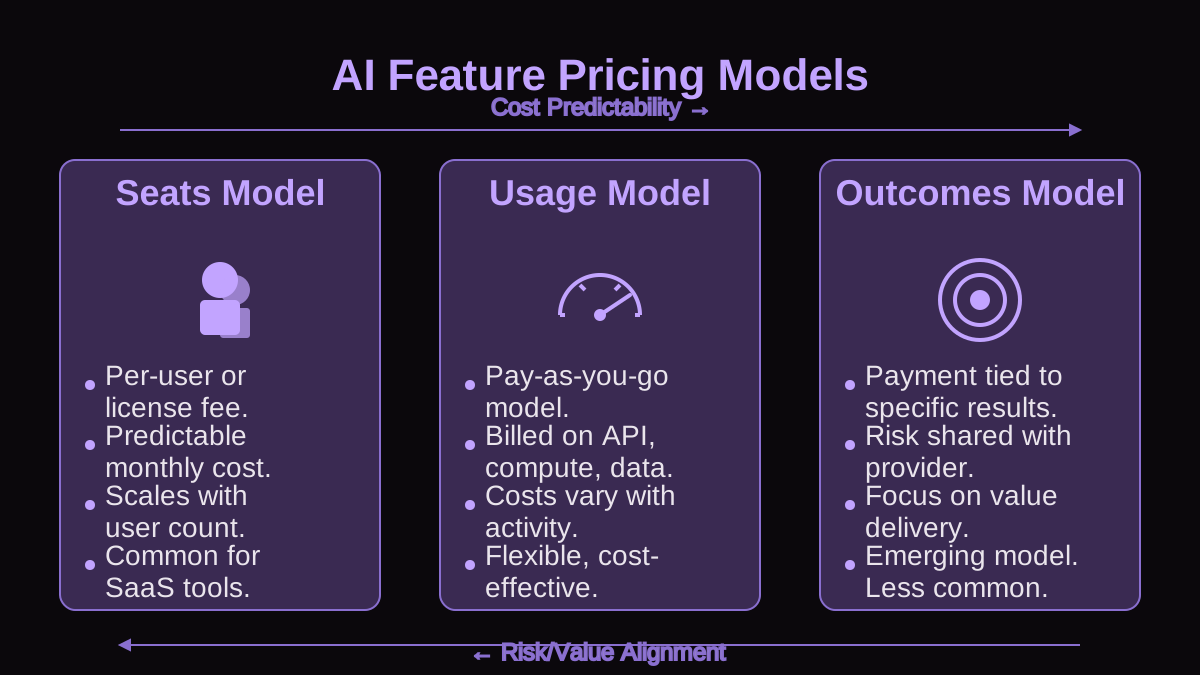
Seat-based pricing, where customers pay a recurring fee per user, is perhaps the most familiar model in the SaaS world. For AI features, this model is most effective when your AI primarily augments an individual's capabilities or provides insights that are consumed on a per-user basis. It offers clear predictability for both you and your customer, simplifying budgeting and forecasting.
I’ve found seat-based pricing works best when the AI’s value is directly tied to an individual accessing and utilizing its functionalities consistently. Think of AI-powered writing assistants that help content creators, AI-driven code completion tools for developers, or AI-enhanced CRM insights that empower individual sales representatives. In these scenarios, the AI is a productivity multiplier for a distinct user, making the 'per seat' model a natural fit. You are essentially selling access to an enhanced individual capability.
However, this model falters when the AI's value isn't strictly tied to a single user, or when it automates tasks, potentially reducing the need for multiple 'seats.' If your AI primarily works in the background, processes large datasets for an entire team, or acts as an autonomous agent, then charging per seat can feel misaligned to the customer. They might question why they are paying for multiple users when the AI does the heavy lifting for all. Furthermore, if user engagement with the AI feature varies wildly, some seats might be underutilized, leading to customer dissatisfaction. To mitigate this, consider offering tiered seat pricing, where different tiers unlock varying levels of AI capabilities or usage limits per user, providing flexibility and better value alignment.
How can usage-based pricing align value for AI products?
Usage-based pricing charges customers based on how much they consume a particular service or resource. For AI features, this model creates a direct correlation between the value received and the cost incurred, which can feel incredibly fair to customers. It’s particularly effective when your AI processes specific transactions, performs calculations, generates outputs, or consumes significant computational resources on a variable basis.
In my experience, usage-based models are ideal for AI features like image generation (charged per image), sentiment analysis APIs (charged per API call or text processed), AI-powered document processing (charged per document or page), or fraud detection (charged per transaction analyzed). The underlying principle here is that the customer pays for the precise amount of AI 'work' performed. This lowers the barrier to entry, as customers can start small and scale their usage as their needs grow, making it attractive for early adopters or those with fluctuating demands.
The challenges, however, are significant. Unpredictable costs can be a major headache for enterprise customers who need stable budgets. This 'meter anxiety' can deter adoption, especially if the AI's consumption is difficult to estimate upfront. From your side, operational costs for AI can vary significantly based on model complexity, inference time, and data volume, making it crucial to have robust cost monitoring. To counter unpredictability, I recommend offering usage tiers with discounted rates at higher volumes, or bundles with a fixed amount of usage included, similar to how cloud providers often package services. Implementing clear dashboards that show real-time consumption and estimated costs can also alleviate customer concerns.
Is outcome-based pricing the holy grail for AI?
Outcome-based pricing, where you charge based on the measurable business results or value your AI delivers, represents the highest level of value alignment. Here, the customer only pays if the AI feature successfully achieves a pre-defined objective, such as increased revenue, reduced costs, or improved conversion rates. This model is incredibly compelling because it shifts nearly all the risk to the vendor, fostering immense trust and demonstrating absolute confidence in your AI's capabilities.
I’ve seen this model applied successfully in highly specialized AI applications. For instance, an AI-driven revenue optimization tool might charge a percentage of the uplift in sales it generates. An AI for supply chain optimization might take a share of the cost savings it identifies and implements. Or an AI lead generation platform could charge per qualified lead. The allure is undeniable: customers love paying only for success. This model forces you, as the product manager, to have an incredibly clear and measurable understanding of your AI's impact on key business metrics.
However, outcome-based pricing is notoriously difficult to implement. The biggest hurdle is attribution: How do you definitively prove that the AI, and not other factors, was solely responsible for the observed outcome? This often requires sophisticated tracking, clear baselining, and robust data sharing agreements. Sales cycles can be long and complex, requiring detailed contracts and frequent performance reviews. Furthermore, if your AI fails to deliver, you bear the financial brunt entirely. My advice here is to start with a hybrid model, perhaps a smaller base fee with an outcome-based bonus, or to focus on outcome-based models only for highly mature AI products with proven, easily attributable results in well-defined environments. Clear, mutually agreed-upon success metrics and transparent data are paramount.
The Vyas AI Pricing Decision Rubric: Choosing Your Core Model
To navigate these complexities, I’ve developed a simple framework that helps product managers systematically evaluate which pricing model, or combination thereof, makes the most sense for their AI feature. This rubric encourages you to look beyond just the technical capabilities of your AI and focus on its market fit and value delivery mechanism.
- 1. Value Delivery Mechanism: How does your AI primarily deliver value? Does it augment individual users (e.g., AI assistant), process distinct units or transactions (e.g., API calls, data analysis), or contribute directly to a measurable business outcome (e.g., revenue increase, cost reduction)?
- 2. Predictability for Customer: How important is predictable cost for your target customers? Are they large enterprises needing stable budgets, or smaller businesses/developers preferring pay-as-you-go flexibility?
- 3. Cost Predictability for Vendor: How predictable are your own operational costs for delivering the AI feature? Is it a fixed infrastructure cost, or does it scale linearly with variable compute, data processing, or third-party API calls?
- 4. Attribution & Measurement: How easy is it to directly measure the AI's contribution to a specific outcome or unit of usage? Can you isolate its impact from other factors?
- 5. Risk Profile: How much financial risk are you willing to take on (e.g., guaranteeing outcomes)? How much risk can your customers comfortably tolerate regarding variable costs?
- 6. Market Precedent & Customer Familiarity: What are the common pricing models in your target market? How familiar and comfortable are your potential customers with seat-based, usage-based, or outcome-based pricing for similar solutions?
A Worked Example: Pricing an AI-Powered Customer Churn Predictor
Let’s walk through a concrete scenario: You're launching an AI feature designed to predict customer churn likelihood for SaaS companies. This AI integrates with a customer's CRM, analyzes various data points (usage patterns, support tickets, billing history), and provides a churn probability score for each customer, along with actionable insights for account managers.
Applying the Vyas AI Pricing Decision Rubric:
- 1. Value Delivery Mechanism: The AI augments account managers by giving them early warnings and insights. It also processes customer data, which is a transactional element. The ultimate value is reduced churn (an outcome). This suggests a blend.
- 2. Predictability for Customer: SaaS companies (your target) generally prefer predictable costs for their tools. High variability would be a deterrent.
- 3. Cost Predictability for Vendor: Your operational costs likely scale with the number of customer records processed and the complexity of their data. More customers mean more compute.
- 4. Attribution & Measurement: Churn reduction is a clear outcome, but proving the AI's direct impact can be tricky. An account manager's intervention, special offers, or market changes also influence churn. Measuring 'customers analyzed' or 'insights generated' is easier.
- 5. Risk Profile: Solely outcome-based (e.g., % of churn saved) would be high risk for you due to attribution challenges. High variability in usage-based could be risky for the customer.
- 6. Market Precedent & Customer Familiarity: Tools augmenting sales/customer success teams are often seat-based. Data processing tools can be usage-based. Pure outcome-based is rare and complex for this type of tool.
Conclusion: A hybrid model makes the most sense here. I would propose a base seat-fee for each account manager who needs access to the AI dashboard and insights. This provides predictability and aligns with individual augmentation. Additionally, I would introduce a usage component based on the number of active customer records being analyzed by the AI. This aligns with your operational costs and scales with the actual 'work' the AI performs. For an advanced tier, you could even consider a small, clearly defined outcome-based bonus if specific, measurable churn reduction targets are met over an agreed period, but only after building strong trust and data transparency.
Common Mistakes in AI Feature Pricing and How to Avoid Them
Even with a structured approach, product managers often fall into common traps when pricing AI features. Being aware of these pitfalls can save you significant time, resources, and customer goodwill.
- Mistake 1: Underestimating operational costs. Failure Mode: Your product becomes unprofitable as usage scales, or you're forced to raise prices unexpectedly. How to Avoid: Conduct thorough cost modeling, including compute, data storage, data transfer, model training, inference, and third-party API costs. Factor in the variability and potential for unforeseen expenses, especially for GPU-intensive or large language model applications.
- Mistake 2: Overcomplicating pricing structures. Failure Mode: Customers struggle to understand their bill, sales teams find it hard to explain value, leading to friction and lost deals. How to Avoid: Keep your pricing models as simple as possible. Clearly articulate the value proposition for each tier or component. If you use a hybrid model, ensure each component is straightforward and justifiable.
- Mistake 3: Misaligning value delivery with the pricing model. Failure Mode: Customers feel like they're paying for something they don't use, or that the cost doesn't reflect the value received, leading to churn. How to Avoid: Use a framework like the Vyas AI Pricing Decision Rubric. Continuously validate your assumptions with customer interviews and usage data. If your AI primarily automates, a per-seat model might not resonate.
- Mistake 4: Ignoring market precedent and customer expectations. Failure Mode: Your pricing seems out of sync with industry norms, creating resistance and making your solution appear less competitive. How to Avoid: Research competitor pricing, not just for AI tools but for adjacent software. Understand what your target customers are accustomed to paying for similar types of value or functionality.
- Mistake 5: Lack of flexibility in pricing. Failure Mode: As your AI capabilities evolve or market conditions change, your rigid pricing model prevents you from adapting, limiting growth. How to Avoid: Design your pricing with iteration in mind. Be prepared to test different models or tiers. Consider offering pilot programs with flexible terms to gather data and feedback before a full rollout. Hybrid models naturally offer more flexibility.
- Mistake 6: Not having a clear pricing narrative. Failure Mode: Sales teams struggle to articulate why your AI feature is priced the way it is, leading to confusion and doubt. How to Avoid: Develop a compelling story that connects your pricing structure directly to the tangible benefits and value customers receive. Train your sales and marketing teams thoroughly on this narrative, empowering them to address pricing objections effectively.
Key Takeaways for Pricing Your AI Features
- There is no single best pricing model for AI features; the optimal choice depends heavily on your product's specific value delivery, customer needs, and operational costs.
- Seat-based pricing works best when your AI augments individual users, offering predictable costs and clear value per access.
- Usage-based pricing is ideal for transactional AI, aligning cost directly with consumption and providing fairness, but requires careful management of customer 'meter anxiety'.
- Outcome-based pricing offers the strongest value alignment, where customers pay only for results, but presents significant challenges in attribution, measurement, and vendor risk.
- Utilize a structured framework, such as the Vyas AI Pricing Decision Rubric, to systematically evaluate criteria like value delivery, predictability, attribution, and risk when making your pricing decisions.
- Hybrid models often provide the most balanced approach, combining elements of seat, usage, or outcome-based pricing to offer flexibility, predictability, and strong value alignment.
- Actively avoid common mistakes by rigorously modeling your operational costs, keeping pricing structures simple, aligning pricing with actual value, understanding market expectations, and being prepared to iterate.
- Pricing is not a one-time decision but an ongoing process of testing, learning, and refining. Stay agile and responsive to customer feedback and market dynamics.