Personalization
Personalization Cold Start: Strategies for Privacy-First AI PMs
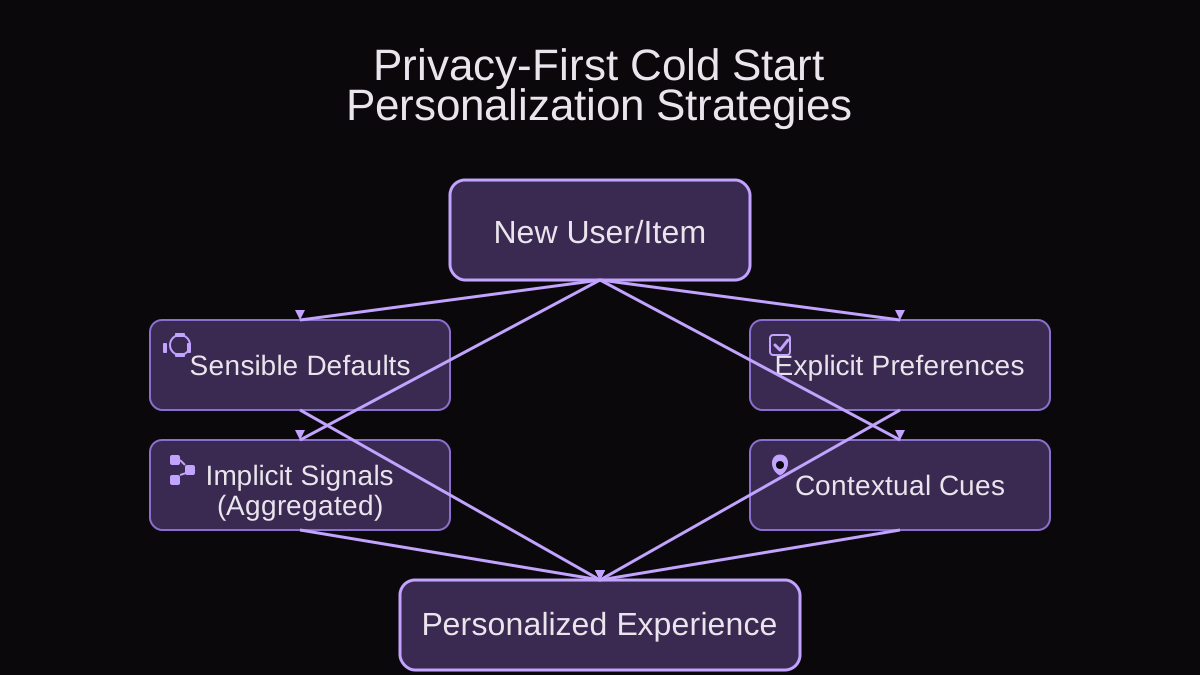
As AI Product Managers, one of the most persistent challenges we face is the 'cold start' problem: how do we deliver a personalized experience when we know nothing about a new user, or when a new item enters our catalog? The answer, especially in today's privacy-conscious landscape, lies in a strategic, multi-pronged approach that prioritizes user trust and data ethics from the outset. Effective cold-start strategies don't demand a data trove; instead, they intelligently leverage a mix of sensible defaults, explicit user preferences, aggregated implicit behaviors, and contextual signals, all while ensuring transparency and minimizing privacy risk. My experience across streaming, fintech, and healthcare has shown that building trust early is paramount.
For product managers, tackling cold start is not just about algorithm efficiency; it's about crafting an initial user journey that feels relevant, reduces friction, and encourages engagement without being intrusive. We need to move beyond generic recommendations quickly, but we must do so in a way that respects the user's data and choices. This guide will walk through practical strategies, a decision framework, and common pitfalls to help you navigate this critical phase of personalization.
Why is Cold Start a Privacy Challenge for AI PMs?
The fundamental paradox of personalization is that to personalize effectively, you need data, but new users or items inherently lack that historical data. In the past, some approaches might have involved aggressive data collection or making broad, potentially inaccurate inferences. However, with increasing regulatory scrutiny (like GDPR, CCPA) and a growing user expectation for privacy, those tactics are no longer viable, nor are they ethical. As AI PMs, our responsibility is to build intelligent systems that respect user agency and data sovereignty.
The privacy challenge intensifies because any attempt to 'guess' user preferences without explicit consent or robust anonymization can backfire spectacularly. It risks alienating users, leading to distrust, and potentially exposing the organization to legal and reputational damage. Our systems must be designed to be privacy-preserving by default, offering transparency and control. This means carefully considering what data we collect, how we use it, and ensuring users understand the value exchange. It also means building systems that can start delivering value with minimal, non-sensitive data, progressively enriching the experience as trust and engagement grow.
What are the Core Privacy-First Cold Start Strategies?
Building a robust cold-start strategy involves combining several approaches, each with its own benefits and limitations. The key is to blend them intelligently, ensuring privacy is a foundational consideration.
- Sensible Defaults / Editorial Curation: This is your baseline. When you have no data, provide a universally appealing, high-quality, or editorially curated experience. Think 'most popular,' 'top trending,' or 'editor's picks.' Why it works: It provides immediate value without requiring any user data. It's a safe, non-intrusive starting point. When it breaks: It's not truly personalized, and users will quickly move past it if it doesn't evolve. Over-reliance can lead to a generic experience that fails to engage diverse audiences.
- Explicit Preferences / Progressive Profiling: Directly ask users for their preferences. This can be done through onboarding surveys, preference centers, or simple 'like/dislike' interactions. Why it works: User input is highly accurate and reflects direct intent, building a strong initial profile. When it breaks: Users suffer from survey fatigue. Too many questions upfront can lead to abandonment. It's crucial to ask only what's absolutely necessary and to make the value proposition clear. Progressive profiling, asking questions as they become relevant, mitigates this.
- Implicit Behavioral Signals (Aggregated/Anonymized): Observe early, anonymized user interactions. This could be clicks, scrolls, dwell time, searches, or items added to a wishlist. Why it works: Actions often speak louder than words. These signals reveal true interest without requiring explicit input, and can be aggregated to maintain privacy. When it breaks: Sparse data in the initial moments can lead to misinterpretations. A single click doesn't define a user. It requires careful aggregation and a strategy to avoid 'echo chambers' or reinforcing initial biases. Ensure data is aggregated and anonymized to protect individual privacy.
- Contextual Personalization: Leverage readily available, often less sensitive data points like device type, time of day, location (with consent), or current events. Why it works: It can provide immediate, relevant personalization without deep historical user data. For example, recommending local news or weather-appropriate products. When it breaks: Contextual signals can be limited in scope and don't reflect deeper personal preferences. Users might find location-based recommendations intrusive if not handled transparently and with clear consent. Always be clear about how location or other contextual data is used.
- Hybrid Approaches & Fallbacks: The most effective strategies combine these methods. Start with sensible defaults, progressively ask for preferences, and then refine with early implicit signals. Always have a graceful fallback (like the sensible default) in case other strategies yield insufficient data. Why it works: It balances immediate value with increasing personalization accuracy over time. When it breaks: Poor integration between strategies can lead to conflicting recommendations or a disjointed user experience. Complexity can also increase maintenance overhead.
How to Choose: The 'Privacy-First Personalization Matrix' Framework
To decide which cold-start strategies are most appropriate for your specific product and user base, I've found it helpful to use a simple decision rubric. This 'Privacy-First Personalization Matrix' helps evaluate potential strategies against key criteria, ensuring you balance personalization effectiveness with ethical data practices.
- Data Sensitivity: How sensitive is the data required for this strategy? (Low: Publicly available; Medium: Aggregated user behavior; High: Personally identifiable, health, financial data). Prioritize strategies requiring low or medium sensitivity data.
- User Effort Required: How much effort does the user need to expend? (Low: No action; Medium: A few clicks/choices; High: Extensive survey/profile setup). Aim for low effort initially, gradually increasing as value is proven.
- Personalization Impact: How significant is the potential improvement in personalization? (Low: Generic; Medium: Moderately relevant; High: Highly tailored). Seek strategies that offer high impact without high data sensitivity or user effort.
- Data Availability: When does the necessary data become available? (Immediate: On signup; Delayed: After several interactions). Strategies with immediate data availability can kickstart faster, but balance with sensitivity.
- User Control & Transparency: How much control does the user have over their data, and how transparent is the use of that data? (High: Opt-in, clear privacy policy; Low: Implicit, opaque). Always aim for high control and transparency, especially for sensitive data.
By evaluating each potential cold-start strategy against these five criteria, you can create a prioritized list of approaches that align with both your product goals and your privacy commitments. For example, a strategy requiring high data sensitivity and high user effort should only be pursued if it offers exceptionally high personalization impact and absolute transparency/control.
Worked Example: Onboarding a New User in a Fintech App
Let's walk through a realistic scenario: onboarding a new user to a fintech app that provides investment recommendations. This user has just signed up, and we have no transaction history or investment preferences. Our goal is to provide relevant recommendations quickly while respecting their privacy.
- Step 1: Sensible Defaults (Immediate, Low Sensitivity, Low Effort). Upon first login, the user sees 'Popular Investment Themes' or 'Top Trending ETFs.' These are based on broad market data or editorial picks, not individual user data. This provides immediate content and value, preventing a blank screen and giving the user something to explore. It meets the user's need for initial content without any privacy risk.
- Step 2: Explicit Preferences (Progressive Profiling, Medium Sensitivity, Medium Effort). As the user navigates, a subtle prompt appears: 'Help us tailor your recommendations: What's your risk tolerance?' (Conservative, Moderate, Aggressive) or 'What are your investment goals?' (Retirement, House Downpayment, Growth). This is a quick, optional survey, not a mandatory questionnaire. By making it progressive and optional, we respect user effort and privacy. We only ask for information directly relevant to personalization and explain its purpose.
- Step 3: Implicit Behavioral Signals (Aggregated, Low Sensitivity, Low Effort). We passively observe anonymized interactions. Did the user click on 'Tech Stocks' more than 'Green Energy'? Did they spend more time viewing articles on 'Diversified Portfolios' versus 'High-Growth Startups'? These signals, when aggregated and anonymized across many new users, start to form a very nascent profile. We don't track specific user IDs for this aggregation, ensuring privacy.
- Step 4: Contextual Personalization (Immediate/Delayed, Low Sensitivity, Low Effort). If the user provided their age range (e.g., in an optional profile step), we might show investment strategies typically favored by their demographic, if ethically handled and transparently disclosed. Alternatively, we could highlight regional market news that might impact their local investments. Consent is paramount for location data.
- Step 5: Hybrid Refinement and Feedback Loop. After a few days, combining these signals – their stated risk tolerance, initial browsing patterns, and general market trends – allows us to generate more refined recommendations. We also provide clear feedback mechanisms: 'Was this recommendation helpful?' or 'Tell us why you liked/disliked this.' This continuous feedback loop further personalizes the experience while giving the user control. The system continuously learns, but always within the bounds of data privacy and user consent.
This step-by-step approach ensures that the user receives value from day one, and the personalization continuously improves without ever resorting to intrusive data collection or making wild, privacy-compromising guesses.
Common Mistakes in Cold Start Personalization (and How to Avoid Them)
Even with the best intentions, cold start personalization can go wrong. Recognizing these common pitfalls is crucial for AI PMs.
- Mistake 1: Over-reliance on explicit data at onboarding. Failure mode: Users are immediately hit with a long survey, get bored, and abandon the onboarding process. They haven't experienced the value proposition yet, so the effort feels unrewarded. How to detect/avoid: Monitor onboarding completion rates and A/B test different numbers of initial questions. Employ progressive profiling, asking only 1-2 critical questions upfront and saving others for later, contextually relevant moments. Clearly articulate the 'why' behind each question.
- Mistake 2: Ignoring privacy implications of early data collection. Failure mode: Collecting too much data too soon, making assumptions without consent, or being opaque about data usage. This erodes user trust and can lead to regulatory fines. How to detect/avoid: Implement a robust data governance framework from day one. Conduct privacy impact assessments for all data collection points. Ensure your privacy policy is clear, concise, and accessible. Offer clear opt-in/opt-out mechanisms. Prioritize anonymization and aggregation for implicit signals.
- Mistake 3: Treating all cold starts the same. Failure mode: Applying the same strategy for a brand-new user, a returning user with new intent (e.g., searching for a new product category), and a brand-new item in the catalog. Each requires a nuanced approach. How to detect/avoid: Segment your cold start problems. Develop distinct strategies for 'new user cold start,' 'new item cold start,' and 'sparse user data cold start.' Recognize that a user's 'cold start' can reset if their interests shift significantly.
- Mistake 4: Not having a graceful fallback. Failure mode: If the initial personalization strategies fail to yield enough data or an appropriate recommendation, the user is left with a blank screen, an error message, or irrelevant content, leading to frustration. How to detect/avoid: Always have a sensible default or editorial layer as the ultimate fallback. This ensures that even in the absence of any data, the user still receives a baseline, valuable experience. Monitor instances where personalization algorithms return no results and ensure your fallbacks are robust.
- Mistake 5: Lack of iterative refinement. Failure mode: Once an initial cold-start strategy is deployed, it's left unchanged, failing to learn and adapt as more user data becomes available. This leads to stagnant personalization that quickly becomes irrelevant. How to detect/avoid: Establish clear metrics for cold-start success (e.g., time to first personalized interaction, engagement with initial recommendations). Implement A/B testing for different cold-start paths. Continuously monitor user feedback and engagement, using these insights to refine algorithms and prompting strategies. Personalization is a continuous journey, not a one-time setup.
Key Takeaways
- Privacy-first cold start is achievable by strategically combining sensible defaults, explicit preferences, aggregated implicit signals, and contextual data.
- Prioritize user trust and transparency from the very first interaction; this is the foundation of long-term engagement.
- The 'Privacy-First Personalization Matrix' provides a structured way to evaluate and select appropriate strategies based on data sensitivity, user effort, personalization impact, data availability, and user control.
- Progressive profiling is key: ask for minimal, high-impact data upfront and gradually collect more as user trust and engagement grow.
- Always have a graceful fallback (like curated content) to ensure users never face a blank or irrelevant experience.
- Segment your cold start challenges – new users, new items, and changing user intent each require tailored approaches.
- Continuously monitor, A/B test, and iterate on your cold-start strategies to ensure ongoing relevance and effectiveness while upholding privacy standards.