Agents
Orchestrating LLM Agents: A PM's Guide to Workflow & Tasks
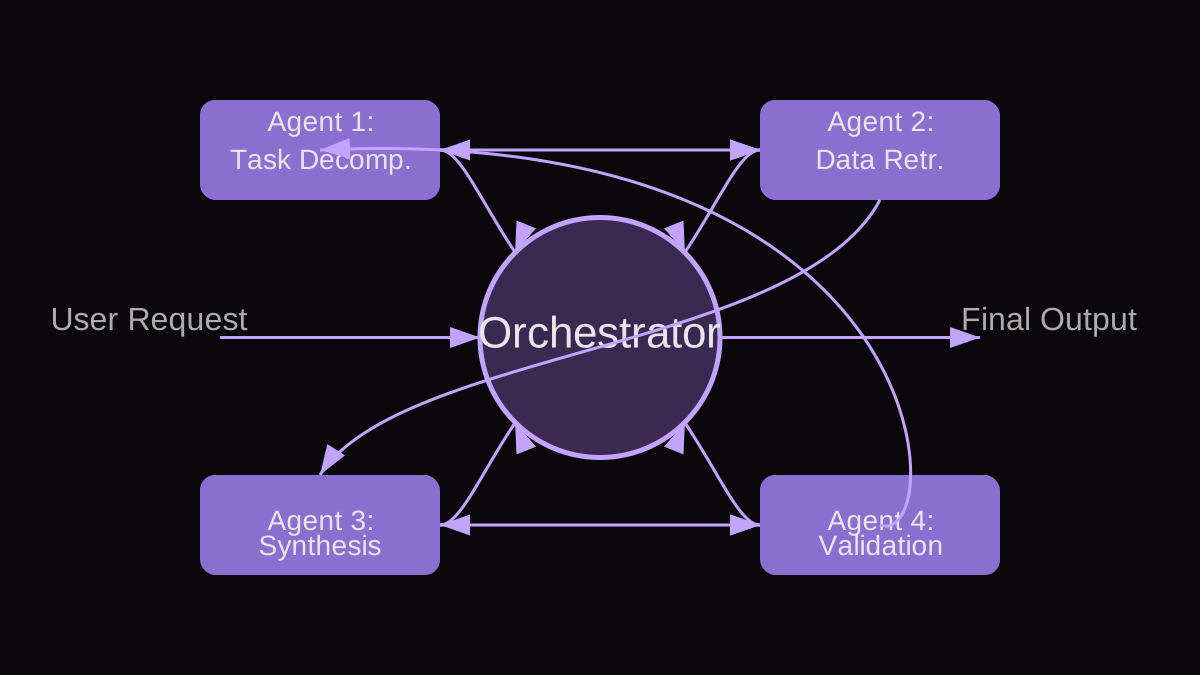
Orchestrating LLM agents means designing, connecting, and managing multiple specialized agents to collaboratively achieve a complex goal. For product managers, this involves defining clear tasks, establishing robust communication protocols, handling failures gracefully, and continuously optimizing the overall workflow to deliver reliable, scalable, and valuable AI-powered solutions. My 10+ years in product management across streaming, fintech, and healthcare, now focused on AI, have shown me that the true power of agents emerges not from individual brilliance, but from thoughtful orchestration.
The shift from single-prompt interactions to multi-agent systems is profound. It moves us from simple tool usage to building autonomous, intelligent workflows. As PMs, our role expands beyond defining features; we now design entire ecosystems of intelligent actors. This guide will walk you through the practical steps and strategic considerations required to effectively manage the workflows and tasks of LLM agents, ensuring they deliver on their promise without becoming an unmanageable black box.
Why is Orchestration Crucial for LLM Agents?
Without proper orchestration, LLM agents quickly become chaotic. Imagine a team of highly intelligent but uncoordinated experts, each brilliant in their niche but lacking a project manager to guide them. The result is often redundant effort, conflicting outputs, and a failure to meet the overarching goal. For an AI product, this translates into unreliable performance, high operational costs, and a frustrating user experience. Our job as PMs is to ensure these powerful components work together seamlessly, not just individually.
Orchestration addresses several critical pain points that arise when deploying agents. First, it manages complexity. A single agent might handle a simple query, but real-world problems – like analyzing financial reports or summarizing medical literature – require multiple steps and diverse expertise. Second, it enhances reliability. By breaking down tasks and assigning them to specialized agents, we reduce the cognitive load on any single LLM, making each step more robust and easier to debug. Third, it improves scalability. A well-orchestrated system can scale individual agents or add new ones without rebuilding the entire architecture. Finally, it optimizes cost. By directing agents precisely to the tasks they are best suited for, we minimize unnecessary token usage and API calls, which directly impacts our bottom line.
From a product management perspective, orchestration is about translating user needs into a predictable, high-quality, and cost-efficient AI service. It forces us to think about the entire lifecycle of a request, from input to output, and to design for resilience, observability, and continuous improvement. We are no longer just delivering a model; we are delivering an intelligent system.
How Do PMs Decompose Complex Tasks for Agents?
Task decomposition is the bedrock of effective agent orchestration. It is the process of breaking down a large, ambitious goal into smaller, manageable, and distinct sub-tasks that can be assigned to individual LLM agents or a sequence of agents. This isn't just about making things simpler; it's about defining clear boundaries, inputs, and outputs for each agent, allowing us to leverage their specialized capabilities effectively. Without thoughtful decomposition, agents might hallucinate, get stuck in loops, or produce irrelevant outputs because their scope is too broad or ill-defined.
When approaching decomposition, I often use what I call "The Agent Workflow Decomposition Rubric." This rubric helps us systematically evaluate a complex task and decide how to best break it down for agent execution.
- 1. Identify the Goal and Terminal State: Clearly define what success looks like. What is the final output or action? This helps you work backward.
- 2. List All Necessary Information and Resources: What data, tools, or external APIs are required at each stage? This reveals potential bottlenecks or prerequisites.
- 3. Map Out Explicit Dependencies: Which sub-tasks absolutely must complete before others can begin? This defines sequential steps.
- 4. Isolate Independent Sub-Problems: Can any parts of the main goal be worked on simultaneously without impacting each other? These are candidates for parallel processing.
- 5. Define Decision Points and Conditional Logic: Where might the workflow diverge based on intermediate results? This introduces conditional branches that an orchestrator must manage.
- 6. Assess Agent Specialization Fit: For each sub-task, is there a clear role for a specific type of agent (e.g., a summarizer, a retriever, a code generator, a validator)? Avoid generalist agents for highly specific tasks.
- 7. Determine Input/Output Schema for Each Step: What exact format does an agent expect as input, and what format will it produce as output? Standardizing this is crucial for seamless handoffs.
- 8. Identify Potential Failure Modes and Recovery Paths: At what point could an agent fail, and what should happen next (retry, escalate, alert)? Designing for failure is as important as designing for success.
Granularity is a key consideration. If tasks are too granular, you introduce excessive overhead in communication and orchestration. If they are too coarse, agents struggle with scope, leading to lower quality outputs and increased hallucinations. The sweet spot is often when each sub-task represents a single, well-defined cognitive step that an LLM excels at, like "extract key entities," "summarize a document," or "generate a draft response."
Designing Agent Workflows: A Step-by-Step Example
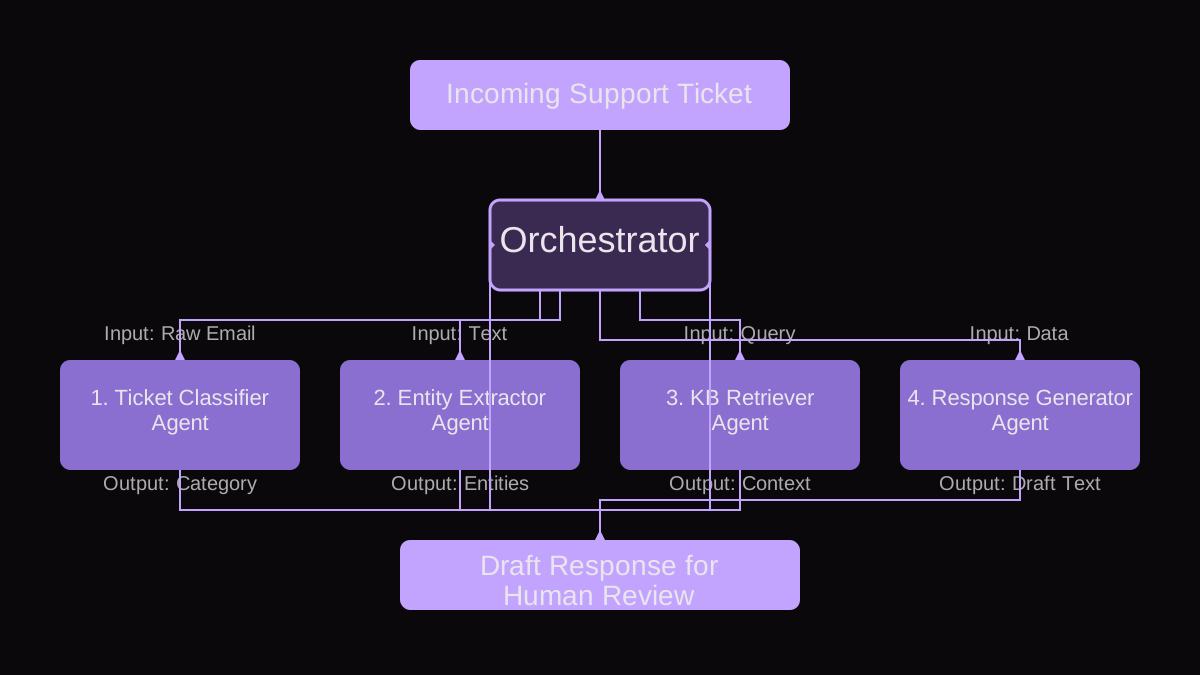
Let's walk through a concrete example: designing an LLM agent workflow for automated customer support ticket triage and resolution suggestion. The goal is to receive raw customer support emails, categorize them, extract key information, find relevant solutions from a knowledge base, and suggest a draft response to a human agent.
- Step 1: Define the Overall Goal: Automatically process incoming support tickets to categorize, extract context, and provide a resolution suggestion, reducing agent response time and improving first-contact resolution rates.
- Step 2: Identify Core Agents Needed: Based on the goal and the decomposition rubric:
- a. Ticket Classifier Agent: Categorizes the ticket (e.g., billing, technical issue, feature request, refund).
- b. Entity Extractor Agent: Pulls out key information like customer ID, product name, error codes, specific problem description.
- c. Knowledge Base Retriever Agent: Searches an internal knowledge base for relevant articles or FAQs based on the extracted entities and classification.
- d. Response Generator Agent: Drafts a polite, helpful response using the extracted information and retrieved knowledge.
- e. Human Escalation/Review Agent: (Conceptual, for oversight) Alerts a human agent when confidence is low or a draft response needs review.
- Step 3: Map the Workflow and Interactions:
- a. Initial Input: Raw customer email arrives.
- b. Orchestrator Passes to Ticket Classifier: Classifier outputs category.
- c. Orchestrator Passes Original Email and Category to Entity Extractor: Extractor outputs structured entities.
- d. Orchestrator Passes Category and Entities to Knowledge Base Retriever: Retriever outputs relevant articles/solutions. (This could run in parallel with the Entity Extractor if the initial classification is sufficient, or sequentially if entities refine the search.)
- e. Orchestrator Passes Original Email, Category, Entities, and Retrieved Knowledge to Response Generator: Generator outputs draft response.
- f. Orchestrator Presents Draft Response to Human Agent: Human agent reviews, edits, and sends. (Alternatively, if confidence is high, the orchestrator might send it directly or queue for light review.)
- Step 4: Define Inputs, Outputs, and Handoffs: Each agent receives a specific JSON or structured text input and produces a defined output. For example, the Ticket Classifier might output {"category": "Technical Issue", "confidence": 0.92}. The Entity Extractor might output {"customer_id": "C12345", "product": "ProApp", "error_code": "E-404"}.
- Step 5: Incorporate Error Handling and Re-orchestration:
- a. Classifier Confidence Check: If confidence is below a threshold, escalate the raw email directly to a human for manual classification.
- b. No Knowledge Base Results: If the Retriever finds nothing, the Response Generator might craft a "we're looking into it" response and flag for human research.
- c. Hallucination Detection: Post-generation, a simpler LLM or rule-based system could check the draft response for obvious inaccuracies or inappropriate tone, triggering a retry or human review.
- Step 6: Iterative Refinement: Deploy with a human-in-the-loop, collect feedback on categorization accuracy, entity extraction quality, and response helpfulness. Use this data to fine-tune agents or adjust orchestration logic.
This example highlights how the orchestrator acts as the conductor, directing the flow, managing state, and making decisions based on agent outputs and predefined rules. It’s not just about chaining agents; it’s about intelligent routing and decision-making at each juncture.
Managing Agent Interactions and State Across Workflows
One of the most challenging aspects for PMs in multi-agent systems is managing how agents interact and maintain context – their "state" – throughout a complex workflow. Agents aren't usually stateless; they need to remember previous steps, intermediate results, and sometimes even long-term preferences or historical data. Poor state management leads to agents forgetting context, repeating questions, or producing disjointed outputs.
There are several patterns for managing agent interactions and state:
- Shared Context Pool: The orchestrator maintains a central data structure (e.g., a JSON object) that accumulates all relevant information as the workflow progresses. Each agent adds its output to this pool, and subsequent agents can access any information within it. This is effective for workflows where all information is eventually needed by a downstream agent.
- Explicit Handoffs: Agents explicitly pass only the necessary information to the next agent in the sequence. This reduces noise and ensures agents only receive relevant context, which can be more efficient for token usage and prevent prompt stuffing. The orchestrator facilitates these precise handoffs.
- Persistent Memory: For agents that need to remember information across multiple, distinct interactions (e.g., a long-running customer assistant), a persistent memory store (like a vector database for chat history or a traditional database for user preferences) is crucial. The orchestrator can retrieve this memory at the start of a session or pass it to relevant agents.
- Feedback Loops and Learning: Beyond simple state, consider how agents learn. An orchestrator can collect feedback on agent performance (e.g., human edits to a generated response) and use this to fine-tune individual agents or adjust orchestration logic (e.g., increasing human review frequency for an agent with low performance). This is critical for continuous improvement and achieving higher levels of autonomy.
From a PM standpoint, designing for state management means asking: What information does each agent truly need? How long does that information need to persist? What are the privacy and security implications of storing this data? And how can we make the state observable for debugging and performance monitoring? The answers will dictate your architecture choices, whether it's a simple shared dictionary or a sophisticated knowledge graph.
Common Mistakes in LLM Agent Orchestration (and How to Avoid Them)
Building agentic systems is still a relatively new frontier, and it's easy to fall into common traps. As PMs, anticipating these pitfalls is key to steering our teams toward successful implementations.
- Failure Mode 1: Over-Agentification: Trying to turn every minor step into a separate agent, or creating agents that are too specialized for their own good. This leads to excessive communication overhead, increased latency, and ballooning costs.
- Detection/Avoidance: Apply the Decomposition Rubric rigorously. Can two tasks be combined into one agent without sacrificing quality or increasing complexity? Start with fewer, broader agents and only split them when a clear need for specialization or distinct failure modes emerges. Measure latency and token usage per agent.
- Failure Mode 2: Vague Agent Directives and Undefined Handoffs: Agents operating without clear instructions on what to do, what output format is expected, or how to pass information to the next step. This results in inconsistent outputs, formatting errors, and workflow breakdowns.
- Detection/Avoidance: Insist on explicit input/output schemas for every agent. Use Pydantic models or clear JSON examples in prompts. Define precise prompt instructions for each agent's role and expected output. Implement strict validation checks on agent outputs before passing them downstream.
- Failure Mode 3: Neglecting Error Handling and Recovery: Assuming agents will always succeed or produce perfect outputs. When an agent fails (e.g., hallucination, API error, malformed output), the entire workflow grinds to a halt.
- Detection/Avoidance: Design for failure from the outset. Implement retry mechanisms, fallback options (e.g., human escalation, default responses), and clear error propagation. Monitor agent outputs for quality and consistency. Build observability into your system to quickly identify where failures occur.
- Failure Mode 4: Insufficient Testing and Validation: Launching agent workflows without comprehensive testing across various inputs and edge cases. This leads to unexpected behavior in production and erode user trust.
- Detection/Avoidance: Develop robust test suites for each agent and the overall workflow. Use diverse data sets, including adversarial examples. Implement A/B testing or gradual rollout strategies. Emphasize human-in-the-loop review during initial deployments to catch subtle errors.
- Failure Mode 5: Ignoring Human Oversight and Feedback Loops: Building fully autonomous systems without a mechanism for human intervention or learning from human corrections. This limits improvement and can lead to uncorrected biases or errors.
- Detection/Avoidance: Integrate human review steps for critical outputs or low-confidence scenarios. Establish clear feedback channels for human agents to correct or annotate agent outputs. Use this feedback to fine-tune models, update knowledge bases, or refine orchestration logic. Remember, AI is often best as an assistant, not a replacement.
As PMs, our role is to champion a robust, resilient design. We must push for clarity, anticipate failure, and ensure that our agent systems are built with a pathway for continuous learning and human oversight.
Key Takeaways
- Orchestration is paramount: It transforms individual LLM agents into cohesive, goal-oriented systems, addressing complexity, reliability, scalability, and cost.
- Systematic decomposition is essential: Break down complex goals into distinct, manageable sub-tasks using rubrics like "The Agent Workflow Decomposition Rubric" to define clear boundaries and handoffs.
- Design for interaction and state: Carefully manage how agents communicate and maintain context, whether through shared pools, explicit handoffs, or persistent memory, to ensure coherent workflows.
- Anticipate and mitigate failures: Implement robust error handling, retry mechanisms, and human escalation paths from the start. Assume agents will fail and design for recovery.
- Prioritize testing and feedback: Thoroughly validate agent performance and the overall workflow with diverse data. Integrate human oversight and feedback loops for continuous improvement and to prevent over-automation.
- Granularity matters: Avoid both over-agentification and overly broad agent roles. Aim for tasks that leverage an LLM's strengths without overwhelming it.
- The PM role is critical: As AI PMs, we are the architects of these intelligent ecosystems, responsible for translating user needs into robust, valuable, and manageable agent workflows.