AI Product
Optimizing AI Product Costs: A PM's Guide to Efficiency
As AI Product Managers, optimizing costs for our products hinges on two critical areas: inference efficiency and data efficiency. Strategic focus on these aspects allows us to deliver high-performing AI solutions without excessive operational expenditure, directly impacting the product's profitability and long-term viability. By making informed decisions about model deployment, data acquisition, and pipeline management, PMs can effectively control the financial footprint of their AI initiatives.
This guide outlines actionable strategies for PMs and aspiring AI PMs to navigate the complexities of AI product costs. I will share my experience from over a decade in product management, including streaming, fintech, and healthcare, to detail how you can achieve significant cost savings while maintaining or even enhancing user experience. We will explore the common pitfalls and provide frameworks to ensure your AI products scale sustainably.
Why Do AI Product Costs Spiral, and How Can PMs Control Them?
AI product costs often balloon due to an underestimation of the continuous operational expenses beyond initial development. The primary culprits are typically compute for model inference, the entire data lifecycle (acquisition, storage, labeling, processing), and the overhead associated with MLOps. Training costs, while significant, are usually finite project expenses, whereas inference and data costs are ongoing and scale with usage, making them critical for PMs to manage.
PMs wield significant influence over these costs by shaping product requirements, guiding architectural choices, and defining data strategies. My role involves constantly balancing feature innovation with cost-efficiency. For instance, demanding a model with ultra-high accuracy for a non-critical feature without considering the inference cost implications is a common scenario that can quickly escalate expenses. We control these by pushing for right-sized solutions, optimizing deployment, and enforcing smart data practices.
Mastering Inference Efficiency: The Core of Cost Optimization
Inference costs represent the computational expense of running your AI model to make predictions or generate outputs. This is often the largest recurring cost for high-traffic AI products. As PMs, we need to understand the techniques available to reduce the computational footprint of our models and advocate for their implementation where appropriate. This isn't just an engineering concern; it's a product design decision.
Key techniques for inference efficiency include model quantization, which reduces the precision of model weights (e.g., from 32-bit to 8-bit integers) without significant accuracy loss, leading to smaller models and faster computations. Pruning removes redundant connections or neurons from a neural network, while distillation involves training a smaller 'student' model to mimic the behavior of a larger 'teacher' model. PMs should challenge their teams to evaluate these methods early in the development cycle, especially for latency-sensitive or high-volume use cases. Ignoring these techniques early on often leads to expensive refactoring later or simply accepting higher operational costs than necessary.
Deployment strategy also plays a huge role. Batching multiple inference requests together can significantly improve hardware utilization but might increase latency for individual requests. Serverless functions offer elasticity but can be more expensive per invocation than dedicated instances for constant high traffic. Edge deployment reduces cloud costs and latency but introduces device management complexities. A PM's role is to weigh these trade-offs against user experience, latency requirements, and overall cost targets. This requires close collaboration with engineering and understanding the technical implications of each choice.
The AI Cost-Benefit Prioritization Framework
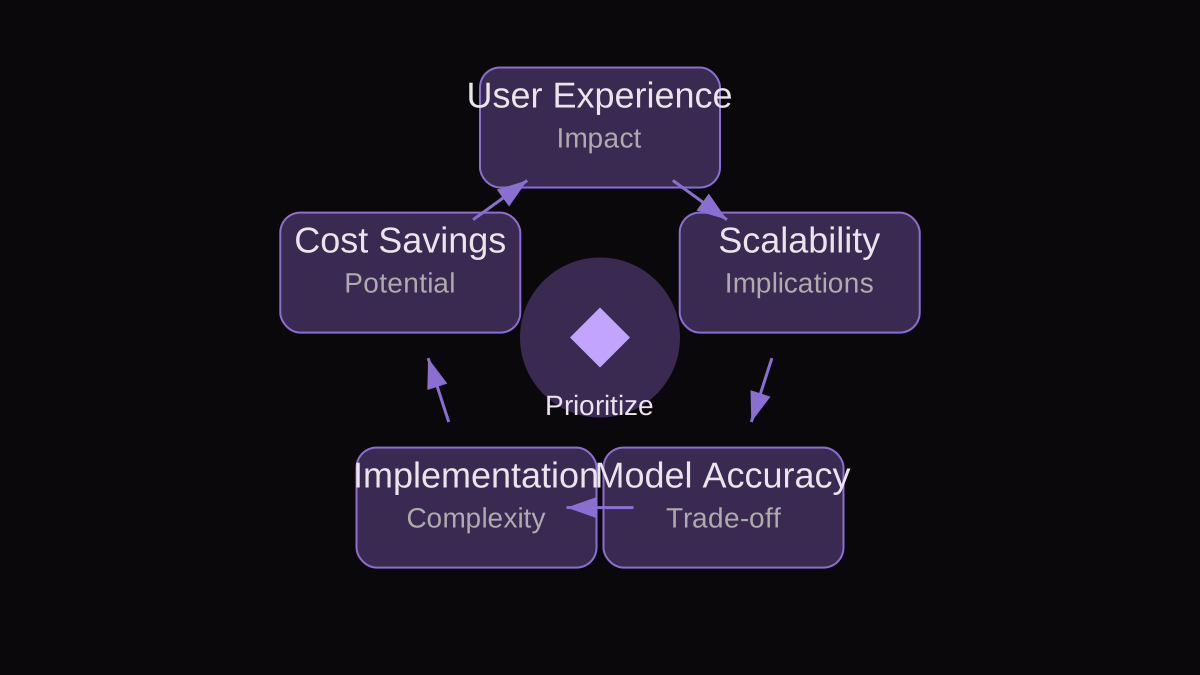
To systematically evaluate and prioritize cost optimization efforts for AI features or products, I use a simple, structured framework. This helps me articulate the value proposition of cost-saving initiatives to stakeholders and ensures we are focusing our resources on the most impactful areas. Here are the criteria I consider:
- 1. User Experience Impact: How does this optimization affect the end-user? Does it improve latency, maintain accuracy, or introduce noticeable degradation? Prioritize changes that are neutral or positive for UX.
- 2. Cost Savings Potential: Quantify the potential cost reduction over a specific period (e.g., monthly, annually). Focus on areas with the highest potential return on investment for engineering effort.
- 3. Implementation Complexity: Estimate the engineering effort required. Simple changes with high savings are low-hanging fruit. Complex changes require a stronger justification from other criteria.
- 4. Model Accuracy Trade-off: Assess if the optimization leads to a drop in model performance. For critical features, even a small drop might be unacceptable; for less critical features, a slight trade-off might be worth significant cost savings.
- 5. Scalability Implications: How will this optimization affect the product's ability to scale? Will it allow for higher traffic without proportional cost increases, or does it introduce new bottlenecks?
Data Efficiency: Your Secret Weapon Against Bloated Bills
Data is the lifeblood of AI, but its lifecycle—acquisition, storage, labeling, processing, and transfer—can quickly become a major cost center. PMs often overlook these costs, focusing solely on model development. However, a lean data strategy is as crucial as an efficient model for overall product profitability.
Strategies like active learning can dramatically reduce labeling costs by intelligently selecting only the most informative data points for human annotation, rather than labeling everything. Synthetic data generation offers another avenue, especially when real data is scarce or expensive to acquire, though it requires careful validation to ensure it accurately reflects real-world distributions. Efficient data pipelines, including smart data versioning and retention policies, prevent data sprawl and unnecessary storage costs. Feature stores can also contribute by centralizing and reusing engineered features, reducing redundant computation and storage.
Worked Example: Optimizing Data Labeling for a New Feature – Let's imagine we are building a new feature for a healthcare AI product: an automated system to categorize patient feedback based on sentiment and topic. Initially, the team proposes sending all incoming feedback (thousands daily) to human annotators. Applying the AI Cost-Benefit Prioritization Framework:
- 1. User Experience Impact: The categorization needs to be accurate for the feature to be useful. If we compromise too much on data quality, the UX suffers.
- 2. Cost Savings Potential: Labeling thousands of entries daily is extremely expensive. High potential for savings.
- 3. Implementation Complexity: Implementing active learning or synthetic data generation has moderate complexity, requiring engineering effort but offering significant long-term returns.
- 4. Model Accuracy Trade-off: We need to find a sweet spot where labeling less data doesn't severely impact accuracy. Synthetic data might initially be less accurate than fully human-labeled real data.
- 5. Scalability Implications: An automated or semi-automated labeling process is far more scalable than purely manual annotation as feedback volume grows.
Based on this, I'd propose a phased approach: Phase 1: Start with a smaller, highly curated dataset for initial model training. Simultaneously, implement an active learning pipeline. The model would process incoming feedback, flag low-confidence predictions, and send only those to human annotators. This significantly reduces the volume for manual labeling. Phase 2: Explore synthetic data generation for less critical categories or to augment rare cases, further reducing reliance on human labeling once the active learning system is stable. This step-by-step optimization ensures we balance accuracy, cost, and scalability for the long term.
Common Mistakes in AI Cost Management and How to Avoid Them
Even with the best intentions, cost overruns are common in AI products. Recognizing these pitfalls early is key to successful management.
Failure Mode 1: Over-engineering Models. Many teams default to using the largest, most accurate model available, even when a simpler model would suffice. This happens when PMs don't clearly define the acceptable accuracy threshold for specific use cases or when engineers prioritize state-of-the-art results over practical cost-efficiency. Detection: High inference costs for features that don't demand extreme precision, or models with negligible performance gains for significant increases in complexity. Avoidance: Always define minimum viable accuracy (MVA) and maximum acceptable latency (MAL) for each feature. Challenge the team to explore simpler models first and only scale up if MVA/MAL cannot be met.
Failure Mode 2: Ignoring Data Lifecycle Costs. Focusing only on model training data acquisition and forgetting the ongoing costs of data storage, versioning, processing, and particularly, re-labeling or augmenting data for model retraining. Detection: Surging cloud storage bills, unexpected data pipeline processing costs, or repeated manual labeling efforts for model updates. Avoidance: Develop a comprehensive data strategy from day one. Implement automated data retention policies, leverage feature stores, and plan for incremental labeling via active learning. PMs must include data operations in their ongoing budget forecasts, not just one-time project costs.
Failure Mode 3: Treating MLOps as an Afterthought. Underestimating the cost of robust MLOps infrastructure, monitoring, and continuous integration/delivery for AI models. This often leads to manual interventions, brittle deployments, and increased engineering overhead. Detection: Frequent model deployment failures, lack of clear performance metrics in production, or engineers spending excessive time on manual tasks. Avoidance: Budget and prioritize MLOps tools and practices from the outset. This includes automated testing, version control for models and data, standardized deployment pipelines, and comprehensive monitoring. A strong MLOps foundation reduces long-term operational costs and risks.
Failure Mode 4: Lack of Clear Cost Metrics and Monitoring. Without specific metrics, it's impossible to know if optimization efforts are working or where new cost centers are emerging. Detection: Only seeing aggregate cloud bills, inability to attribute costs to specific models or features, or surprise cost spikes. Avoidance: Work with engineering to define and track key cost metrics per model, feature, and user segment. Implement dashboards that provide visibility into cost per inference, data processing costs, and overall resource utilization. Regular cost reviews should be a standard part of your product management cadences.
Operationalizing Cost Efficiency: Metrics and Monitoring for PMs
Effective cost management is an ongoing process, not a one-time project. As PMs, we need to establish clear metrics and monitoring mechanisms to keep our AI products financially healthy. This involves more than just looking at cloud bills; it's about understanding the granular costs associated with each component of your AI system.
Key metrics I regularly track include: Cost per inference (total inference cost / total inferences), inference latency (to ensure optimizations don't degrade UX), compute utilization (to identify underutilized resources), data storage costs (per GB, per feature store entry), labeling costs (per labeled item, per hour), and model retraining frequency/cost. These metrics provide a clear picture of where money is being spent and where optimizations can have the most impact. For example, a rising cost per inference might indicate an inefficient model deployment, while soaring data storage costs could point to unmanaged data sprawl.
Utilize cloud cost management tools (like AWS Cost Explorer, Azure Cost Management, or Google Cloud Billing Reports) but push for more granular tagging and allocation by service, model, and even feature. MLOps platforms often provide built-in monitoring capabilities that can track model performance and resource usage. Regular, dedicated cost review meetings with engineering and finance are crucial. These aren't just for reporting; they are for identifying trends, discussing potential optimizations, and making informed trade-offs. This proactive approach ensures that cost efficiency is a continuous consideration, not a reactive panic.
Key Takeaways
- AI product cost optimization is a core PM responsibility, focusing on inference and data efficiency, not just initial development.
- Inference costs are controlled through model optimization techniques like quantization, pruning, and distillation, and strategic deployment choices (batching, serverless, edge).
- Data costs are managed by efficient acquisition, smart storage, active learning, synthetic data, and robust data pipeline management.
- The AI Cost-Benefit Prioritization Framework (User Experience Impact, Cost Savings Potential, Implementation Complexity, Model Accuracy Trade-off, Scalability Implications) provides a structured way to evaluate optimization initiatives.
- Avoid common mistakes: over-engineering models, ignoring data lifecycle costs, treating MLOps as an afterthought, and lacking clear cost metrics and monitoring.
- Implement granular cost metrics and regular monitoring dashboards to track cost per inference, data costs, and resource utilization, enabling proactive financial health management.