Product Craft
Navigating AI Product Stakeholders: A PM's Guide to Alignment
As an AI Product Manager, successfully launching and scaling an AI product hinges on adeptly navigating a complex web of stakeholders whose diverse perspectives, technical understanding, and risk appetites can either propel or derail an initiative. Effective stakeholder management in AI is not merely about communication; it is about establishing early identification, fostering tailored communication, and deploying a robust framework to achieve unwavering alignment on product vision, ethical considerations, and measurable impact.
The unique characteristics of AI—its iterative nature, data dependency, potential for bias, and often abstract technical underpinnings—amplify the need for a strategic, consistent approach to stakeholder engagement. My experience across streaming, fintech, and healthcare has shown me that without this proactive engagement, even the most promising AI ideas remain just that: ideas.
Identifying Key AI Stakeholders: Who Are They and Why Do They Matter?
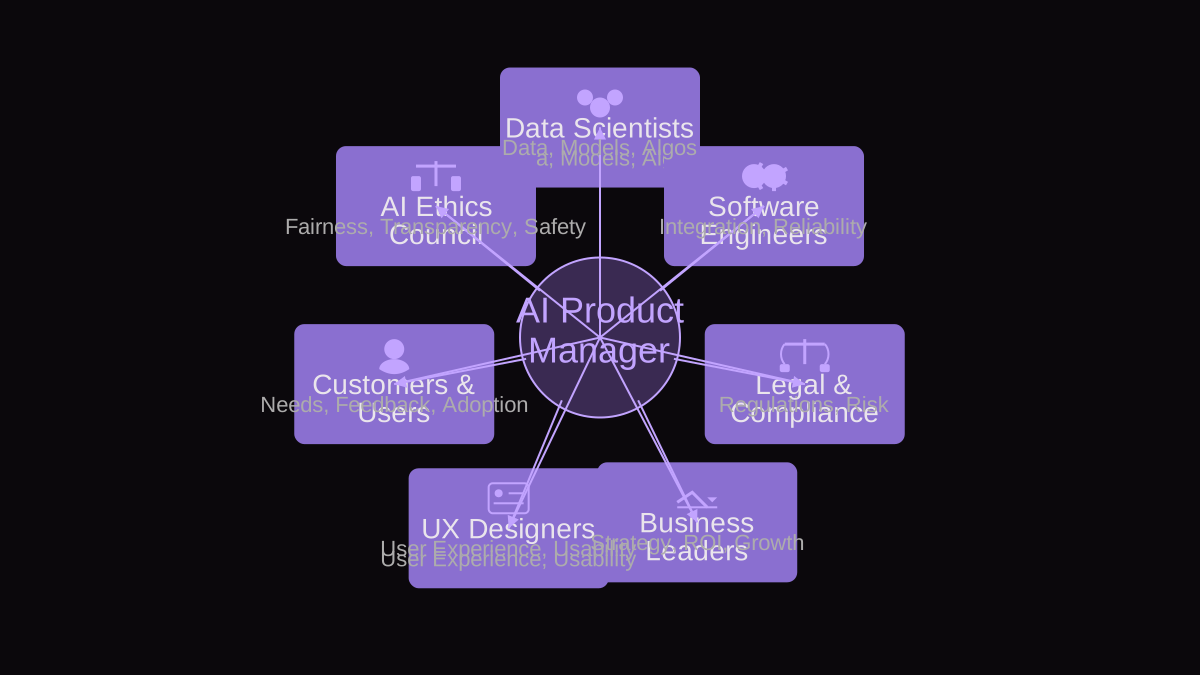
Unlike traditional software, AI products inherently touch every part of an organization, from deep technical infrastructure to ethical governance. This expands the typical stakeholder map significantly, introducing new disciplines and demanding a nuanced understanding of each group's unique motivations and concerns. Your first step is to precisely identify who has a vested interest, influence, or expertise in your AI product.
- Data Scientists and Machine Learning Engineers: These are your technical backbone. Their concerns revolve around model performance, data quality, algorithmic bias, research horizons, and the feasibility of building and maintaining complex models. They often prioritize technical elegance and cutting-edge solutions. Understanding their perspective is crucial for realistic roadmapping.
- Software Engineers: Beyond the ML model, the AI product needs to be integrated, scalable, reliable, and deployable. Engineers focus on infrastructure, integration points, system costs, and maintainability. Their input is vital for operationalizing your AI solution and ensuring it fits within the broader technical ecosystem.
- Legal and Compliance Teams: With AI, data privacy (e.g., GDPR, HIPAA), intellectual property, regulatory adherence, and explainability requirements are paramount. These stakeholders are inherently risk-averse, focused on legal guardrails and protecting the organization from liabilities. Engaging them early prevents costly reworks and ensures ethical deployment.
- Business Leaders and Executives: Their primary lens is return on investment (ROI), strategic alignment, market competitive advantage, and revenue generation. They need to understand the business impact and how the AI product contributes to overarching company goals. Speak their language of value and tangible outcomes.
- UX Designers and Product Designers: They advocate for the end-user experience, trust in the AI system, intuitive interaction, and ethical AI design. Their focus is on ensuring the AI is usable, understandable, and provides a delightful, responsible experience for the target audience.
- Customers and End-Users: Ultimately, they define the value proposition, problem solving, ease of use, and trust in your product. Their feedback, often gathered through research and testing, is invaluable for product adoption and satisfaction. Their voice should inform every decision.
- Ethics Committee or Responsible AI Council: An increasingly critical stakeholder, especially in sensitive domains. They focus on bias detection, fairness, transparency, accountability, and the broader societal impact of your AI. Ignoring them can lead to reputational damage or regulatory backlash.
Each of these groups brings a vital, yet often conflicting, lens to product development. As PMs, our task isn't just to list them, but to deeply understand their core motivations, concerns, and the metrics by which they measure success. Ignoring any one stakeholder can lead to project delays, ethical breaches, or outright market failure. Proactive engagement builds trust and preempts conflicts.
How Do I Build a Shared Understanding of AI Product Vision?
Divergent mental models are arguably an AI Product Manager's biggest enemy. An engineer might think in terms of 'model accuracy,' a business leader in 'market share,' and legal in 'data residency.' Bridging these gaps requires more than just meetings; it demands a structured approach to establish a common language, a unified vision, and a shared understanding of success. I've found that a specific framework, when applied consistently, can be invaluable for diagnosing and resolving misalignment early.
I call it 'The AI Product Alignment Rubric.' It's a set of criteria designed to surface areas of consensus and disagreement across all key stakeholders. We use it to evaluate our collective understanding before and during development.
- 1. Problem Definition Clarity: Is the core user or business problem explicitly stated, universally understood, and agreed upon by all stakeholders? Can we articulate the 'why' behind the AI solution, not just the 'what' we're building, with everyone on the same page?
- 2. AI Value Proposition Articulation: Can every stakeholder explain how AI specifically adds unique, differentiated value to solve the problem, beyond what a traditional software approach could achieve? What is the unique AI advantage, and is its impact quantifiable and believable?
- 3. Risk & Mitigation Transparency: Have all potential risks – including bias, ethical concerns, data privacy, model drift, security vulnerabilities, and technical debt – been openly discussed, documented, and do all stakeholders agree on the priority and strategies for mitigation? Is there a clear owner for each identified risk?
- 4. Success Metrics Alignment: Are key performance indicators (KPIs) agreed upon across business, technical, and user experience perspectives? Are we measuring both business impact (e.g., revenue, cost savings, user engagement) and responsible model performance (e.g., accuracy, fairness, latency, interpretability)? How will we define and track 'good'?
- 5. Resource & Feasibility Consensus: Is there a clear understanding and agreement on the necessary resources (e.g., data access, compute power, specialized talent, budget) and the technical feasibility within given constraints and timelines? Does everyone understand the investment required and the limitations?
This rubric isn't just a checklist; it's a diagnostic tool. In alignment workshops, I ask stakeholders to individually rate our current consensus on each point from 1 (strongly disagree/unclear) to 5 (fully aligned/clear). Low scores immediately reveal fault lines that need deeper discussion, education, or negotiation. This forces us to address misalignment head-on, transforming abstract disagreements into concrete action items before they escalate into crises.
Strategies for Effective Influence and Conflict Resolution in AI
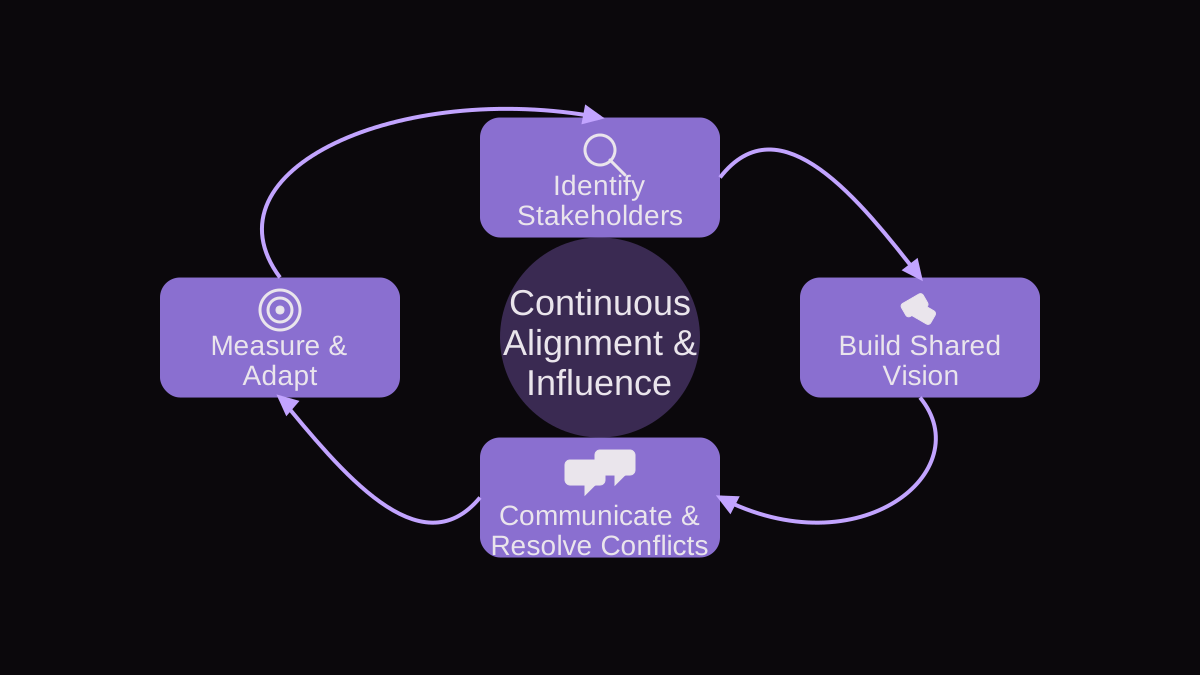
Even with a shared rubric, influencing stakeholders and resolving conflicts requires more than just presenting data; it demands empathy, strategic communication, and a knack for finding common ground. The complexities of AI mean that raw facts often aren't enough to sway opinions or bridge understanding gaps. You need to adapt your approach to resonate with each stakeholder's unique concerns.
- Translate Between Languages: This is paramount. Speak the language of each stakeholder. For business leaders, focus on ROI and strategic advantage. For engineers, discuss technical challenges, architectural choices, and system reliability. For legal, emphasize compliance, risk reduction, and data governance. Avoid technical jargon when speaking to non-technical audiences, or explain it clearly using analogies relevant to their domain.
- Show, Don't Just Tell: Abstract AI concepts are hard to grasp. Prototypes, mock-ups, interactive dashboards, and even early-stage model outputs are incredibly powerful. Demonstrate the AI's capabilities and, crucially, its limitations visually. Making abstract concepts tangible fosters understanding and builds trust far more effectively than slides alone.
- Leverage Data and Evidence Responsibly: Use model performance metrics, A/B test results, user research insights, and market data to support your arguments. However, be transparent about data limitations, uncertainties, and the 'black box' aspects of certain models. With AI, a responsible presentation of evidence, including its caveats, builds long-term credibility.
- Facilitate Structured Debate: Create safe spaces where stakeholders can voice concerns without fear of judgment. Use structured facilitation techniques, like 'pros, cons, and mitigations' or 'decision matrices,' to guide discussions towards solutions rather than allowing them to devolve into unproductive arguments. Ensure every voice feels heard.
- Identify Common Ground and Shared Goals: Even when perspectives clash, there's usually an underlying shared objective (e.g., improving customer satisfaction, increasing efficiency, driving business growth). Frame solutions and compromises around these overarching goals, demonstrating how a proposed path ultimately serves everyone's best interests.
- Educate Iteratively and Continuously: AI concepts, especially topics like model drift, data bias, or explainability, can be complex. Provide continuous, digestible education. This isn't a one-time workshop; it's an ongoing process of sharing knowledge, demystifying AI, and building collective literacy. This consistent education builds trust and reduces fear of the unknown.
When conflicts inevitably arise, often due to competing priorities, resource constraints, or misunderstandings about AI's capabilities or risks, my approach is to de-escalate by focusing on objective criteria from our alignment rubric and re-centering the discussion on the core user problem. It's rarely about who is 'right,' but about finding the most optimal and responsible path forward that balances competing demands while achieving the product's ultimate goal.
Worked Example: Navigating Stakeholder Priorities for a Healthcare AI Feature
Let's walk through a realistic scenario: developing an AI feature to predict patient readmission risk for a large hospital system. This feature aims to identify high-risk patients for proactive intervention, ultimately improving patient outcomes and reducing hospital operating costs. This is a high-stakes environment where trust, ethics, and accuracy are paramount.
- Step 1: Initial Stakeholder Mapping and Problem Definition. I'd convene an initial discovery session with key representatives: hospital administrators (focused on cost reduction, operational efficiency, regulatory compliance targets), clinical leads (concerned with patient care quality, clinician workflow, potential for alert fatigue), data scientists (model accuracy, data availability, explainability methods), legal and privacy officers (HIPAA compliance, data security, patient consent), and a UX lead (clinician trust in predictions, ease of use, interpretability). The core, agreed-upon problem: reducing preventable 30-day patient readmissions, which are costly and negatively impact patient well-being.
- Step 2: Applying the AI Product Alignment Rubric. We'd go through each point of the rubric in a workshop setting:
- Problem Definition Clarity: Unanimous agreement on reducing preventable 30-day readmissions. Everyone understood the 'why.' Score: 5/5.
- AI Value Proposition: Data scientists presented how ML models could identify complex, non-obvious risk factors better than traditional scoring systems. Clinicians highlighted the potential for proactive, personalized interventions. Legal raised concerns about the 'black box' nature of some ML models and liability. This was a point of tension. Score: 3/5.
- Risk & Mitigation Transparency: Legal emphasized strict data anonymization, audit trails, and clear documentation for clinical decision support. Clinicians worried about false positives leading to unnecessary interventions and alert fatigue. Data scientists proposed using explainable AI techniques (like SHAP values) to show 'why' a prediction was made, along with confidence scores. Agreements on robust data governance, model monitoring, and human-in-the-loop oversight were established. Score: 4/5 after discussion.
- Success Metrics Alignment: Administrators proposed reducing readmission rates by a specific percentage and quantifying associated cost savings. Clinicians added improving patient satisfaction scores and reducing clinician burnout (by making their work more impactful). Data scientists suggested model precision, recall, and F1-score as technical metrics. We aligned on a balanced scorecard: primary metric was readmission reduction, secondary were cost savings, clinician adoption rate, and a minimum acceptable F1-score for the model. Score: 5/5.
- Resource & Feasibility Consensus: Data scientists detailed requirements for EHR data access, compute resources, and labeling efforts. Engineers estimated integration time with existing hospital systems. Administrators committed necessary budget and personnel. Score: 5/5.
- Step 3: Addressing Specific Conflicts and Influencing Decisions. The biggest friction point was the 'black box' concern from legal and clinical stakeholders. They were wary of an AI making predictions that directly influenced patient care without clear rationale. My strategy involved:
- Translating: I translated the technical concept of SHAP values (which explain feature contribution) into clinical terms: 'Here's why the model thinks this patient is high risk, based on these specific factors from their medical history.' This made it actionable for clinicians.
- Showing: We demonstrated a low-fidelity prototype where the AI provided a risk score along with the top three contributing factors, but the final decision to intervene remained firmly with the clinician. The AI was presented as a 'smart assistant,' not an autonomous decision-maker.
- Educating: I shared general industry examples of AI decision support tools in healthcare (without naming specific clients) that improved outcomes when coupled with human expertise, emphasizing the 'human-in-the-loop' approach.
- Step 4: Outcome. Through these efforts, the team aligned on developing an 'AI-assisted decision support' tool, not a fully autonomous one. This balanced the administrators' desire for impact with clinical safety, legal compliance, and user trust. The AI's role was clarified: it would empower clinicians with better information, leading to stronger buy-in, faster adoption, and a clearer, more ethical path to implementation. The initial 3/5 on AI Value Proposition moved to a 4/5 as the 'how' became clearer and more palatable.
This example highlights how the AI Product Alignment Rubric helps surface specific areas of misalignment, allowing the PM to apply targeted influence strategies. It moves stakeholders from abstract concerns to concrete solutions that satisfy diverse needs, demonstrating the power of structured engagement in a complex AI environment.
Common Mistakes AI Product Managers Make with Stakeholders
Even with the best intentions and a solid framework, AI Product Managers can stumble when managing stakeholders. Recognizing these common pitfalls is the first step to avoiding them, saving you significant time, resources, and reputation.
- Mistake 1: Assuming Technical Literacy. Failure Mode: Presenting complex machine learning concepts, model architectures, or data pipeline specifics without simplification, leading to blank stares, disengagement, or significant misunderstandings from non-technical stakeholders. Detection: Stakeholders frequently ask basic clarifying questions, nod without comprehension, or make decisions based on an incomplete or incorrect understanding of the technology. Avoidance: Always start with the 'what' and 'why' in business terms, then introduce technical details gradually using analogies, visual aids, and simplified language. The 'translate between languages' tactic is critical here.
- Mistake 2: Over-Promising AI Capabilities. Failure Mode: Hyping up AI as a magic bullet, leading to unrealistic expectations regarding accuracy, speed of development, scope, or the ability to solve all problems. This often happens due to internal pressure or excitement. Detection: Stakeholders demand features that are technically infeasible given current data/models, expect immediate perfect results, or express disappointment when the AI doesn't live up to an exaggerated initial vision. Avoidance: Be transparent about AI's inherent limitations, data dependencies, and the iterative nature of model improvement. Manage expectations upfront using realistic examples, clearly define the scope, and emphasize the journey of refinement.
- Mistake 3: Neglecting Ethical and Legal Considerations Early. Failure Mode: Discovering critical compliance issues (e.g., data privacy violations, significant model bias, lack of auditability) late in the development cycle, leading to costly reworks, project delays, or even cancellation and reputational damage. Detection: Legal, compliance, or ethics teams raise significant red flags during late-stage reviews, or public scrutiny emerges post-launch. Avoidance: Involve legal, compliance, and ethics stakeholders from day one. Integrate 'Risk & Mitigation Transparency' from the alignment rubric into every phase of discovery and development, making it a non-negotiable part of the process.
- Mistake 4: Focusing Solely on Model Performance Metrics. Failure Mode: Prioritizing accuracy, F1-score, or other technical metrics above all else, at the expense of user experience, explainability, or actual business value. A technically perfect model that no one trusts or uses is a failed product. Detection: Users distrust the AI, adoption rates are low, or the model performs well in a lab setting but fails to solve the real-world problem effectively due to poor integration or lack of interpretability. Avoidance: Balance technical metrics with business impact, user feedback, and ethical considerations. The 'Success Metrics Alignment' rubric point helps ensure a holistic view, emphasizing human and business outcomes alongside technical ones.
- Mistake 5: Lack of Continuous, Tailored Communication. Failure Mode: Stakeholders feel out of the loop, leading to an erosion of trust, last-minute objections, or a perception that their input isn't valued. This often stems from a 'set it and forget it' approach to communication. Detection: Surprises emerge, re-work requests increase unexpectedly, or stakeholders express feeling excluded from the decision-making process. Avoidance: Establish regular, structured communication cadences tailored to each stakeholder group's needs and preferred channels. Provide updates on progress, challenges, upcoming decisions, and how previous feedback was incorporated, even when there's nothing 'new' to report.
Key Takeaways for AI Product Stakeholder Management
- Proactively identify and deeply understand your diverse AI stakeholder landscape, recognizing their unique motivations, concerns, and measures of success.
- Utilize a structured framework like the 'AI Product Alignment Rubric' to foster a shared understanding of the problem, AI's unique value, potential risks, and agreed-upon success metrics.
- Master the art of translating complex AI concepts into relatable business and user language, demonstrating capabilities and limitations visually, and responsibly leveraging data to influence decisions.
- Integrate ethical, legal, and user experience considerations from the outset, involving relevant stakeholders early to prevent costly reworks and build responsible AI products.
- Manage expectations diligently by being transparent about AI's capabilities, limitations, and the iterative nature of its development, fostering realistic understanding.
- Maintain continuous, tailored communication with all stakeholders to build trust, ensure ongoing alignment, and adapt to evolving needs throughout the entire product lifecycle.