undefined
Measuring Success in AI Products: Beyond Traditional Metrics
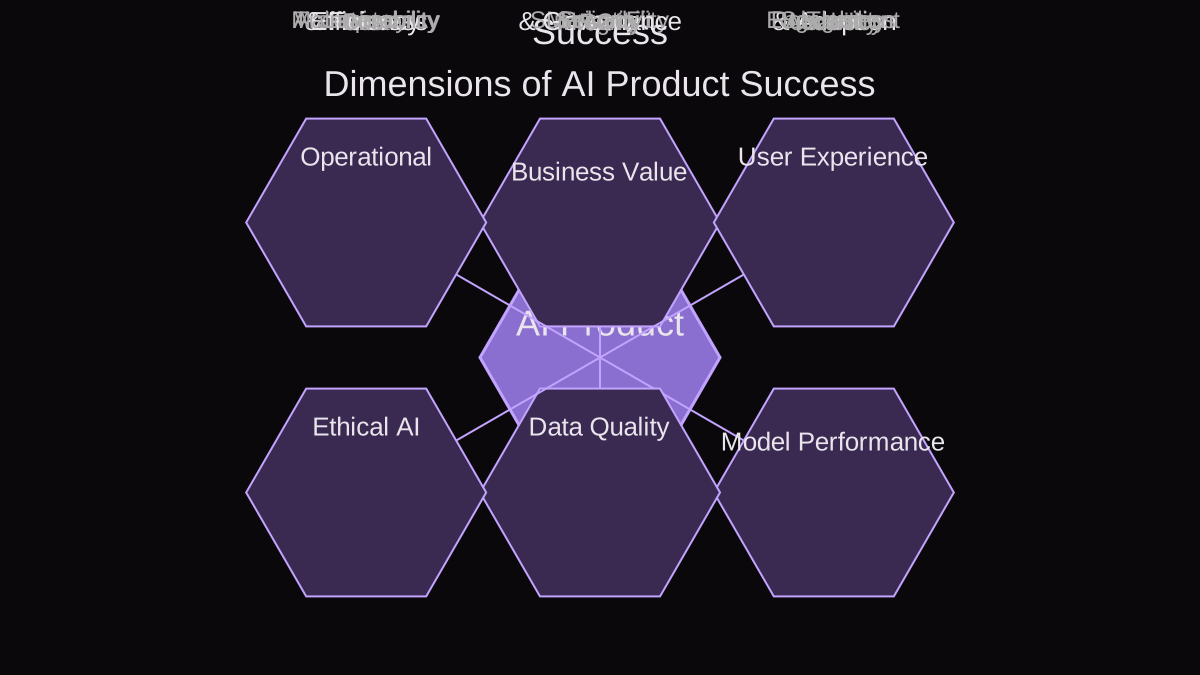
Measuring the success of an AI product requires a much broader and more nuanced perspective than traditional software products. Simply tracking user engagement or revenue uplift, while important, often misses critical dimensions unique to AI, such as model performance, data quality, and ethical considerations. True success for an AI product means delivering demonstrable business value, fostering user trust and adoption, maintaining robust and fair model performance, and adhering to responsible AI principles throughout its lifecycle. It is a multi-faceted challenge that demands a holistic measurement framework.
My 10+ years in product management, particularly in streaming, fintech, and healthcare, have shown me that the unique characteristics of AI—its probabilistic nature, its reliance on constantly evolving data, and its potential for unintended bias—necessitate a re-evaluation of how we define and track success. Failing to adapt our measurement strategies can lead to products that are technically sound but fail to deliver real-world impact, erode user trust, or even cause harm. This guide will walk you through building a comprehensive approach to ensure your AI products genuinely succeed.
Why Can't We Just Use Standard Product Metrics for AI?
Traditional product metrics like Daily Active Users (DAU), Monthly Recurring Revenue (MRR), or conversion rates are foundational, but they tell an incomplete story for AI products. AI components often operate behind the scenes, influencing outcomes rather than being direct user interfaces. For example, a recommendation engine might impact user engagement and revenue, but simply measuring those top-line metrics doesn't tell you if the recommendations are accurate, fair, or even improving over time due to the model itself. We need to dig deeper.
The core problem lies in the unique nature of AI. AI systems are probabilistic, not deterministic. Their performance is highly dependent on the quality and freshness of the data they're trained on. They can suffer from 'model drift' where performance degrades silently over time as real-world data changes. Furthermore, AI can introduce biases, propagate unfairness, or make decisions that are difficult to explain, leading to potential ethical and regulatory issues. Standard metrics don't account for these complexities directly, making it hard to diagnose problems, iterate effectively, or build user trust.
- Probabilistic Outcomes: AI provides predictions or recommendations, not guaranteed results, meaning success isn't always a binary outcome.
- Data Dependency and Drift: AI models are living entities that degrade without fresh, relevant data, impacting performance over time in ways traditional software doesn't.
- Hidden Complexity: Much of an AI system's 'work' happens in the backend, making direct user interaction metrics insufficient to gauge its internal health.
- Ethical and Fairness Concerns: AI can inadvertently perpetuate or amplify biases present in data, demanding specific metrics to monitor and mitigate these risks.
- Explainability and Trust: Users often need to understand why an AI made a particular decision, especially in sensitive domains, which traditional metrics rarely capture.
The AID-E Framework for AI Product Success: A Holistic Rubric
To address the unique challenges of AI product success measurement, I advocate for a holistic framework. I call it the AID-E Framework, which stands for Alignment, Impact, Data & Model, and Ethics. This framework provides a structured way to evaluate AI products across critical dimensions, ensuring we don't over-index on one area while neglecting others. It's designed to be a living rubric that evolves with your product and organizational maturity.
- 1. Alignment to Business Value: Does the AI product directly contribute to strategic business objectives? This is about connecting the AI's output to the 'why' of its existence. We need to ensure that the AI is solving a real problem that moves the needle on key organizational goals, such as revenue growth, cost reduction, market share, or operational efficiency. Without this alignment, even technically brilliant AI can be a costly distraction.
- 2. Impact on User Experience & Adoption: Is the AI product truly useful, usable, and trustworthy for its end-users? This goes beyond basic adoption rates. It includes metrics around user satisfaction, task completion efficiency, perceived accuracy, and the crucial element of user trust. If users don't trust or find value in the AI's output, it will simply be ignored or abandoned, regardless of its backend sophistication.
- 3. Data & Model Performance: Is the underlying AI model technically sound, robust, and operating efficiently? This dimension covers the engineering and data science health of the AI system. It includes traditional model performance metrics (accuracy, precision, recall), but also crucial operational metrics like latency, throughput, model drift detection, and data quality. A decaying model or poor data pipeline will inevitably undermine user experience and business value.
- 4. Ethical & Responsible AI: Is the AI system fair, transparent, and safe, avoiding unintended biases or harm? This is increasingly non-negotiable. We must proactively measure and mitigate risks related to fairness, bias, privacy, and explainability. Ignoring this can lead to significant reputational damage, regulatory penalties, and a complete erosion of user trust. This dimension must be integrated from the very inception of an AI product.
How Do We Actually Measure Each Dimension? (Metrics Deep Dive)
Applying the AID-E framework means translating each dimension into quantifiable, actionable metrics. This requires collaboration between product managers, data scientists, engineers, and even legal/compliance teams. Here’s a breakdown of the types of metrics to consider for each dimension:
- For Alignment to Business Value:
- Revenue Uplift: Direct increase in sales, average order value, or new subscriptions attributable to the AI.
- Cost Reduction: Savings from automation, optimized resource allocation, or reduced errors.
- Operational Efficiency: Reduction in process time, manual effort, or resource consumption.
- Customer Retention/Churn: Improvement in customer loyalty or reduction in churn rates.
- For Impact on User Experience & Adoption:
- Task Completion Rate: Percentage of users successfully completing a task with AI assistance.
- Time Saved: Average reduction in time taken for a task due to AI.
- User Satisfaction (CSAT/NPS): Feedback scores directly related to the AI feature's usefulness and experience.
- Feature Adoption Rate: Percentage of users engaging with the AI-powered feature.
- Perceived Accuracy/Trust Scores: Surveys or direct feedback on how accurate or trustworthy users find the AI's outputs.
- For Data & Model Performance:
- Model Accuracy Metrics: Precision, Recall, F1-score, AUC, MAE, RMSE (context-dependent).
- Latency & Throughput: Speed of predictions and volume of requests handled.
- Model Drift Detection: Monitoring changes in input data distribution or prediction error over time.
- Data Quality Metrics: Completeness, consistency, freshness, and accuracy of input data.
- System Uptime & Error Rate: Standard reliability metrics for the AI service.
- For Ethical & Responsible AI:
- Bias Metrics: Demographic parity, equal opportunity difference, disparate impact ratio, accuracy parity across sensitive groups.
- Explainability Scores: Quantifying the clarity or interpretability of model decisions (e.g., LIME, SHAP scores).
- Adversarial Robustness: Measures of how well the model withstands malicious input attacks.
- Privacy Compliance: Adherence to data privacy regulations (e.g., GDPR, HIPAA) through auditable logging and data access controls.
- Feedback Mechanism Utilization: Rate at which users report issues or provide feedback on AI outputs, especially related to fairness or errors.
Concrete Worked Example: Personalizing a Healthcare Recommendation Engine
Let’s walk through a realistic scenario. Imagine you’re the AI Product Manager for a new feature in a healthcare application: an AI-powered preventative health recommendation engine. This engine analyzes a user's health profile (anonymized medical history, lifestyle data, genetic predispositions) and suggests personalized actions like specific exercises, dietary changes, or health screenings.
Applying the AID-E Framework:
Step 1: Define Alignment to Business Value. The business objective is to improve user health outcomes and reduce long-term healthcare costs for the organization (e.g., an insurance provider or large employer). Metrics would include: reduction in preventable acute health events (e.g., heart attacks, diabetes onset) among users receiving recommendations, increased engagement with preventative care programs, and a measurable decrease in average healthcare claims over 12-24 months for the engaged cohort.
Step 2: Define Impact on User Experience & Adoption. Users need to trust and act on these sensitive health recommendations. Metrics here include: recommendation click-through rate, user completion rate for recommended actions (e.g., tracking a suggested exercise routine), user satisfaction scores specifically for the recommendations (e.g., 'How relevant were these recommendations to you?'), and the rate at which users provide feedback on recommendations. We would also track the percentage of users who opt-in to use the recommendation engine.
Step 3: Define Data & Model Performance. This is crucial in healthcare. Metrics include: model precision and recall for predicting at-risk conditions, the novelty and diversity of recommendations (to avoid recommending the same things repeatedly), latency of recommendation generation, and crucially, continuous monitoring for model drift. We'd also track data quality—e.g., completeness and freshness of user health profiles, and accuracy of medical data used for training. An alert system for data anomalies would be essential.
Step 4: Define Ethical & Responsible AI. This is paramount in healthcare. Metrics would include: fairness metrics to ensure recommendations are equally effective and relevant across different demographic groups (e.g., age, gender, ethnicity), avoiding bias towards specific treatments or providers. We'd also measure explainability: how often users request an explanation for a recommendation, and the perceived clarity of those explanations. Privacy compliance (HIPAA adherence) is a non-negotiable baseline, monitored through audit logs and access controls.
By combining these dimensions, you create a comprehensive success dashboard that goes beyond simple clicks, offering a true picture of the AI product's health, impact, and responsible operation. This allows you to identify where the product is excelling and where it needs intervention, from model retraining to UI improvements or bias mitigation strategies.

Common Mistakes When Measuring AI Product Success
Even with a robust framework, it's easy to fall into common traps. Recognizing these pitfalls and proactively addressing them is a mark of an experienced AI Product Manager.
- Mistake 1: Over-indexing on Model Accuracy. Failure Mode: A model might achieve 99% accuracy on a test set but fail completely in the real world because it's solving the wrong problem, or its outputs aren't integrated into a usable product experience. I've seen teams spend months optimizing an F1-score only to find the feature generates no user adoption. How to Detect/Avoid: Always link model metrics directly to business outcomes and user experience. If a gain in accuracy doesn't translate to a business or user metric improvement, question its value. Implement A/B tests that measure end-to-end impact, not just model output.
- Mistake 2: Neglecting Data Quality and Drift. Failure Mode: AI models are voracious consumers of data. If the input data quality degrades or the real-world distribution shifts ('drift'), the model's performance will silently erode, leading to poor predictions and user frustration. This is a common silent killer of AI products. How to Detect/Avoid: Implement continuous data monitoring pipelines. Track data freshness, completeness, and statistical distribution shifts (e.g., using statistical distance measures). Set up alerts for significant deviations. Proactively plan for model retraining and redeployment as part of your product lifecycle.
- Mistake 3: Ignoring User Trust and Adoption. Failure Mode: Even a technically perfect AI model will fail if users don't trust its recommendations or find it difficult to use. In sensitive domains like healthcare or finance, a lack of transparency or perceived bias can lead to immediate abandonment. How to Detect/Avoid: Integrate user research, qualitative feedback, and A/B testing into your measurement strategy. Don't just look at click-throughs; measure perceived accuracy, usefulness, and trust through surveys or direct user interviews. Provide clear explanations for AI decisions where appropriate.
- Mistake 4: Disconnecting AI Metrics from Business Outcomes. Failure Mode: Many organizations measure AI for AI's sake, tracking intricate model performance metrics without a clear line of sight to the actual business value being delivered. This makes it impossible to justify ROI or secure future investment. How to Detect/Avoid: For every AI feature, define its direct impact on a strategic business KPI from day one. Regularly report on these connections. If a model metric improves but the business metric doesn't, investigate the disconnect – it might be a product design issue, a user experience problem, or even a misunderstanding of the business problem itself.
- Mistake 5: Lack of Ethical Consideration from Day One. Failure Mode: Retrofitting fairness or transparency after a model is deployed is far more difficult and costly than building it in from the start. Ignoring ethical considerations can lead to reputational damage, regulatory fines, and alienate users. How to Detect/Avoid: Embed ethical AI principles into your product discovery and design phases. Conduct bias audits on training data and model outputs. Work with legal and compliance teams to ensure adherence to relevant regulations. Make fairness, privacy, and explainability explicit metrics you track, just like accuracy or revenue.
Key Takeaways
- AI product success extends beyond traditional metrics, requiring a holistic approach that accounts for unique AI characteristics.
- The AID-E Framework (Alignment, Impact, Data & Model, Ethics) provides a structured rubric for comprehensive evaluation.
- Alignment to Business Value ensures AI efforts contribute directly to strategic organizational goals.
- Impact on User Experience and Adoption emphasizes the crucial role of user trust, usability, and perceived value.
- Data and Model Performance focuses on the technical health, robustness, and efficiency of the AI system, including continuous monitoring for drift.
- Ethical and Responsible AI addresses fairness, transparency, and safety, which are non-negotiable for building trustworthy products.
- Translate each AID-E dimension into specific, quantifiable metrics, collaborating across disciplines to define them.
- Avoid common pitfalls like over-indexing on model accuracy, neglecting data quality, ignoring user trust, or disconnecting AI metrics from business outcomes.
- Integrate ethical AI considerations from the very beginning of the product lifecycle to avoid costly retrofitting and build user confidence.