AI Product
Managing Technical Debt in AI Products: A PM's Strategic Approach
Technical debt in AI products is a complex beast, far beyond traditional software. It encompasses model decay, data drift, unscalable infrastructure, and opaque experimentation. My strategic approach as an AI PM involves proactively identifying, quantifying, and prioritizing this debt by assessing its direct impact on user value, operational efficiency, and future innovation, ensuring our products remain robust and competitive.
Ignoring AI technical debt isn't an option; it's a ticking time bomb that erodes model performance, increases operational costs, and stifles innovation. As product managers, our role is not just to define features but to ensure the underlying systems can reliably deliver them. This means understanding the unique facets of AI debt and integrating its management into our product roadmap from day one.
What is Technical Debt in AI, and Why is it Different?
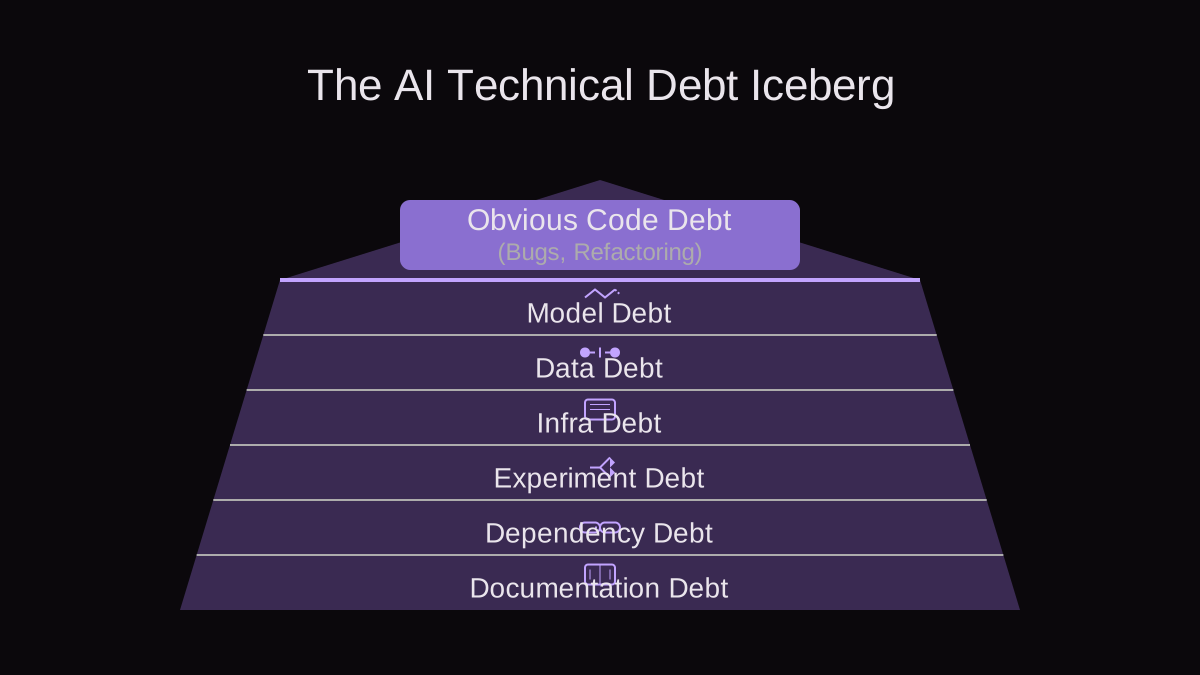
In traditional software, technical debt often refers to shortcuts taken in code, leading to increased development time and bugs. In AI, this definition expands dramatically. We're not just talking about code quality; we're talking about the integrity of the models, the quality of the data feeding them, and the entire MLOps ecosystem that supports their lifecycle. This is why AI technical debt is fundamentally different and often more insidious.
- Model Debt: This includes issues like model decay (performance degrading over time due to concept or data drift), lack of explainability, poor version control for models, or insufficient retraining strategies. When it breaks, your model becomes less accurate, leading to poor user experiences, incorrect predictions, or even financial losses, often silently at first.
- Data Debt: This is perhaps the most critical and often overlooked. It encompasses inconsistent data schemas, poor data quality, lack of proper data governance, unmanaged data pipelines, and inadequate data labeling. When it breaks, your models receive garbage input, leading to garbage output, or your data processing pipelines become bottlenecks, preventing timely model updates.
- MLOps Debt: The lack of robust MLOps practices creates debt in deployment, monitoring, and experimentation. Manual deployments, fragmented monitoring tools, and an inability to reproduce experiments are common. When it breaks, you can't quickly deploy new models, detect performance regressions, or iterate effectively, slowing down innovation to a crawl.
- Infrastructure Debt: This involves an AI infrastructure that isn't scalable, lacks proper monitoring, or relies on outdated components. Without proper infrastructure, scaling your AI products becomes a nightmare, leading to outages, slow performance, and wasted compute resources. When it breaks, your product simply stops working under load or becomes prohibitively expensive.
The key differentiator is the dynamic nature of AI systems. Unlike static software, AI models continuously interact with evolving data and environments. This means debt can accumulate not just from engineering choices but from external factors like changes in user behavior or real-world data distributions. The 'interest' on this debt is paid in declining accuracy, increased operational overhead, and a slower pace of innovation.
How Do I Identify AI Technical Debt?
Identifying AI technical debt requires a multi-faceted approach, combining quantitative metrics with qualitative insights. As a PM, I don't just wait for an engineer to flag something; I actively look for signals across the entire product lifecycle. It’s about being proactive and establishing clear indicators.
- Performance Monitoring: Regularly track key model metrics like accuracy, precision, recall, F1-score, and latency. Sudden drops or gradual degradation are clear indicators of model decay or data drift. I also monitor inference costs; unexpected spikes can point to inefficient models or infrastructure.
- Data Quality Checks: Implement automated checks for data completeness, consistency, and validity at various points in your data pipelines. High rates of missing values, anomalies, or schema violations are red flags for data debt. We need to know not just if data is flowing, but if it's usable.
- MLOps Maturity Assessment: Evaluate your team’s ability to version models, reproduce experiments, deploy updates quickly, and monitor models in production. Gaps here highlight MLOps debt. For instance, if deploying a new model takes weeks, that's a problem.
- Developer Feedback: Regularly solicit feedback from your engineering and data science teams. They are on the front lines and often know where the 'pain points' are. Ask about areas that are hard to change, frequently break, or require excessive manual intervention.
- User Feedback and Support Tickets: Pay attention to user complaints that might indirectly point to AI model issues. Are users reporting irrelevant recommendations, incorrect classifications, or slow responses? These can be symptoms of underlying technical debt.
- Infrastructure and Cost Audits: Periodically review your cloud infrastructure costs and resource utilization. Over-provisioned resources, underutilized hardware, or lack of auto-scaling indicate infrastructure debt that's costing money and limiting agility.
My goal is to create a continuous feedback loop where these signals are regularly reviewed. This isn't a one-time audit; it's an ongoing process that keeps the product healthy. Without these detection mechanisms, debt can silently compound, making future remediation exponentially harder.
Prioritizing AI Technical Debt: The AI Debt Impact Matrix
Once identified, the next challenge is prioritization. Not all debt is created equal, and we can't fix everything at once. I use a framework I call the 'AI Debt Impact Matrix' to guide these decisions. It helps me weigh the urgency and business value against the effort involved, similar to how we prioritize features, but with a specific lens for AI complexities.
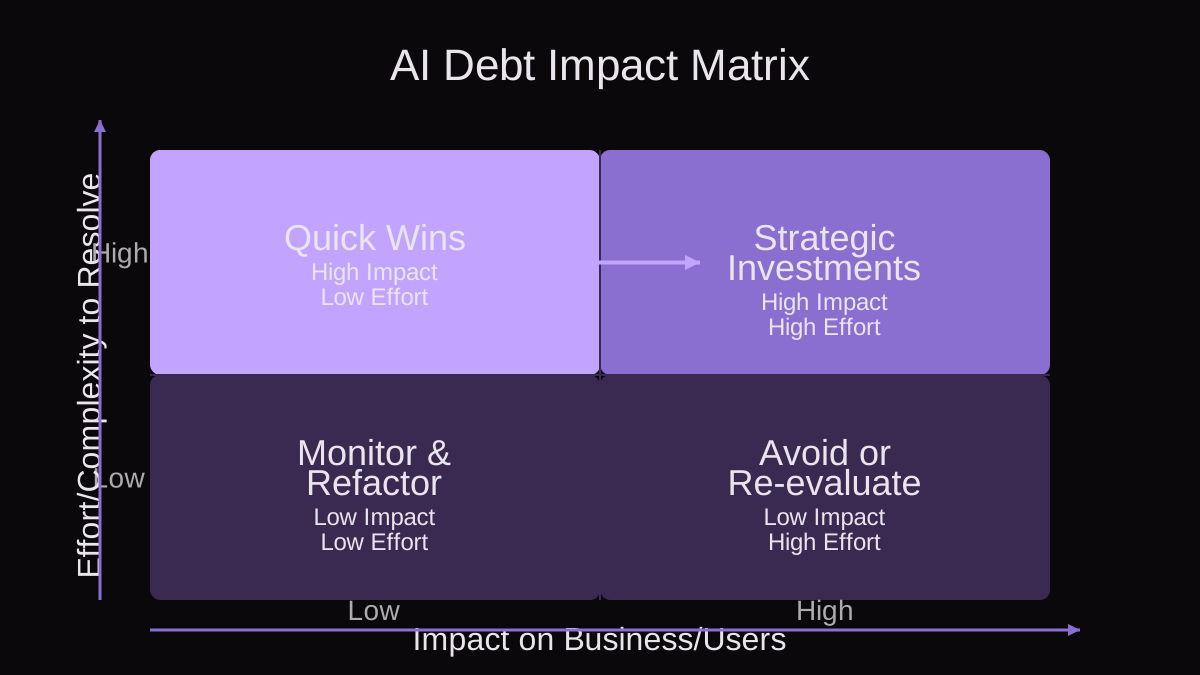
The matrix categorizes debt based on two primary axes: Business/User Impact and Effort to Resolve. Here are the criteria I use:
- 1. Business/User Impact: How severely does this debt affect our strategic goals, user experience, revenue, or regulatory compliance? High impact means direct negative consequences for the business or users. Low impact means minimal or indirect consequences.
- 2. Risk of Failure/Escalation: What is the likelihood that this debt will lead to a critical outage, security vulnerability, significant performance degradation, or data integrity issue? High risk means an imminent threat. Low risk means a minor inconvenience or future inefficiency.
- 3. Future Innovation Blockage: How much does this debt hinder our ability to build new features, iterate on models, or adopt new technologies? High blockage means it's a critical impediment. Low blockage means it's a minor inconvenience.
- 4. Effort to Resolve: How much time, resources, and complexity are involved in fixing this debt? This should be estimated by engineering and data science teams. Low effort means days or weeks. High effort means months or significant architectural changes.
Based on these criteria, I map the debt into quadrants, just like a standard prioritization matrix:
- Quick Wins (High Impact, Low Effort): These are immediate priorities. Tackle them first to gain momentum and demonstrate value. Example: Patching a critical bug in a data pipeline that causes intermittent data loss.
- Strategic Investments (High Impact, High Effort): These are major projects requiring dedicated resources and careful planning. They often involve significant architectural changes or MLOps maturity improvements. Example: Building a robust model monitoring and auto-retraining pipeline to combat known model decay.
- Monitor & Refactor (Low Impact, Low Effort): These can be addressed during routine maintenance sprints or by individual teams. Keep an eye on them, as they can become high impact over time. Example: Refactoring a small, inefficient piece of model inference code.
- Avoid or Re-evaluate (Low Impact, High Effort): Challenge these items. Is the effort truly justified for such low impact? Sometimes, it's better to live with minor imperfections or re-evaluate if the problem is even worth solving. Example: Completely re-architecting a legacy data schema that only affects a non-critical internal dashboard and has a stable, albeit inefficient, workaround.
Concrete Worked Example: Fraud Detection System
Imagine I'm the PM for an AI-powered fraud detection system. We've identified three key pieces of technical debt:
- Debt Item A: The fraud model's performance (recall) has slowly dropped by 5% over the last six months due to concept drift (new fraud patterns emerging) but there's no automated retraining pipeline.
- Debt Item B: A critical data ingestion pipeline for transaction data frequently fails, requiring manual restarts by an engineer, leading to 2-3 hour data freshness delays daily.
- Debt Item C: The model inference service is deployed on an old cluster, and while it works, scaling it for peak loads (e.g., holiday seasons) requires manual intervention and often results in latency spikes for a small percentage of requests.
Applying the AI Debt Impact Matrix:
- Debt Item A (Model Decay):
- 1. Business/User Impact: High. 5% drop in recall means more fraud goes undetected, directly impacting revenue and customer trust.
- 2. Risk of Failure/Escalation: High. Fraudsters are constantly evolving; without automated retraining, the model will become increasingly ineffective.
- 3. Future Innovation Blockage: High. Can't deploy new model versions or experiment with new features effectively without a retraining pipeline.
- 4. Effort to Resolve: High. Requires building a robust MLOps retraining pipeline, including data versioning, model versioning, and automated deployment. (Estimated: 2-3 months).
- Verdict: Strategic Investment.
- Debt Item B (Data Ingestion Pipeline Failures):
- 1. Business/User Impact: Critical. Daily delays mean real-time fraud detection is compromised, increasing exposure to fraud losses. Engineers are also pulled into reactive work.
- 2. Risk of Failure/Escalation: Critical. Manual restarts are unsustainable and prone to human error; a major failure could halt fraud detection entirely.
- 3. Future Innovation Blockage: Moderate. Blocks features that rely on real-time data but doesn't stop model improvements directly.
- 4. Effort to Resolve: Low-Medium. Refactoring the pipeline, adding better error handling, and implementing automated retry logic. (Estimated: 2-4 weeks).
- Verdict: Quick Win (High Impact, Low-Medium Effort).
- Debt Item C (Old Inference Cluster):
- 1. Business/User Impact: Low-Medium. Latency spikes affect a small percentage of users during peak, but core functionality isn't broken. Operational costs might be slightly higher.
- 2. Risk of Failure/Escalation: Moderate. Could lead to service degradation or potential outages during extreme peaks if not managed, but current impact is limited.
- 3. Future Innovation Blockage: Low. Doesn't directly prevent model iteration, but could slow down deployment of larger, more complex models.
- 4. Effort to Resolve: High. Migrating to a new, auto-scaling cloud infrastructure or re-architecting the deployment strategy. (Estimated: 3-4 months).
- Verdict: Avoid or Re-evaluate (Currently Low-Medium Impact for High Effort) – Consider monitoring and only address if impact increases or during a broader infrastructure overhaul.
My immediate priority would be Debt Item B (Quick Win), as its direct business impact is critical and the effort is manageable. Then, I'd plan Debt Item A (Strategic Investment) into the next quarter's roadmap. Debt Item C would be deprioritized for now, unless its impact significantly worsens.
Common Mistakes AI PMs Make in Managing Technical Debt
Even with frameworks, it’s easy to fall into traps when managing AI technical debt. I’ve seen these mistakes repeatedly, and knowing how to spot and avoid them is crucial.
- 1. Treating AI Debt Like Traditional Software Debt: Failure Mode: Assuming a 'bug fix' sprint will solve model decay or data quality issues. Detection: Engineering team continuously struggles with 'unexpected' model performance issues or data pipeline breakdowns. Avoidance: Educate yourself and your team on the unique aspects of AI debt. Dedicate specific time and resources to MLOps, data governance, and model monitoring, recognizing they are distinct from traditional software engineering tasks.
- 2. Ignoring Data Debt: Failure Mode: Focusing solely on model performance metrics while neglecting the underlying data quality. Detection: Models perform well in testing but poorly in production, or engineers spend excessive time cleaning/transforming data before model training. Avoidance: Prioritize data quality, data lineage, and robust data pipelines as first-class citizens. Work with data engineers to establish data contracts and monitoring for data drift and anomalies.
- 3. Lack of Dedicated MLOps Investment: Failure Mode: Expecting data scientists to handle deployment, monitoring, and pipeline automation without dedicated MLOps support. Detection: Slow model deployment cycles, inability to reproduce experiments, or manual interventions required for model retraining/monitoring. Avoidance: Advocate for and invest in dedicated MLOps engineering resources and tools. MLOps is not a luxury; it's a necessity for scalable, production-ready AI.
- 4. Underestimating the Compounding Interest: Failure Mode: Deferring small pieces of debt indefinitely, believing they are low priority. Detection: Small inefficiencies grow into major architectural roadblocks, making future changes impossible or prohibitively expensive. Avoidance: Integrate debt repayment into every sprint or roadmap. Even dedicating 10-20% of engineering capacity to technical debt each cycle can prevent massive future headaches. Use the 'Quick Wins' quadrant of the matrix proactively.
- 5. Not Involving Cross-Functional Teams Early: Failure Mode: Debt is identified and scoped purely by the data science or engineering team, without PM or business context. Detection: Solutions proposed don't align with business priorities, or critical aspects of user impact are missed. Avoidance: Ensure technical debt discussions are cross-functional. As a PM, bring the business and user context, and involve legal/compliance for data governance debt, and operations for infrastructure debt.
The key is to remember that AI products are living systems. They require continuous care, monitoring, and strategic investment to maintain their health and deliver value. Proactive management of technical debt is a core part of that responsibility.
Building a Culture of Debt Management: Best Practices
Managing technical debt isn't just about applying a framework; it's about embedding a proactive mindset within the team and the organization. As an AI PM, I see it as my role to champion this culture.
- Allocate Dedicated Capacity: Explicitly reserve a portion of each sprint or roadmap for technical debt repayment. This could be 10-20% of engineering capacity. Without this explicit allocation, debt work often gets squeezed out by new features.
- Visibility and Communication: Make technical debt visible. Document it clearly, track it in your project management tools, and discuss it openly in roadmap meetings. Explain the 'why' to stakeholders – how resolving debt enables future features, reduces risk, and improves user experience.
- Define 'Done' Broadly: Ensure that 'done' for an AI feature includes not just the model performance but also robust MLOps, monitoring, data quality checks, and documentation. Prevent new debt from accumulating by having a high quality bar from the outset.
- Empower Teams: Give engineering and data science teams the autonomy to identify and propose solutions for technical debt. They are the experts who understand the intricacies of the systems best.
- Continuous Learning and Iteration: The AI landscape evolves rapidly, so what constitutes 'best practice' for MLOps or data governance changes. Foster a culture of continuous learning and adaptation to new tools and methodologies.
- Celebrate Debt Repayment: Acknowledge and celebrate when significant pieces of technical debt are resolved. This reinforces the value of the work and motivates teams to tackle future challenges.
Ultimately, strategic AI technical debt management is about balancing short-term feature delivery with long-term product health and innovation. It’s a continuous negotiation, a blend of art and science, that is absolutely critical for any AI product manager serious about building sustainable, impactful AI products.
Key Takeaways
- AI technical debt is fundamentally different from traditional software debt, encompassing model, data, MLOps, and infrastructure complexities.
- Proactive identification involves monitoring performance, data quality, MLOps maturity, and collecting cross-functional feedback.
- The AI Debt Impact Matrix helps prioritize debt by assessing business/user impact, risk, innovation blockage, and effort to resolve.
- Avoid common mistakes like ignoring data debt, underinvesting in MLOps, or treating AI debt like generic software issues.
- Build a culture of debt management through dedicated capacity, visibility, broad 'done' definitions, and continuous learning.