Personalization
Leveraging LLMs for Hyper-Personalization: A PM's Guide
Hyper-personalization with Large Language Models (LLMs) isn't just an incremental improvement; it's a paradigm shift from broad segmentation to truly individual, dynamic experiences. For product managers, this means moving beyond static rules and deterministic logic to systems that understand context, nuance, and intent at scale, allowing us to deliver content, recommendations, and interactions tailored to a single user in real time. My experience across streaming, fintech, and healthcare has shown me that the true power lies in LLMs' ability to synthesize vast amounts of diverse data and generate highly relevant, natural language outputs that anticipate and meet specific user needs, fundamentally transforming engagement and driving measurable product value.
This guide outlines a practical approach for product managers and aspiring AI PMs to navigate the complexities and opportunities of building next-generation hyper-personalization features using LLMs.
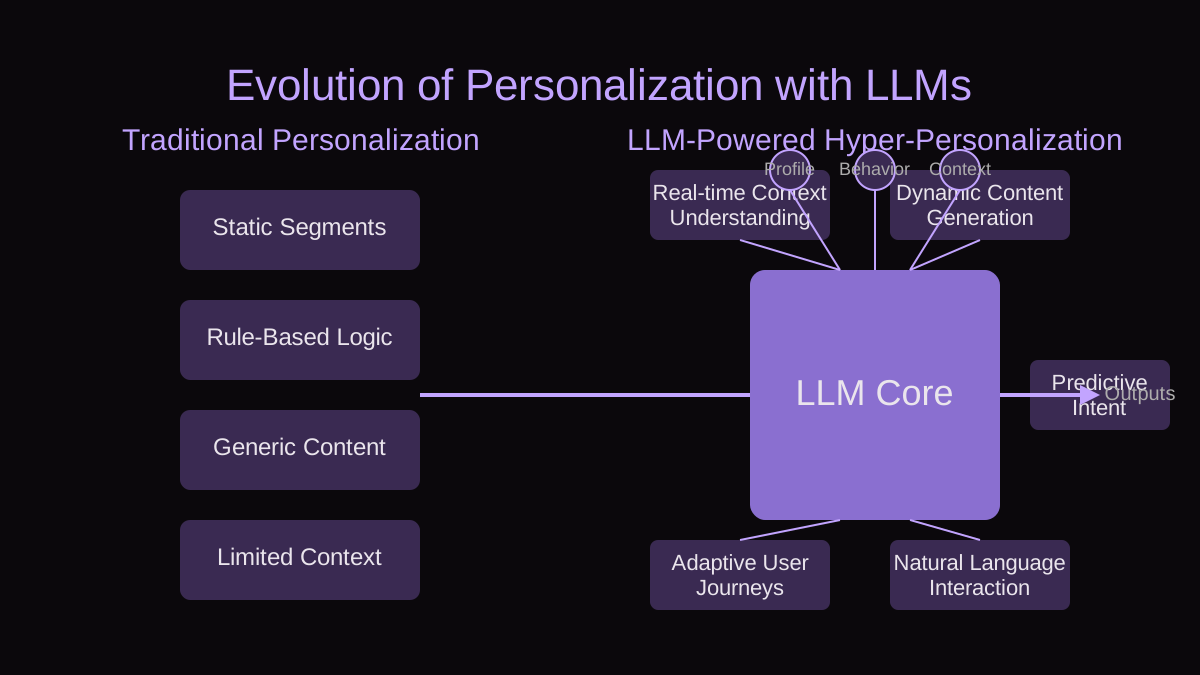
Why are LLMs a game-changer for hyper-personalization?
Traditional personalization, while effective in its time, operates largely on predefined rules and segments. You might group users by age, past purchases, or viewing habits, and then apply a set of rules: if user is in 'Segment A', show 'Product X'. This approach is limited by its inherent rigidity. It struggles with the long tail of user preferences, nuanced context, and the sheer volume of data points that make up an individual's unique journey. It's like trying to fit a bespoke suit using only a few standard sizes.
LLMs break these limitations by bringing several critical capabilities to the forefront. First, their advanced natural language understanding allows them to derive deep meaning and intent from unstructured data – user queries, reviews, support tickets, even conversational history. This moves beyond keywords to truly grasp the 'why' behind user actions. Second, their generative power means they can create novel, dynamic content on the fly, not just select from a predefined library. This is crucial for truly personalized recommendations, summaries, or even conversational agents that feel genuinely responsive. Imagine a health app not just recommending a generic article, but generating a personalized summary of your latest lab results, explaining what they mean for you specifically, and suggesting next steps in a compassionate tone. This level of dynamic, context-aware content generation is where LLMs truly shine, enabling a depth of personalization previously unattainable at scale. They can connect disparate pieces of information – a user's browsing history, purchase patterns, demographic data, and even their current emotional state inferred from text – to construct a holistic profile and deliver hyper-relevant interactions.
How do I identify genuine hyper-personalization opportunities with LLMs? (The Context-to-Value Mapping Rubric)
Not every personalization problem needs an LLM, and throwing an LLM at a simple rule-based problem is a costly overcomplication. As a PM, your job is to identify where LLMs offer a disproportionate advantage. I use what I call the 'Context-to-Value Mapping Rubric' to evaluate potential use cases. This rubric helps you assess if the complexity and cost of an LLM solution are justified by the unique value it can unlock.
- High Volume and Diversity of Contextual Data: Does the problem space involve a vast amount of varied, often unstructured data (text, user behavior, sensor data, external events) that, when combined, creates a unique context for each user? LLMs excel at synthesizing this complexity. If your data is mostly structured and limited, traditional methods might suffice.
- Need for Dynamic, Generative Content: Does the personalization require generating unique, nuanced, or conversational content rather than selecting from a finite set of options? If you need a personalized summary, a custom response, or a creative recommendation, an LLM is a strong candidate. If it's just showing 'Product X' because 'User likes Y', it's likely not.
- Significant Friction or Suboptimal Experience with Current Personalization: Is your existing personalization falling short? Are users expressing frustration with generic recommendations, irrelevant content, or a lack of understanding? Look for areas where users feel misunderstood or underserved by existing systems. This indicates a gap an LLM could fill.
- Clear, Measurable Impact on User Experience or Business Metrics: Can you clearly articulate how a hyper-personalized experience would move the needle on key metrics (e.g., increased engagement, higher conversion, reduced churn, improved NPS)? Without a tangible benefit, the investment in LLMs is hard to justify. Focus on quantifiable outcomes.
- Manageable Ethical, Privacy, and Safety Considerations: Have you assessed the risks associated with using LLMs in this context? This includes data privacy, potential for bias, hallucinations, and 'creepiness'. If the risks are too high or unmitigable, rethink the application. Always prioritize user trust and safety.
Apply this rubric to your product's pain points. If a potential feature scores high on most of these criteria, you likely have a compelling LLM-driven hyper-personalization opportunity.
How do I build an LLM-powered hyper-personalization feature? (Worked Example: Healthcare Patient Portal)
Let's walk through a concrete example. Imagine I'm the PM for a digital healthcare patient portal, focusing on chronic disease management (e.g., diabetes, hypertension). Our current portal offers generic health articles and appointment reminders. The problem: low patient engagement, lack of adherence to care plans, and a feeling that the system doesn't truly 'know' them.
My goal is to create a 'Personalized Health Companion' feature using an LLM to provide highly relevant, proactive, and empathetic support.
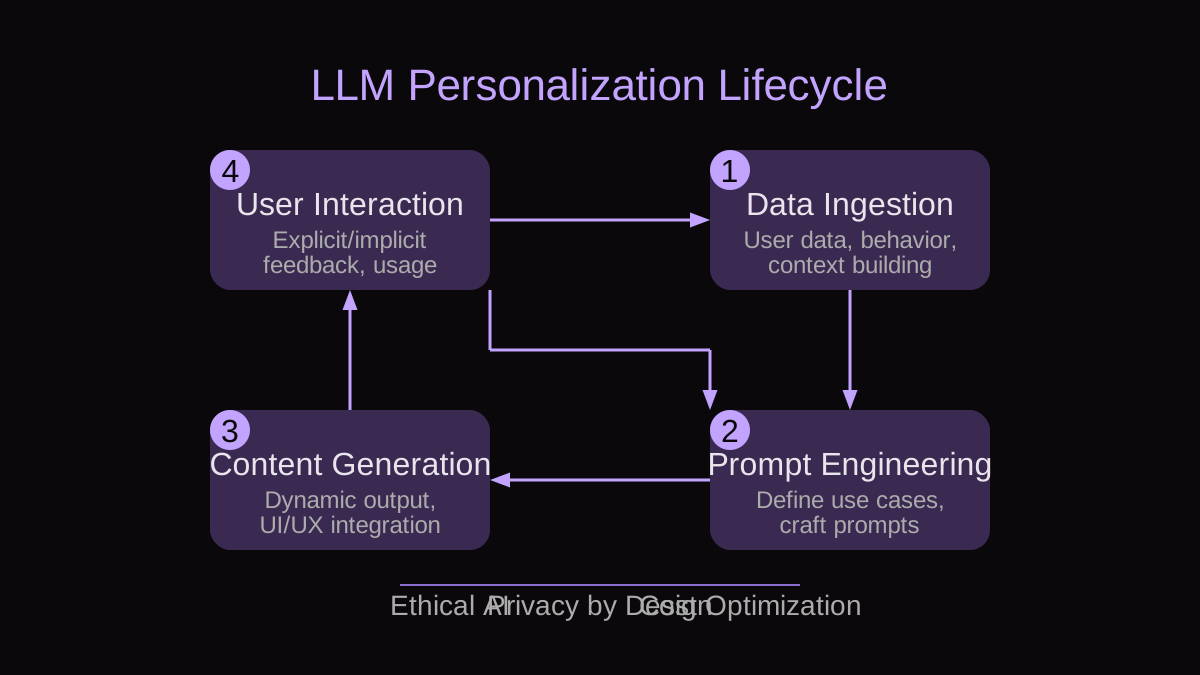
- Step 1: Data Ingestion & Context Building. This is foundational. We need to securely aggregate relevant patient data, always with explicit consent and adhering strictly to HIPAA/GDPR. Sources include: Electronic Health Records (EHR) – diagnoses, medications, lab results, clinical notes; Wearable Device Data – glucose levels, blood pressure, activity, sleep; Patient-Reported Outcomes (PROs) – mood, symptoms, diet logs; User Preferences – communication style, preferred learning methods, wellness goals. The LLM will use this aggregated data to build a rich, real-time context for each patient. We're not feeding raw PHI directly into the LLM for training; rather, we're using secure data pipelines to extract and represent relevant, anonymized or pseudonymized features and facts that the LLM can reference via Retrieval Augmented Generation (RAG) or by being part of the prompt context.
- Step 2: Define Use Cases & Prompt Engineering. Based on the data, we identify specific hyper-personalization scenarios. For our health companion: personalized summaries of recent lab results, proactive health nudges based on trends, empathetic responses to patient queries, and tailored educational content. For prompt engineering, we'd craft specific prompts for each use case. For a lab summary, a prompt might look like: 'Given Patient X's recent lab results (attach structured data for glucose, A1C, cholesterol), their medical history (diabetes type 2, hypertension), current medications, and expressed goal (lower A1C), generate a concise, easy-to-understand summary explaining what these results mean for THEM, highlight any concerning trends, and suggest 1-2 actionable, personalized steps they can take today. Maintain an empathetic, encouraging tone. Avoid medical jargon.' For proactive nudges: 'Based on Patient Y's recent high glucose readings and their activity tracker showing low activity, generate a gentle reminder about a short walk after dinner, tying it to their goal of managing blood sugar.' The key is to provide enough context and clear instructions to guide the LLM's output and minimize hallucinations.
- Step 3: Integration Points & User Experience. Where does this personalized content live? It might appear as a dynamic 'Today's Health Insights' card on the dashboard, as proactive notifications, or as part of a conversational chat interface. The UX must be intuitive, making it clear this is personalized. We'd design UI components that leverage the LLM's output – a dynamic text block for summaries, interactive buttons for suggested actions, and a chat interface for Q&A. Importantly, we ensure an 'explainability' feature, allowing users to understand why a recommendation was made, fostering trust and transparency.
- Step 4: Feedback Loop & Iteration. Hyper-personalization is never 'done'. We'd implement mechanisms for explicit and implicit feedback. Explicit: 'Was this helpful? Yes/No' buttons, thumbs up/down, satisfaction surveys. Implicit: Tracking engagement with personalized content (click-through rates, time spent, adherence to suggested actions), changes in health metrics over time. This feedback is crucial for fine-tuning the LLM prompts, updating our contextual data models, and iteratively improving the relevance and accuracy of the personalization. We might use human-in-the-loop review for critical outputs, especially in healthcare, to ensure safety and accuracy before broad deployment.
What are the common pitfalls when implementing LLM personalization, and how do I avoid them?
As with any powerful technology, LLMs come with their own set of challenges. Being aware of these common pitfalls and having strategies to mitigate them is crucial for a PM.
- Failure Mode 1: Over-Personalization and the 'Creepiness' Factor. This happens when personalization feels intrusive or predictive in an unsettling way, eroding user trust. Detection: Monitor user feedback closely, specifically for terms like 'creepy,' 'watched,' or 'how did it know that?' Look for sudden drops in engagement with personalized features or increased opt-out rates. Avoidance: Implement strict boundaries on what data is used and how. Always provide transparency about why something is being recommended or shown ('You might like this because you viewed X'). Offer clear user controls for privacy settings and the ability to turn off certain personalization aspects. Focus on delivering clear value, not just being 'smart.' Ask yourself: Is this feature delightful, or just data-driven?
- Failure Mode 2: Hallucinations and Inaccuracy. LLMs can sometimes generate plausible-sounding but factually incorrect information. In critical domains like healthcare or finance, this is unacceptable. Detection: Implement rigorous testing, including human-in-the-loop review for high-impact outputs. A/B test personalized content against a control to catch unexpected negative outcomes. Use metrics focused on factual accuracy where applicable. Avoidance: Ground the LLM with verified, up-to-date data using Retrieval Augmented Generation (RAG). This ensures the LLM primarily retrieves facts from trusted sources rather than generating them. Implement strict guardrails and content filters to prevent the generation of harmful or inaccurate information. For critical use cases, rely on LLMs for summarization or style transformation rather than raw fact generation, and always have a human oversight layer.
- Failure Mode 3: Data Privacy and Security Breaches. Using vast amounts of personal data to fuel personalization inherently increases privacy risks if not handled correctly. Detection: Regular security audits, penetration testing, and continuous monitoring of data access logs. Conduct thorough privacy impact assessments. Avoidance: Prioritize privacy by design. Anonymize or pseudonymize data whenever possible. Implement robust access controls and encryption for all data in transit and at rest. Ensure compliance with relevant data protection regulations (e.g., GDPR, HIPAA, CCPA) from day one. Do not feed raw, sensitive user data directly into general-purpose LLMs without proper isolation and masking. Consider federated learning approaches where models learn from decentralized data without it ever leaving local devices.
- Failure Mode 4: Scalability and Cost Issues. LLMs can be computationally intensive and expensive, especially for real-time inference at scale. Detection: Monitor API costs, latency, and resource utilization as your user base grows. Conduct thorough load testing. Avoidance: Optimize prompt length and complexity – shorter, clearer prompts generally consume fewer tokens and resources. Cache frequently requested personalized content where appropriate. Strategically choose LLM models based on task complexity; a smaller, fine-tuned model might suffice for many personalization tasks, rather than always defaulting to the largest, most expensive model. Explore batch processing for less time-sensitive personalization. Continuously evaluate cloud provider offerings and pricing models.
Measuring Success: How do I know my LLM personalization is working?
Measuring the success of LLM-powered personalization goes beyond simple engagement metrics. You need to tie it back to core product and business objectives, understanding both quantitative and qualitative impacts.
- Business Metrics: Focus on metrics that directly impact the bottom line. For an e-commerce platform, this could be increased conversion rates on personalized recommendations, higher average order value (AOV), or improved customer lifetime value (CLTV). For a subscription service, it might be reduced churn rates due to more relevant content or increased upsell/cross-sell conversion. In our healthcare example, it would be improved adherence to care plans, higher completion rates for health goals, or reduced hospital readmissions (long-term).
- User Experience Metrics: Quantify the user's perception of value. Net Promoter Score (NPS) can capture overall satisfaction. Task completion rates for personalized journeys (e.g., finding relevant information faster) are critical. Look at time spent on personalized content or features (but be careful, sometimes efficiency is the goal). Qualitative feedback from surveys, user interviews, and sentiment analysis of open-ended responses provides invaluable insights into how users feel about the personalization.
- Engagement Metrics: While not the sole measure, engagement still matters. Track click-through rates (CTR) on personalized recommendations versus generic ones. Monitor interaction rates with LLM-generated content, such as replies to conversational agents or time spent reading personalized summaries. However, always contextualize these; high engagement isn't always good if it doesn't lead to deeper value.
- A/B Testing and Control Groups: This is non-negotiable. Always run experiments comparing your LLM-powered personalization against a control group (e.g., no personalization, or traditional rule-based personalization). This allows you to isolate the true impact of the LLM feature and quantify its incremental value. Ensure your test groups are statistically significant and run experiments long enough to capture meaningful trends.
- Quality and Safety Metrics: Especially in sensitive domains, you need to track the factual accuracy of LLM outputs, incidence of hallucinations, and compliance with ethical guidelines. This often requires a combination of automated checks and human review processes.
Key Takeaways
- LLMs fundamentally change personalization by enabling dynamic, context-aware content generation and deep natural language understanding, moving beyond static segmentation.
- Use the Context-to-Value Mapping Rubric to identify genuine LLM personalization opportunities that offer significant value and justify the complexity.
- Building an LLM-powered feature requires meticulous data ingestion, precise prompt engineering, thoughtful UX integration, and a robust feedback loop for continuous iteration.
- Proactively address common pitfalls like 'creepiness' (with transparency and user control), hallucinations (with RAG and guardrails), data privacy (with privacy by design), and scalability (with optimization and strategic model choice).
- Measure success by tying LLM personalization to core business metrics, user experience improvements, and engagement, always validated through rigorous A/B testing and qualitative feedback.