AI Product
LLM Infrastructure: A PM's Build vs. Buy Decision Framework
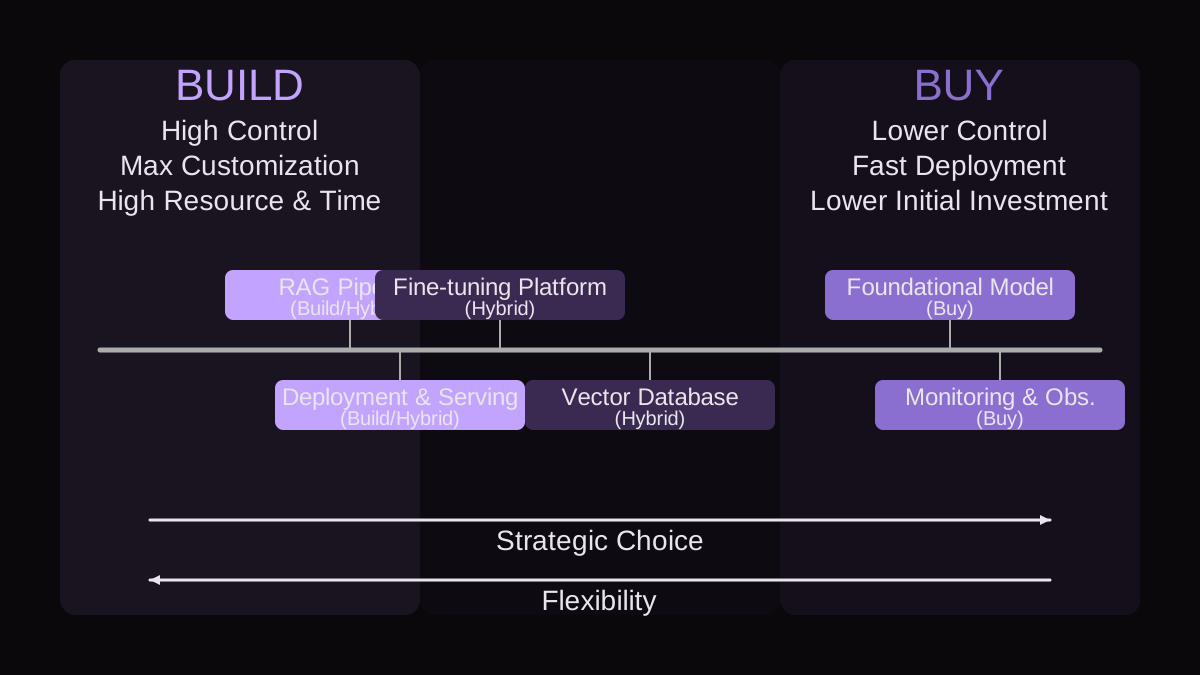
As an AI Product Manager, one of the most significant strategic decisions I face with Large Language Models isn't about which model to use, but how to build the underlying infrastructure to support it. The build vs. buy dilemma for LLM infrastructure is rarely a binary choice; it's a spectrum dictated by your company's strategic priorities, existing technical capabilities, speed-to-market needs, and long-term vision for differentiation. My experience across streaming, fintech, and healthcare has shown me that the right answer hinges on a deep understanding of where your unique value lies and where leveraging existing solutions accelerates your path to impact without compromising core IP.
The goal isn't just to get an LLM working, but to deploy it reliably, securely, scalably, and cost-effectively, while maintaining agility for future innovations. This guide provides a decision framework to help you, as a product leader, navigate these complex trade-offs and make confident choices that align with your product and business goals.
Why is the Build vs. Buy Decision So Complex for LLMs?
Compared to traditional software components, LLM infrastructure introduces unique complexities that amplify the build vs. buy challenge. We're not just deploying an API; we're dealing with massive models, vast datasets, and rapidly evolving tooling. This makes the cost, operational overhead, and strategic implications much higher.
- Rapidly Evolving Landscape: The pace of innovation in LLMs, foundational models, and supporting tooling (vector databases, orchestration frameworks, fine-tuning platforms) is unprecedented. What's cutting-edge today might be commodity tomorrow, making long-term planning difficult.
- High Operational Overhead: Running LLMs demands significant GPU resources, specialized MLOps expertise, and robust monitoring. Building this in-house requires deep capabilities in distributed systems, model serving, and cost optimization.
- Data Gravity and Security: LLMs are data-hungry. Managing the ingestion, processing, security, and governance of proprietary data for fine-tuning or RAG (Retrieval Augmented Generation) pipelines is a critical, often underestimated, undertaking.
- Talent Scarcity: Expertise in LLM engineering, MLOps, and prompt engineering is in high demand and short supply. Attracting and retaining this talent is a challenge for many organizations, making a 'build' strategy difficult to execute.
- Cost Volatility: The cost of inference, fine-tuning, and data storage can fluctuate significantly with usage and model advancements. Forecasting these costs for a build scenario is complex, and unexpected scale can quickly become prohibitive.
The LLM Infrastructure Decision Rubric: My 6-Point Framework
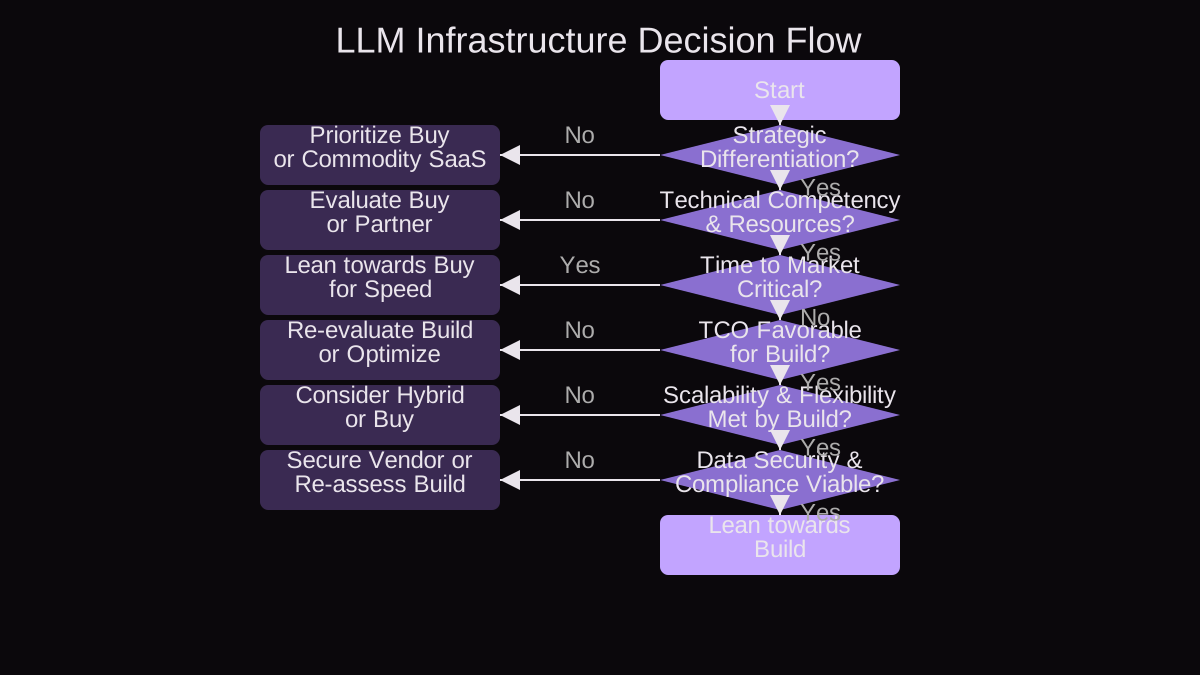
To cut through the complexity, I use a structured framework I call The LLM Infrastructure Decision Rubric. This rubric helps evaluate each component of your LLM stack against core strategic and operational criteria. Apply these criteria to each significant piece of infrastructure, from your foundational model choice to your data orchestration and serving layers.
- 1. Strategic Differentiation: Does building this component directly contribute to your core product's unique value proposition or competitive advantage? If it's a commodity component that doesn't differentiate you, buying is often the better default.
- 2. Technical Competency & Resources: Do you have the in-house expertise (MLOps, distributed systems, data engineering) and the available engineering resources to build and maintain this component effectively? Be realistic about your team's current bandwidth and future hiring plans. Underestimating this is a common failure point.
- 3. Time to Market & Iteration Speed: How critical is it to get this functionality deployed quickly? Does building it in-house introduce unacceptable delays to your product roadmap? Buying often offers faster initial deployment, but assess if it hinders future iteration.
- 4. Total Cost of Ownership (TCO): Beyond initial development, what are the ongoing costs of maintenance, scaling, security updates, and future upgrades for building? Compare this comprehensively against licensing fees, usage costs, and support for buying. Remember to factor in opportunity cost of engineering time.
- 5. Scalability & Flexibility: Can the chosen solution (build or buy) scale to meet your projected growth needs without prohibitive cost or architectural re-work? How flexible is it to integrate with your existing systems and adapt to future technological shifts or model advancements?
- 6. Data Security & Compliance: Does the component handle sensitive data? What are the regulatory and compliance requirements (e.g., HIPAA, GDPR, SOC2)? Building allows maximum control, but buying from a compliant vendor can offload significant burden, provided their controls meet your standards.
How Do I Apply This Framework in a Real-World Scenario? (Worked Example)
Let's walk through a common scenario: a healthcare startup, 'MediAI,' building an AI assistant for clinicians to summarize patient notes and answer medical queries based on their EMR data. This is a highly sensitive and high-stakes application. We'll apply the rubric to a few key infrastructure components.
Scenario context: MediAI has a small, but experienced, ML engineering team. Their primary competitive advantage is the accuracy and trustworthiness of their clinical insights, derived from proprietary data and domain-specific fine-tuning, and seamless integration into existing EMR workflows.
Component 1: Foundational LLM
- 1. Strategic Differentiation: Low. While the choice of model impacts performance, the model itself is a commodity. MediAI's differentiation comes from its fine-tuning and application logic, not from building the base model.
- 2. Technical Competency: Extremely high for building a foundational model from scratch; low for integrating an existing API. MediAI does not have the billions of dollars or research labs needed to build a frontier LLM.
- 3. Time to Market: Very slow for building, very fast for buying (API access). MediAI needs to launch quickly to secure early clinician adoption.
- 4. TCO: Prohibitively expensive to build, manageable usage-based cost for buying.
- 5. Scalability & Flexibility: Buying offers immediate scalability from leading providers. Building would require immense infrastructure.
- 6. Data Security & Compliance: Key concern. Buying requires careful selection of a provider with robust data privacy guarantees (e.g., no data used for training, HIPAA compliance, private endpoint options).
- Decision: BUY. MediAI chooses a leading commercial LLM provider with strong HIPAA-compliant data practices and private deployment options.
Component 2: Fine-tuning Platform for Domain Adaptation
- 1. Strategic Differentiation: High. MediAI's unique value is in highly accurate, medically-tuned responses. The ability to fine-tune effectively on proprietary EMR data is central to this. Owning this process offers a competitive edge.
- 2. Technical Competency: Moderate. MediAI has ML engineers who understand fine-tuning concepts, but building an entire platform (data orchestration, GPU management, experiment tracking) is a big lift.
- 3. Time to Market: Moderate. Building a full platform takes time, but using a commercial platform offers faster setup. However, the nuances of medical data might make off-the-shelf solutions less effective than a tailored internal approach.
- 4. TCO: Building is expensive initially due to infra setup and MLOps engineering. Buying involves recurring platform fees, which can escalate with usage. A hybrid approach might be optimal.
- 5. Scalability & Flexibility: Building offers maximum flexibility for custom data formats and experimental fine-tuning methods. Buying ties you to vendor capabilities.
- 6. Data Security & Compliance: Extremely high. Fine-tuning involves patient data. Building provides maximum control over the data environment. Buying requires extreme diligence on vendor security and data isolation.
- Decision: HYBRID/BUILD. MediAI decides to build a custom data preparation and fine-tuning orchestration layer that runs on a private cloud instance, leveraging specialized open-source tools for experiment tracking. They avoid generic managed fine-tuning services where their data might reside in shared infrastructure. This gives them control over their IP and sensitive data, while still using some pre-built tools.
Component 3: Retrieval Augmented Generation (RAG) Pipeline and Vector Database
- 1. Strategic Differentiation: High. The quality of retrieved information from EMRs directly impacts the assistant's accuracy and trustworthiness. Optimizing retrieval is key to MediAI's value proposition.
- 2. Technical Competency: Moderate to High. Building a robust RAG pipeline (embedding generation, indexing, retrieval logic, re-ranking) and managing a vector database requires specialized skills. Many PMs underestimate the complexity here.
- 3. Time to Market: Building a production-ready RAG system can be slow. Buying a managed vector database and leveraging open-source RAG frameworks can accelerate this.
- 4. TCO: Managed vector databases have clear pricing. Building involves significant engineering effort and ongoing maintenance for the database and the custom retrieval logic.
- 5. Scalability & Flexibility: Managed vector databases offer scalability, but custom RAG logic gives more flexibility for tailoring retrieval to specific medical query patterns.
- 6. Data Security & Compliance: High. EMR data is stored and retrieved. Need secure storage for embeddings and robust access controls.
- Decision: HYBRID. MediAI opts to buy a managed, HIPAA-compliant vector database service that offers private endpoint access. However, they build their custom RAG orchestration layer and retrieval algorithms in-house. This allows them to iterate on their core differentiating retrieval logic while offloading the database operational burden to a specialized vendor.
What Are the Common Mistakes PMs Make in LLM Build vs. Buy?
Even with a framework, pitfalls abound. I've seen these mistakes derail projects, leading to cost overruns, missed deadlines, and compromised product quality. Understanding these failure modes is key to avoiding them.
- Underestimating Operational Overhead: Failure Mode: Teams build a component, but then struggle with ongoing maintenance, security patches, scaling, and debugging. How to Detect/Avoid: Conduct a thorough TCO analysis that includes post-launch operational costs, not just initial development. Engage MLOps and infrastructure teams early in the planning process to get realistic estimates for ongoing support.
- Ignoring Vendor Lock-in (and its costs): Failure Mode: Opting for a convenient 'buy' solution without considering the difficulty and cost of switching vendors later. How to Detect/Avoid: Evaluate exit strategies and data portability. Prioritize solutions built on open standards or those that offer clear data export capabilities. Understand the cost implications of migration if a vendor's pricing or features change unfavorably.
- Over-indexing on Short-Term Cost Savings: Failure Mode: Choosing the cheapest immediate option (either build or buy) without considering long-term scalability, maintenance, or strategic value. How to Detect/Avoid: Always perform a full TCO analysis over a 3-5 year horizon. Factor in the opportunity cost of engineering time spent on non-differentiating features.
- Neglecting Data Governance & Compliance: Failure Mode: Rushing to use an LLM solution without fully understanding how it handles sensitive data, leading to compliance breaches or reputational damage. How to Detect/Avoid: Involve legal and compliance teams from day one. Thoroughly vet vendor data policies, encryption methods, and regional data residency. For build scenarios, establish robust internal data governance policies.
- Chasing Hype Over Value: Failure Mode: Building or buying the latest, flashiest LLM tool because it's new, rather than because it genuinely solves a user problem or aligns with strategic goals. How to Detect/Avoid: Ground all decisions in user needs and business value. Ask: 'What problem does this solve for our users?' and 'How does this directly contribute to our strategic objectives?' If the answer is vague, reconsider.
How Do I Future-Proof My LLM Infrastructure Decisions?
The LLM landscape won't stop evolving. Your decisions today need to provide flexibility for tomorrow. Future-proofing your LLM infrastructure isn't about predicting the future, but about building an adaptable architecture that minimizes friction when new models, techniques, or business needs emerge.
- Prioritize Modularity and Abstraction: Decouple components wherever possible. Use APIs and clear interfaces. This allows you to swap out a vector database, a fine-tuning platform, or even a foundational model with less architectural rework.
- Embrace Open Standards and Open Source Where Appropriate: Relying on open standards (e.g., ONNX for model inference) and well-supported open-source projects can reduce vendor lock-in and provide a community safety net. Contribute back to these communities if you can.
- Design for Experimentation: Build the infrastructure to support rapid experimentation with different models, prompting strategies, and fine-tuning approaches. This means robust MLOps tooling, A/B testing capabilities, and clear metrics tracking.
- Invest in Data Pipelines: Regardless of build or buy, your ability to clean, process, and manage data for LLMs will be a constant differentiator. A robust data infrastructure is the foundation of any successful AI product.
- Continuous Evaluation: The decision isn't set in stone. Regularly re-evaluate your build vs. buy choices as the market evolves, your team's capabilities grow, and your product strategy shifts. What was a 'buy' decision today might become a 'build' opportunity tomorrow, and vice-versa.
Key Takeaways
- The build vs. buy decision for LLM infrastructure is a strategic spectrum, not a binary choice, heavily influenced by your product's unique value proposition.
- Use The LLM Infrastructure Decision Rubric to systematically evaluate components based on Strategic Differentiation, Technical Competency, Time to Market, TCO, Scalability/Flexibility, and Data Security/Compliance.
- Apply the rubric to individual components of your stack (e.g., foundational models, fine-tuning platforms, RAG pipelines) as the optimal decision can vary for each.
- Avoid common pitfalls like underestimating operational overhead, ignoring vendor lock-in, short-sighted cost analysis, neglecting data governance, and chasing hype.
- Future-proof your decisions by prioritizing modularity, open standards, robust data pipelines, and continuous re-evaluation of your choices.