AI Product
Iterating on AI Products: Beyond A/B Tests with Observability & Feedback Loops
Iterating on AI products effectively requires moving beyond the traditional A/B testing paradigm common in classic software development. While A/B tests offer valuable insights for static features, the dynamic, probabilistic, and data-dependent nature of AI models means their real-world performance is often too complex for simple hypothesis testing. Instead, AI product managers must build sophisticated observability frameworks and robust, multi-directional feedback loops that provide continuous insights into model behavior, data drift, and nuanced user interactions, enabling proactive adjustments and sustained value delivery.
My 10+ years in product management across streaming, fintech, and healthcare, with a recent focus on AI, have repeatedly shown that success hinges not just on the initial model launch, but on the ongoing, intelligent iteration cycle. This isn't about discarding A/B tests entirely, but rather understanding their limitations in the AI context and augmenting them with deeper, more continuous methods.
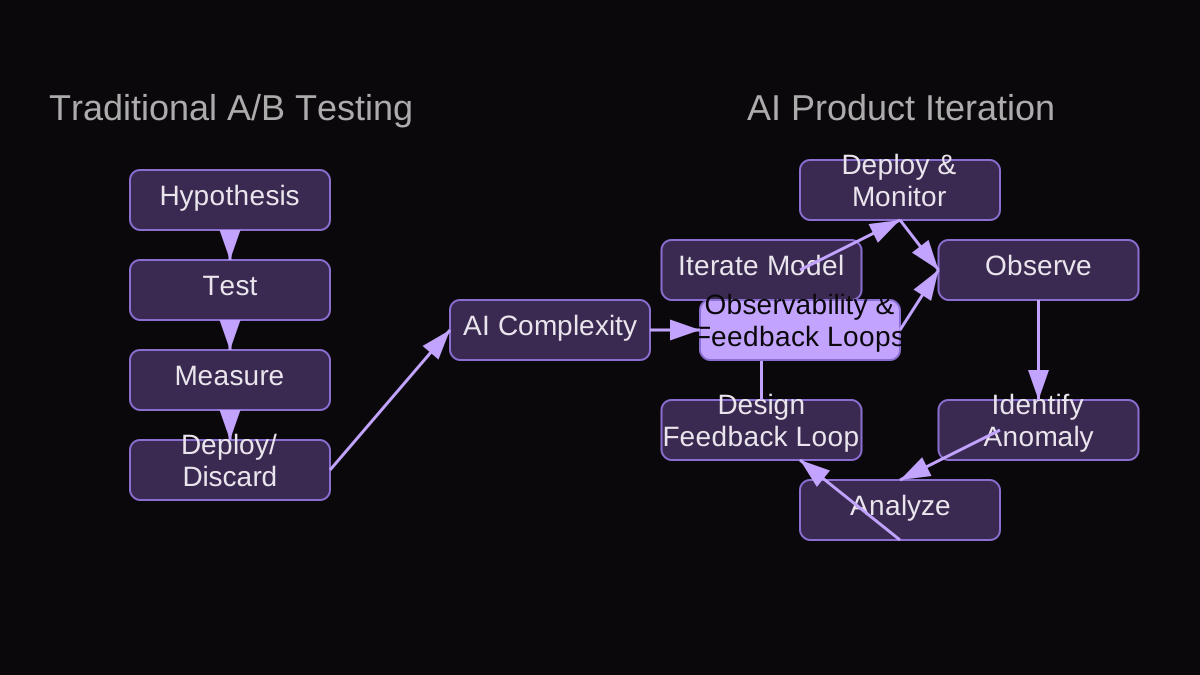
Why traditional A/B tests often fall short for AI products?
A/B tests are excellent for comparing two discrete, pre-defined experiences or features, holding all other variables constant to measure impact on a specific metric. This works well for button colors, headline variations, or checkout flow changes. However, AI products introduce several complexities that undermine the reliability and actionability of classic A/B testing:
- Dynamic Model Behavior: AI models are probabilistic and adaptive. Their outputs can change based on new data, retraining, or even internal state, making it difficult to isolate the 'treatment' in an A/B test. The 'control' might not be truly static if it's an AI model itself.
- Long-Term vs. Short-Term Effects: Some AI changes, especially those impacting user trust or habit formation, may not show immediate impact in a short A/B test. The full effect might manifest weeks or months later.
- Interaction Effects: AI models often interact with multiple parts of a product or ecosystem. A change in one AI component might have ripple effects that are hard to attribute solely to the A/B test variant.
- Cold Start Problem: For personalization or recommendation engines, new users or items lack sufficient data to provide meaningful results in an A/B test, leading to skewed outcomes or long ramp-up times.
- Defining the 'Win' Metric: AI's impact can be multifaceted (e.g., accuracy, diversity, fairness, latency, cost). A single A/B test metric might optimize one aspect at the expense of others, especially when complex trade-offs are involved.
- Ethical and Fairness Implications: A/B testing might inadvertently expose a subset of users to a biased or unfair model variant for the duration of the test, raising ethical concerns that go beyond typical feature testing.
Given these challenges, relying solely on A/B tests for AI product iteration is like trying to navigate a complex, dynamic landscape with only a static map. We need real-time sensors and continuous updates.
What is AI Observability and why does it matter?
AI observability is the practice of understanding the internal state and behavior of an AI system from its external outputs. It goes beyond basic monitoring (which tells you if something is working or broken) to tell you why and how it's working (or failing). For AI PMs, observability is our window into the black box, allowing us to proactively detect issues, understand model performance shifts, and identify new opportunities for improvement without waiting for a user to report a bug or an A/B test to conclude.
Why does it matter so much? Because AI models are not deterministic. They are statistical. They learn and adapt, and their performance is intrinsically tied to the data they encounter in the real world. Without deep observability, an AI model can silently degrade, drift, or exhibit biases, leading to poor user experiences, lost revenue, or even ethical breaches. It's the foundation for informed, data-driven iteration.
- Model Performance Metrics: Tracking accuracy, precision, recall, F1-score, AUC, latency, and throughput in real-time, broken down by segments (user type, device, geography).
- Data Drift & Skew Detection: Monitoring input data distributions for changes over time (drift) or discrepancies between training and serving data (skew) that can degrade model performance.
- Feature Importance & Attribution: Understanding which features are most influential in model predictions and how those influences change over time or across different inputs.
- Model Explainability (XAI): Providing insights into why a model made a specific prediction, especially for critical decisions, to build trust and aid debugging.
- User Interaction & Outcome Logging: Capturing how users interact with AI-generated outputs (clicks, dismissals, edits, feedback) and the ultimate business outcomes (conversions, retention, task completion).
- Error Analysis & Failure Modes: Logging specific instances where the model performed poorly, categorizing error types, and identifying patterns in these failures.
How do you build effective feedback loops? Introducing Nehal's Iteration Rubric
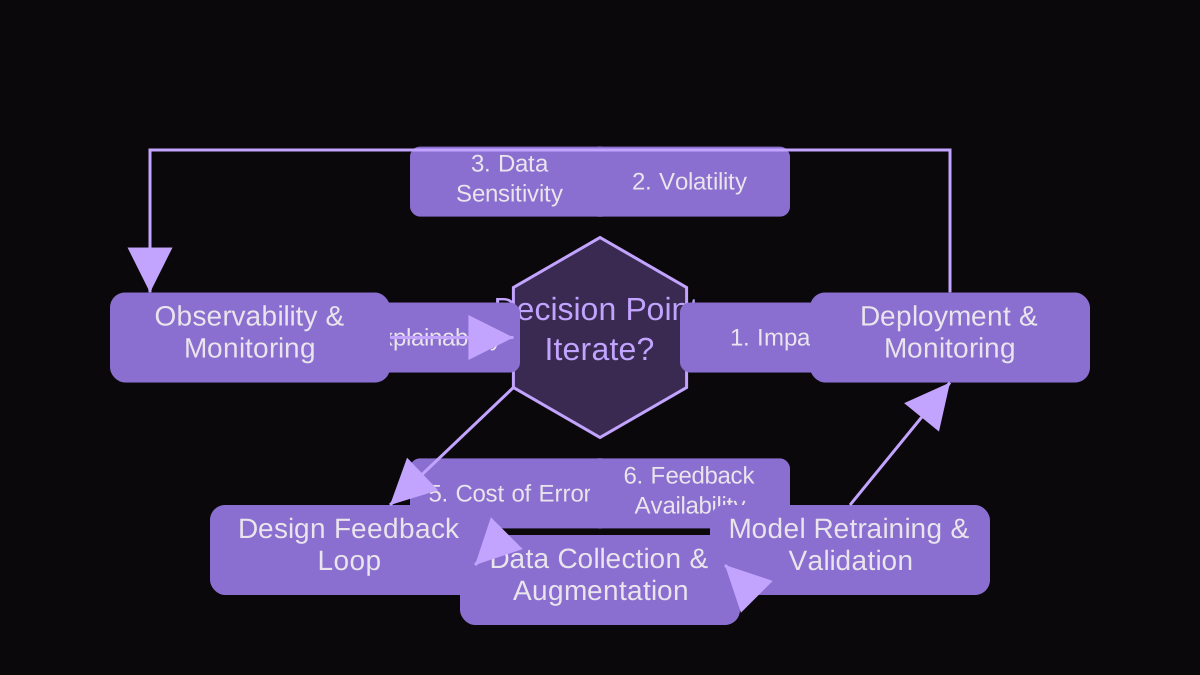
Observability provides the 'what' and 'why,' but effective iteration demands a structured 'how.' Feedback loops are the mechanisms that translate insights from observability into actionable improvements for the AI product. They bridge the gap between detection and correction. To systematize this, I use a framework I call "Nehal's AI Iteration Rubric" to guide decisions on how and when to iterate.
- 1. Impact Severity (Business & User): Assess the potential negative impact of the current model behavior or the positive impact of a potential iteration. Is it causing significant user frustration, revenue loss, or compliance risk? High impact demands faster, more robust feedback loops.
- 2. Model Volatility & Confidence: How often does the model's performance fluctuate, and how confident are we in its predictions in this specific context? High volatility or low confidence areas need closer monitoring and more aggressive feedback integration.
- 3. Data Freshness & Drift Sensitivity: How quickly does the underlying data change, and how sensitive is the model to these changes? Products dependent on rapidly evolving data (e.g., trending news, stock prices) require continuous retraining loops.
- 4. Explainability & Debuggability: How easy is it to understand why the model made a particular decision, and how straightforward is it to identify the root cause of an error? High explainability allows for quicker, more targeted iterations, while low explainability may require more complex human-in-the-loop validation.
- 5. Cost of Error & Ethical Implications: What are the consequences of a model mistake? In healthcare or finance, an error can be catastrophic. These scenarios demand extremely rigorous, often human-validated, feedback loops to prevent harm. Low-stakes errors might tolerate automated, faster iterations.
- 6. Feedback Loop Type Availability: What types of feedback can we actually collect? Implicit (clicks, time on page), explicit (thumbs up/down, surveys), human-in-the-loop (expert review), or synthetic (simulations)? The available mechanisms dictate the iteration strategy.
Using this rubric, PMs can prioritize which parts of the AI system need immediate attention, what kind of feedback to prioritize, and what the cadence of iteration should be. It helps move beyond reactive fixes to a proactive, strategic approach.
A Worked Example: Iterating on a Healthcare AI Assistant
Let's walk through a realistic scenario. Imagine I'm the PM for an AI-powered healthcare assistant that summarizes patient medical records for doctors, highlighting key diagnoses and treatment plans. This system is live and used daily.
Step 1: Observability Detects an Anomaly. Our observability dashboard, which tracks model performance (summarization accuracy, hallucination rate) and data drift, flags a sudden increase in 'hallucination' scores for patient records containing specific types of complex genetic test results. Simultaneously, user feedback (explicit 'thumbs down' on summaries and free-text comments) starts to mention inconsistencies in these specific cases. The model is confidently generating plausible-sounding but incorrect information.
Step 2: Applying Nehal's AI Iteration Rubric. I apply the rubric to this anomaly:
- Impact Severity: Very High. Incorrect medical summaries can lead to misdiagnosis or inappropriate treatment, directly impacting patient safety and doctor trust.
- Model Volatility: High in this specific segment. The model is confidently hallucinating, indicating a significant breakdown.
- Data Freshness & Drift: Moderate. While genetic tests don't change daily, new testing methodologies and result formats emerge, suggesting potential data drift in the training data versus serving data for these specific inputs.
- Explainability & Debuggability: Moderate. We can see the generated output and compare it to the source, but understanding why the model chose to hallucinate specific details is harder without deeper XAI tools.
- Cost of Error & Ethical Implications: Extremely High. Direct patient harm is a clear ethical red line. This requires immediate action.
- Feedback Loop Type: We have implicit (doctor edits to summary) and explicit (thumbs down, comments). We need to augment this with human-in-the-loop expert review for critical cases.
Step 3: Designing and Implementing the Targeted Feedback Loop. Based on the rubric, a multi-pronged approach is needed:
- Immediate Action: Temporarily disable the AI summarization for records identified as containing complex genetic test results, reverting to a human-curated or simpler rule-based summary, to prevent further harm. This is a crucial safety measure.
- Enhanced Human-in-the-Loop (HITL): Route all summaries containing genetic test information to a panel of medical experts for review and correction before they reach the doctor. This provides high-quality ground truth data.
- Root Cause Analysis: Leverage XAI tools to understand why the model is hallucinating for these specific inputs. Is it an encoding issue? A lack of similar examples in training data? A misinterpretation of medical terminology?
- Data Collection & Augmentation: Actively collect more diverse and representative training data specifically for complex genetic test results. This might involve manual annotation or synthetic data generation.
- Model Retraining & Validation: Retrain the model with the augmented data. Implement rigorous offline validation metrics focused on hallucination detection and factual accuracy for genetic test summaries.
Step 4: Iteration and Re-deployment. After retraining and validating the model offline with the new data and HITL corrections, we re-deploy the updated model. Crucially, the observability metrics for genetic test summaries are now under heightened scrutiny. The HITL review continues, but its volume should decrease as the model improves. The feedback loop is closed, and the iteration cycle begins anew, continuously monitoring and refining.
Common Mistakes When Iterating on AI Products
Even with robust observability and feedback loops, pitfalls abound. Here are some common mistakes I've seen, along with how to detect and avoid them:
- Mistake: Over-reliance on offline metrics. Focusing solely on performance metrics from your test dataset (e.g., AUC on a held-out set) and assuming it translates perfectly to production. Detection: Discrepancy between offline and online performance metrics, user complaints despite 'good' offline scores. Avoidance: Always prioritize online, real-world metrics, and design your offline evaluation to closely mirror production data distributions and use cases. Establish robust online observability from day one.
- Mistake: Ignoring implicit user feedback. Only looking at explicit 'thumbs up/down' or survey responses, missing rich signals from user behavior. Detection: Low explicit feedback rates, but changes in user behavior (e.g., increased abandonment, reduced engagement) around AI-powered features. Avoidance: Instrument your product to capture implicit signals like clicks, scrolls, time spent, edits, and re-queries. Correlate these with AI outputs to infer satisfaction.
- Mistake: Lack of data versioning and lineage. Not tracking which model version was trained on which specific dataset, making debugging and reproduction impossible. Detection: Inability to reproduce past model behavior, difficulty in understanding why a change improved or degraded performance, 'it works on my machine' syndrome. Avoidance: Implement strict data versioning for training, validation, and test datasets, and link them directly to model versions. Use MLOps tools that enforce this discipline.
- Mistake: Building a 'fire-and-forget' AI. Deploying a model and assuming it will perform consistently without ongoing maintenance. Detection: Gradual degradation of model performance over time (data drift, concept drift), increasing customer support tickets related to AI features, silent failures. Avoidance: Design continuous monitoring and automated retraining pipelines. Establish thresholds for performance degradation that trigger alerts and reviews.
- Mistake: Not closing the feedback loop. Collecting feedback but failing to integrate it back into the model improvement cycle. Detection: Repeated issues, user complaints about the same problems over time, a growing backlog of unaddressed model 'bugs'. Avoidance: Assign ownership for feedback analysis and ensure clear processes for how feedback informs model retraining, data augmentation, or feature engineering. Dedicate resources to acting on insights.
- Mistake: Over-engineering the feedback system too early. Building overly complex feedback UIs or data pipelines before understanding the core problems. Detection: Low adoption of complex feedback mechanisms, high cost for little actionable insight. Avoidance: Start simple. Implement basic implicit and explicit feedback first, then iterate on the feedback mechanisms themselves based on what's most useful and used. Focus on high-signal, low-effort feedback.
Key Takeaways
- Traditional A/B tests are insufficient for iterating on complex AI products due to their dynamic nature, long-term effects, and interaction complexities.
- AI observability is critical; it's the continuous monitoring of model performance, data drift, user interaction, and explainability that reveals the 'why' behind AI behavior.
- Effective iteration requires robust feedback loops that translate observability insights into actionable model improvements.
- Utilize a structured framework like Nehal's AI Iteration Rubric to systematically evaluate issues and prioritize iteration strategies based on impact, volatility, data sensitivity, explainability, cost of error, and available feedback types.
- Always prioritize real-world, online metrics over solely offline evaluation to ensure the model delivers value in production.
- Actively collect and integrate both implicit and explicit user feedback, ensuring it directly informs model retraining and data augmentation efforts.
- Avoid common pitfalls like ignoring data versioning, neglecting continuous monitoring, or failing to close the feedback loop, which can lead to silent degradation and user dissatisfaction.