undefined
Identifying High-Impact AI Product Opportunities for Real ROI
AI product success hinges on rigorously validating opportunities, not just technical feasibility, but real business value and user adoption. My approach focuses on a structured process that combines problem identification, data availability, model viability, and clear ROI projection, ensuring we build AI products that truly move the needle rather than becoming expensive science projects. This systematic validation is what separates impactful AI Product Managers from those chasing the latest buzzwords, enabling us to deliver solutions that genuinely solve critical business problems and drive measurable returns.
Over my seventeen years in IT and ten years in product management across diverse sectors like streaming, fintech, and healthcare, I have seen countless AI initiatives stumble. The common thread is often a failure in the initial validation phase. It is easy to be captivated by the potential of AI, but the real work lies in grounding that potential in practical reality, identifying genuine needs, and verifying that AI is not just a possible solution, but the optimal one. This guide will walk you through my methodology for achieving that clarity and confidence.
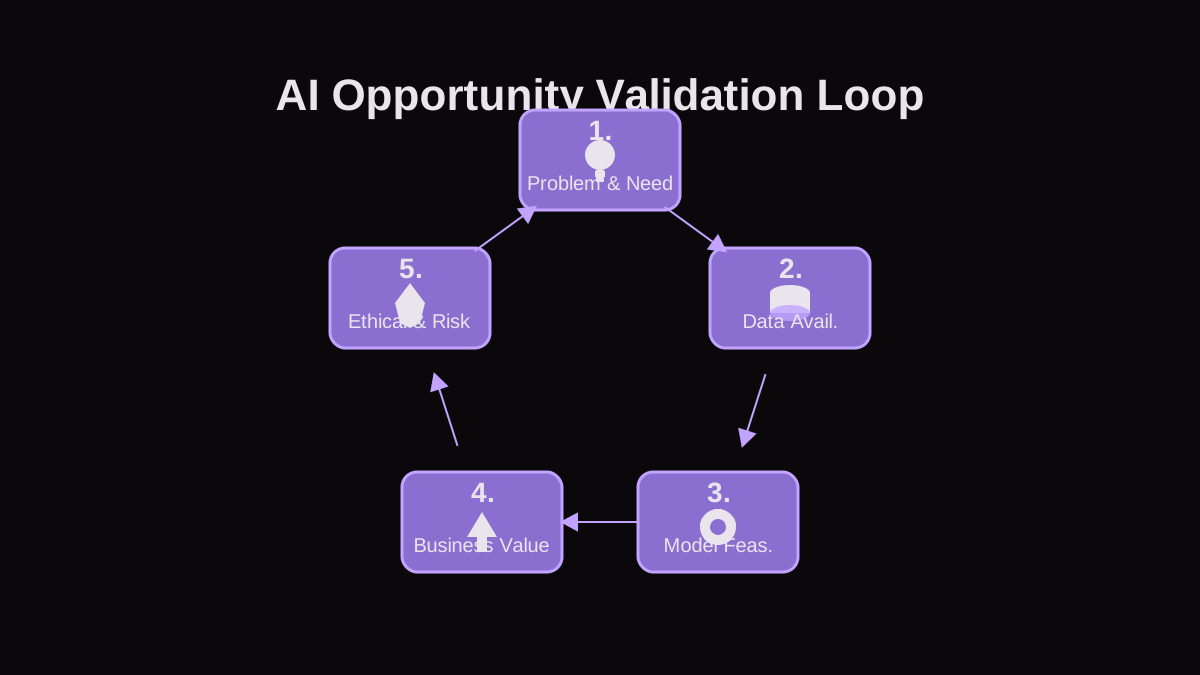
Why Do So Many AI Products Fail to Deliver Value?
Many AI products never reach their full potential, or worse, become costly failures, because they are often born from a fascination with the technology itself rather than a deep understanding of a pressing problem. This is a critical distinction. As product managers, our primary role is to solve problems, not just deploy technology. When we start with the solution—"let's use machine learning for X"—instead of the problem—"Y is a major pain point, what's the best way to address it?"—we set ourselves up for failure.
Another common pitfall is underestimating the complexity of data. AI models are only as good as the data they are trained on. Issues like data scarcity, poor quality, bias, or lack of accessibility can cripple even the most brilliant algorithm. Without a clear path from raw data to a production-ready feature, an AI concept remains just that—a concept. Furthermore, a lack of clearly defined success metrics and a tangible path to Return on Investment (ROI) mean that even if a product technically works, its business value remains unproven, making it difficult to justify continued investment or scaling. Without understanding the 'why' and 'for whom,' the 'what' becomes irrelevant.
The AI Opportunity Scorecard: A Decision Rubric for PMs
To cut through the hype and focus on actionable, high-impact opportunities, I rely on a structured decision rubric I call the AI Opportunity Scorecard. This framework helps objectively evaluate potential AI product ideas across critical dimensions, providing a quantitative basis for prioritization and investment decisions. Each criterion is scored (e.g., 1-5, low to high) to generate an overall viability score, helping to compare disparate ideas on a level playing field. Here are the six core criteria:
- 1. Problem Urgency & Impact: How critical is the problem we are trying to solve? Does it affect a significant user base or have a substantial business impact? A high score here indicates that solving this problem would genuinely move the needle for users or the business. If the problem is minor or a 'nice-to-have', even brilliant AI won't make it a breakthrough product.
- 2. Data Availability & Quality: Do we have access to the necessary data to train and validate an AI model? Is the data clean, relevant, sufficiently large, and free from significant bias? A high score means the data landscape is favorable. Without sufficient, high-quality, and ethically sourced data, any AI initiative is dead on arrival, regardless of the problem's urgency.
- 3. Technical Feasibility & Model Viability: Is the problem solvable with current AI capabilities and our team's expertise? Are there established models or techniques that apply, or would this require significant R&D? A high score implies a clear path to a working model with reasonable confidence in performance. Pursuing problems that are at the bleeding edge of AI research might be exciting, but for product delivery, proven feasibility is key.
- 4. Business Value & ROI Potential: What is the measurable financial or strategic return if this AI product succeeds? Can we quantify cost savings, revenue generation, efficiency gains, or competitive advantage? A high score means a clear, significant, and measurable ROI. If you cannot articulate the business value in tangible terms, it is an expensive science project, not a product.
- 5. User Adoption & Integration: How easily can target users adopt this solution into their existing workflows? How seamlessly does it integrate with current systems and processes? A high score indicates minimal friction for users and high compatibility with the tech stack. A technically brilliant solution that users struggle to adopt or that requires massive system overhaul will fail.
- 6. Ethical Implications & Risk: What are the potential biases, fairness concerns, privacy risks, or unintended societal consequences of this AI system? How manageable are these risks, and do we have a clear strategy for responsible AI development? A high score means low, manageable risks with clear mitigation strategies. Ignoring ethical considerations not only poses reputational risks but can lead to legal issues and user distrust.
Worked Example: Applying the Scorecard to a Healthcare Scenario
Let us walk through a realistic scenario to see the AI Opportunity Scorecard in action. Imagine a large hospital system is struggling with high patient no-show rates for outpatient appointments. These no-shows lead to significant financial losses due to wasted staff time and unutilized resources, and they also impact other patients' access to care. The executive team has heard about predictive AI and wants to explore a solution.
As the AI Product Manager, I would apply the scorecard:
- 1. Problem Urgency & Impact: High. No-shows cost the hospital millions annually, reduce operational efficiency, and limit access for other patients. This is a critical pain point with clear financial and patient care implications.
- 2. Data Availability & Quality: High. The hospital has extensive Electronic Health Records (EHRs) that contain appointment history (show/no-show), patient demographics, visit frequency, past communication preferences, and more. This data is likely well-structured. We would need to conduct a thorough data audit to confirm quality, identify missing values, and assess consistency, but the raw material is abundant. Crucially, we must address ethical considerations around using sensitive health data for prediction and ensure anonymization or strict access controls.
- 3. Technical Feasibility & Model Viability: High. Predicting no-shows is a classic classification problem, a mature area in machine learning. Techniques like Logistic Regression, Gradient Boosting Machines, or neural networks could be applied. The challenge would be achieving high predictive accuracy while maintaining explainability for clinicians and managing the dynamic nature of patient behavior. A proof-of-concept could be developed relatively quickly.
- 4. Business Value & ROI Potential: High. A successful AI model that reduces no-shows by even a small percentage (e.g., 5-10%) would result in direct cost savings (more filled slots, less wasted staff time) and potential revenue gains. This could also enable more effective overbooking strategies or targeted reminder campaigns, all quantifiable metrics. The path to ROI is direct and measurable.
- 5. User Adoption & Integration: Moderate. The solution would need to integrate seamlessly with the existing hospital scheduling system and patient communication platforms. Clinicians and administrative staff would need to trust the predictions and adapt their workflows (e.g., targeting high-risk patients for extra reminders). This requires significant change management and user-centered design to ensure the tool is perceived as helpful, not a burden. We would need to build features that make the AI's insights actionable within their current tools.
- 6. Ethical Implications & Risk: Moderate. This is a critical area. Potential risks include bias in predictions (e.g., if the model disproportionately flags certain demographic groups as high no-show risks, leading to differential treatment), privacy concerns with health data, and the risk of reinforcing existing inequities. A robust framework for fairness, accountability, transparency, and data governance would be essential from day one. We would need to involve ethicists and patient advocates in the design and validation process.
Overall, this is a very promising opportunity. The problem is urgent, data is available, the technology is feasible, and the ROI is clear. The primary areas to focus on during development would be user integration and, critically, ensuring ethical deployment and fairness, particularly regarding bias in the model and data privacy. By using the scorecard, we have a clear map of both the strengths and the challenges, allowing for targeted mitigation strategies.
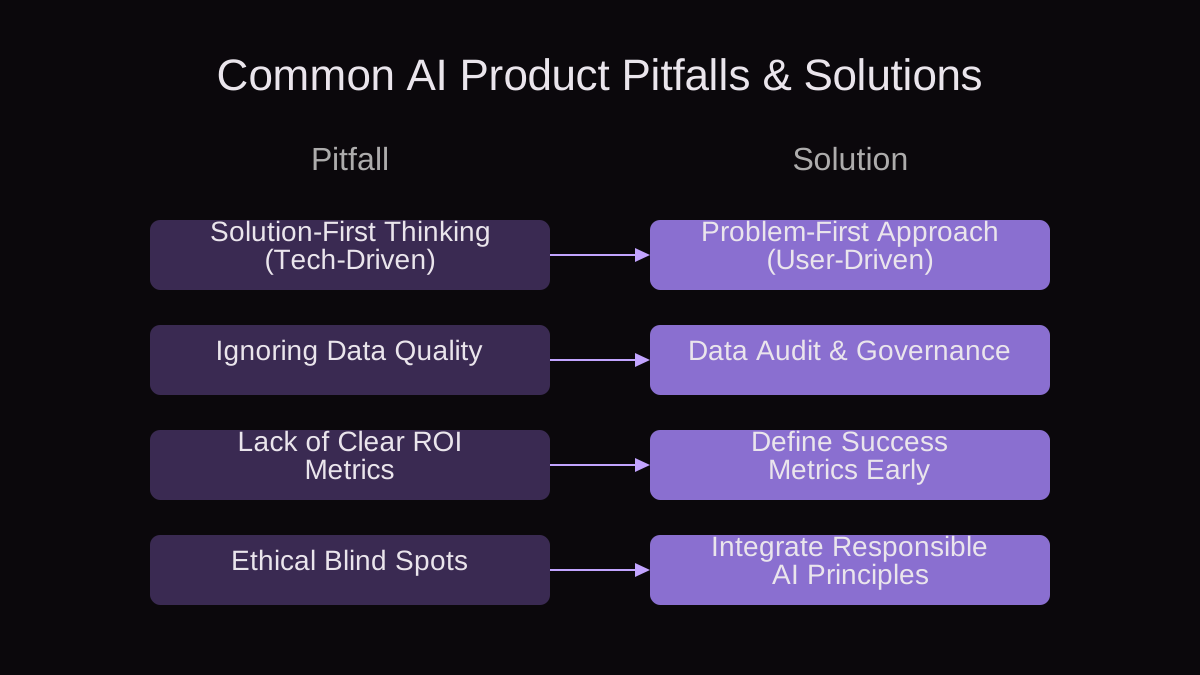
Common Mistakes When Validating AI Opportunities and How to Avoid Them
Even with a structured framework, it is easy to fall into common traps. Recognizing these failure modes early can save immense time and resources.
- 1. The 'Hammer Looking for a Nail' Syndrome (Solution-First Thinking): Failure Mode: Starting with an exciting AI technology (e.g., LLMs, computer vision) and then trying to find a problem it can solve. This often leads to solutions for non-existent or low-priority problems, resulting in a product nobody needs or wants. How to Detect/Avoid: Always start with a validated problem. Conduct thorough user research, stakeholder interviews, and market analysis to identify pain points before even thinking about AI. The problem should dictate the technology, not the other way around. Ask: "What problem are we solving, and for whom?" before "How can we use this AI tech?"
- 2. Underestimating Data Complexity and Quality: Failure Mode: Assuming available data is sufficient and clean without rigorous assessment. This leads to models that perform poorly in production, require constant manual intervention, or deliver biased results. How to Detect/Avoid: Treat data as a first-class citizen in your validation process. Conduct comprehensive data audits early on, involving data scientists and engineers. Understand data lineage, cleanliness, potential biases, and ethical implications. Plan for data governance, continuous monitoring, and pipeline robustness from the outset. Do not just ask if data exists; ask if it is good enough.
- 3. Fuzzy or Non-Existent ROI Metrics: Failure Mode: Launching an AI product without clear, quantifiable metrics for success and a defined path to business value. This makes it impossible to demonstrate impact, justify investment, or iterate effectively. How to Detect/Avoid: Before a single line of code is written, define what success looks like in measurable terms. How will this AI product save money, generate revenue, or improve efficiency? Establish baseline metrics and target improvements. Ensure these metrics are tied directly to business outcomes, not just model performance. If you cannot define the ROI, you do not have a product.
- 4. Ignoring Ethical, Fairness, and Bias Considerations: Failure Mode: Overlooking the potential for AI systems to perpetuate or amplify biases, infringe on privacy, or have unintended negative societal consequences until late in the development cycle, leading to costly redesigns or public backlash. How to Detect/Avoid: Integrate Responsible AI principles from day one. Conduct ethical impact assessments as part of the validation process. Proactively identify potential biases in data and algorithms, establish fairness metrics, and design for transparency and explainability. Involve diverse perspectives, including legal, ethical, and user advocacy groups, in your planning. This is not just about compliance; it is about building trustworthy products.
Beyond Validation: Scaling and Evolving Your AI Product
Validation is not a one-time event; it is an ongoing process that extends throughout the product lifecycle. Once an AI opportunity has been thoroughly vetted and a minimum viable product (MVP) launched, the focus shifts to continuous learning, monitoring, and iteration. The real world introduces new data, new user behaviors, and evolving business needs, all of which can impact your AI model's performance and the product's overall value.
Establishing robust MLOps practices is crucial here. This includes automated data pipelines, continuous integration and deployment (CI/CD) for models, performance monitoring (for both model accuracy and business metrics), and drift detection. As an AI PM, your role evolves to overseeing the health of the model in production, understanding when retraining is needed, identifying new feature opportunities, and managing technical debt. The initial validation provides the foundation, but sustained success comes from diligently managing and evolving the AI product over time, always tying back to the original problem and its impact.
Key Takeaways
- Start with a validated, urgent problem, not a technology looking for a use case. The problem defines the need, not the AI.
- Utilize a structured framework like the AI Opportunity Scorecard to objectively evaluate ideas across critical dimensions: problem, data, tech, business value, adoption, and ethics.
- Prioritize data quality and availability as foundational. Without good data, even the best AI concept will fail.
- Define clear, quantifiable business value and ROI metrics upfront. If you cannot measure success, you cannot manage it.
- Integrate ethical considerations, fairness, and bias mitigation into your validation process from the very beginning.
- Anticipate common pitfalls like solution-first thinking and data underestimation, and proactively build strategies to avoid them.
- Remember that validation is continuous; successful AI products require ongoing monitoring, iteration, and robust MLOps practices post-launch.