Agents
Human-in-the-Loop AI: When to Add, When to Remove
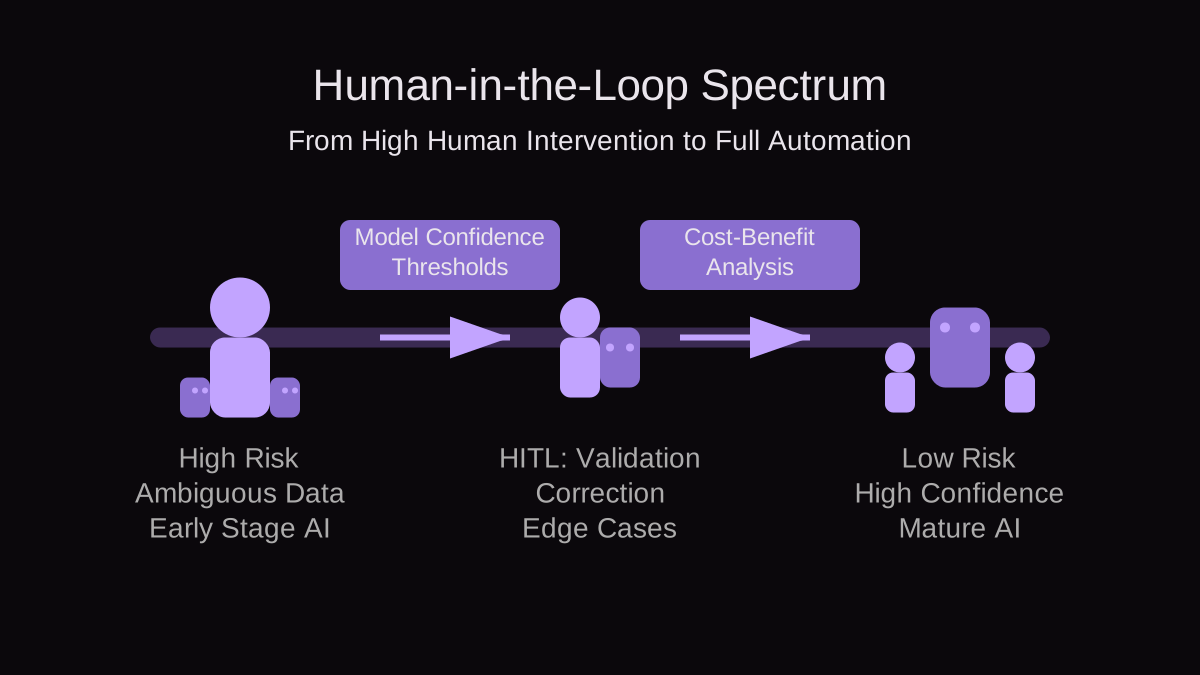
As AI Product Managers, one of the most persistent and impactful questions we face is not whether to use AI, but how to effectively deploy it alongside human intelligence. The decision of when to add a human-in-the-loop (HITL) and when to remove one is rarely binary; it is a continuous spectrum guided by risk tolerance, data complexity, regulatory requirements, cost implications, and user experience. My experience across streaming, fintech, and healthcare has shown that successful AI implementation hinges on understanding this dynamic balance, optimizing for accuracy and efficiency while preserving trust and ethical integrity.
The core principle is to strategically leverage human judgment where AI struggles with ambiguity, high-stakes decisions, or novel situations, and to systematically automate as AI models mature and demonstrate consistent, reliable performance. This approach minimizes unnecessary costs associated with human intervention while maximizing the learning potential for your AI, paving a clear path toward increasingly autonomous and robust systems.
Why Do We Need Humans in AI Systems Anyway?
It might seem counterintuitive to introduce human steps into systems designed for automation, but humans serve several critical functions that AI, especially in its nascent stages, cannot replicate. Understanding these roles is foundational to effective HITL design.
- Handling Ambiguity and Nuance: AI struggles with context, sarcasm, evolving language, or highly subjective tasks where there isn't a clear right or wrong answer. Humans excel at interpreting subtle cues and applying common sense.
- Managing Edge Cases and Outliers: While AI performs well on typical data, it often fails spectacularly on rare, unusual, or novel inputs. Humans are essential for identifying and correctly classifying these edge cases, which in turn provides valuable training data for future model improvements.
- Ensuring Ethical Oversight and Bias Mitigation: AI models can inherit and even amplify biases present in their training data. Humans are crucial for reviewing decisions for fairness, identifying discriminatory patterns, and intervening in ethically sensitive situations, especially in areas like lending, hiring, or healthcare.
- Building and Maintaining Trust: For many users, direct human involvement in critical decisions fosters greater trust and accountability. Knowing a human can review or override an AI decision provides a necessary safety net, particularly in high-stakes applications.
- Generating High-Quality Training Data: Humans are often the best source for labeling and annotating data, especially for new or complex tasks. This human-labeled data is the bedrock upon which supervised learning models are built and refined.
- Regulatory Compliance and Auditability: In regulated industries like fintech and healthcare, human review can be a non-negotiable requirement to meet compliance standards, provide audit trails, and ensure accountability for decisions.
Ignoring these inherent limitations of AI and the unique strengths of human intelligence can lead to costly errors, damaged user trust, and regulatory penalties. The goal isn't to replace humans entirely, but to augment their capabilities and strategically offload repetitive tasks to AI.
The "Vyas AI PM's HITL Compass": When to Introduce a Human Loop
To systematically decide if and when to introduce a human-in-the-loop, I use a decision rubric that considers several key dimensions. This isn't a checklist to tick off, but a framework to guide your strategic thinking and stakeholder discussions. Score each criterion from 1 (low) to 5 (high) to assess the initial need for HITL.
- 1. Consequence of Error (Risk Tolerance): How severe are the repercussions of an incorrect AI decision? (e.g., financial loss, patient harm, legal liability, reputational damage). Higher consequence implies a greater need for HITL.
- 2. Data Ambiguity and Variability: How clear and consistent is the input data? Is it prone to misinterpretation, missing information, or high variability? High ambiguity requires more human intervention.
- 3. Regulatory and Ethical Scrutiny: Is the domain highly regulated (e.g., finance, healthcare)? Does the decision have significant ethical implications or potential for bias? Higher scrutiny demands human oversight.
- 4. Cost of Human Intervention vs. Automation: What is the cost of having a human perform the task versus the cost of an AI error? If the cost of error is far greater than human intervention, HITL is justified. Consider scalability here; human cost becomes prohibitive at high volumes.
- 5. Learning Potential for AI: How much will human feedback improve the AI model? Is the task suitable for generating high-quality training data that will help the AI learn and eventually automate? If humans can teach the AI effectively, HITL is valuable.
- 6. User Experience Impact: How does the presence or absence of a human affect user trust, satisfaction, and adoption? Is a human touch desired or expected by the end-user for this specific interaction?
If your aggregate score is high (e.g., above 15-20), a human-in-the-loop is almost certainly necessary at the outset. Even with lower scores, consider a minimal HITL for monitoring and exception handling during initial deployment.
A Worked Example: Streamlining Healthcare Claims Processing
Let's apply the Vyas AI PM's HITL Compass to a real-world scenario: automating healthcare claims processing. Our goal is to reduce manual review time and accelerate payment cycles while maintaining accuracy and compliance.
Initial Assessment (High HITL):
- 1. Consequence of Error: High. Incorrect claims processing can lead to significant financial loss for providers/payers, patient dissatisfaction, and potential regulatory fines. Score: 5
- 2. Data Ambiguity: High. Claims data often contains free-text notes, complex medical codes, variations in documentation, and sometimes intentional obfuscation. Score: 4
- 3. Regulatory/Ethical Scrutiny: High. Healthcare is heavily regulated (HIPAA, etc.). Ethical considerations around patient data and fair treatment are paramount. Score: 5
- 4. Cost of Human Intervention vs. Automation: Moderate. Human review is expensive, but the cost of errors is higher. Initial automation might be cheaper but riskier. Score: 3
- 5. Learning Potential for AI: High. Human reviewers identifying discrepancies and valid claims provide excellent feedback for AI model training. Score: 5
- 6. User Experience Impact: Moderate. While speed is valued, accuracy and trust in payment are critical. Errors erode trust quickly. Score: 3
Initial Aggregate Score: 25. This clearly indicates a strong need for HITL from day one.
Implementation Strategy (Phase 1: High HITL):
- AI's Role: Develop an AI model to pre-screen claims, flag potentially fraudulent or erroneous claims, and automatically approve very low-risk, straightforward claims (e.g., common procedures with perfect documentation).
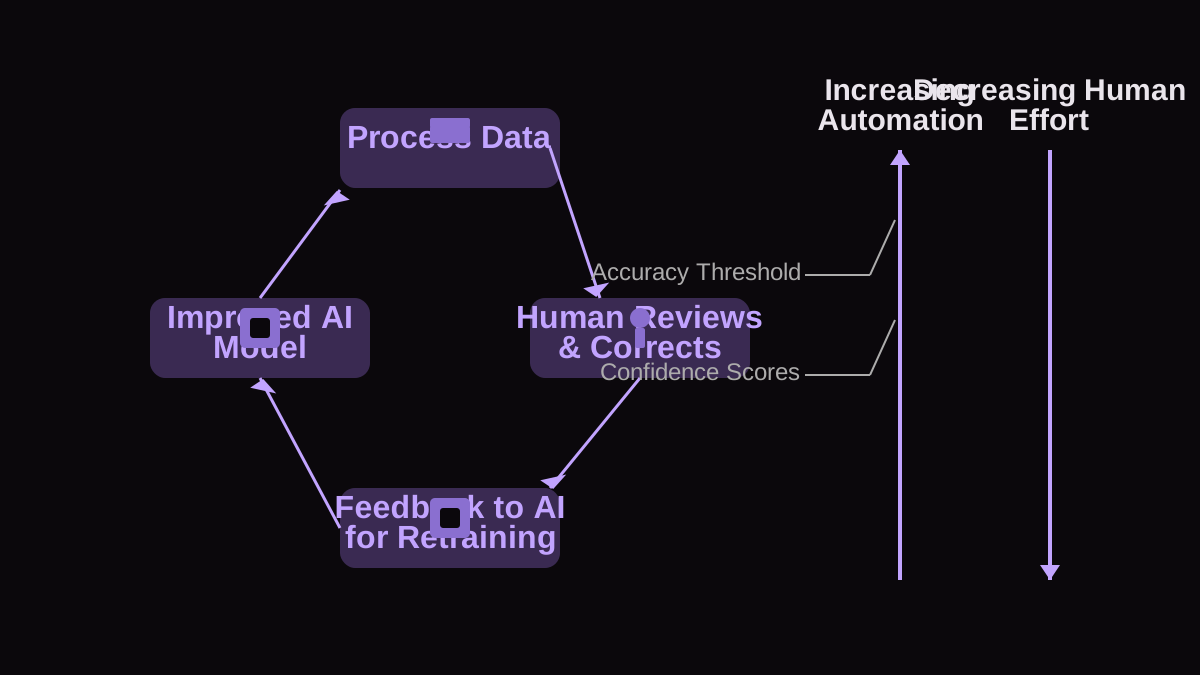
- Human's Role: Human claims adjusters review all flagged claims, correct AI misclassifications, and process all claims the AI has low confidence in. Critically, they also provide explicit feedback on the AI's predictions (e.g., 'correct approval,' 'incorrect flag,' 'missed fraud').
- Feedback Loop: This human feedback is continuously fed back into the AI model for retraining, improving its accuracy and confidence over time.
How Do You Know When It's Time to Remove the Human?
Removing the human from the loop is a gradual, data-driven process, not a sudden switch. It involves monitoring key performance indicators and increasing automation in stages. Here's how to approach it:
- Define Clear Automation Thresholds: Before you even deploy, establish specific, measurable criteria for when a human can be removed. Examples include: AI model consistently achieves X% accuracy on Y type of claims, AI confidence score for a decision is above Z for N consecutive days, or human override rate for a specific AI decision falls below M%.
- Monitor AI Performance Metrics: Continuously track accuracy, precision, recall, F1-score, and most importantly, the AI's confidence scores for its predictions. Look for sustained periods of high performance and low error rates on tasks previously reviewed by humans.
- Analyze Human Override Rates: If humans are consistently agreeing with the AI's decision or making only minor, non-critical adjustments, it's a strong signal for automation. Track the types of overrides – are they correcting fundamental errors or just stylistic preferences?
- Assess Cost-Benefit Ratios: As AI improves, the cost of maintaining human review for tasks it can handle accurately becomes a clear drain on resources. Quantify the savings from automation versus the potential cost of an occasional AI error.
- Gradual Rollout and A/B Testing: Don't remove humans entirely overnight. Start by automating a small percentage of previously human-reviewed tasks, monitoring them closely. Use A/B testing where feasible, comparing fully automated vs. HITL workflows.
- Focus on Specific Task Automation: It's rarely an 'all or nothing' situation. Identify specific sub-tasks or decision points within the workflow where the AI has demonstrated robust performance and can operate independently. For instance, in claims processing, the AI might fully approve claims below a certain dollar threshold and confidence level, while humans still review higher-value or complex cases.
- Maintain a Watchtower: Even after removing a human from the active decision-making loop, always maintain a robust monitoring system. This involves anomaly detection, performance drift alerts, and a clear escalation path back to human review if AI performance degrades or novel situations arise.
Returning to our healthcare claims example, Phase 2 (Reduced HITL) might involve: The AI automatically processes 80% of claims with high confidence and low value, while humans focus on the remaining 20% (complex cases, large amounts, or those flagged as suspicious). Phase 3 (Minimal HITL) could see the AI processing 95% of claims, with humans acting as auditors, reviewing a random sample, and focusing solely on the most ambiguous or high-risk edge cases, continuously refining the AI's understanding of true fraud.
Common Mistakes: Pitfalls in Managing Human-in-the-Loop Systems
The path to optimized HITL systems is fraught with potential missteps. Being aware of these common errors can help you navigate more effectively.
- Mistake 1: Premature Automation. Failure Mode: Removing humans before the AI is truly ready, leading to a surge in errors, user frustration, and loss of trust. How to Detect/Avoid: Over-relying on internal metrics without validating against real-world performance; not setting clear, data-driven automation thresholds; ignoring human override rates. Always validate AI performance under real-world conditions and ensure human feedback loops are robust before scaling back.
- Mistake 2: Over-Reliance on Humans (The "Human Crutch"). Failure Mode: Keeping humans in the loop longer than necessary, driving up operational costs and hindering AI learning. The AI never gets enough challenging data to improve. How to Detect/Avoid: Lack of a clear plan for AI improvement; not actively using human feedback to retrain and iterate on the model; fear of failure preventing gradual automation. Regularly review the cost-benefit of human intervention and actively seek opportunities to automate segments of the workflow.
- Mistake 3: Lack of a Structured Feedback Loop. Failure Mode: Humans review AI outputs but their corrections or insights aren't systematically fed back into the AI for retraining, stagnating model improvement. How to Detect/Avoid: Human reviewers just 'correct' without categorizing the error or explaining 'why'; no dedicated data science resources to process human feedback. Design explicit feedback mechanisms (e.g., dropdowns for error types, free-text explanations for edge cases) and integrate them into your MLOps pipeline.
- Mistake 4: Ignoring Human Fatigue and Bias. Failure Mode: Human reviewers become fatigued, leading to inconsistent judgments, errors, or unconsciously introducing their own biases, which then pollute the training data. How to Detect/Avoid: High variance in human review quality; lack of inter-rater agreement checks; no mechanisms for identifying and mitigating human bias. Implement regular quality control checks for human reviewers, provide clear guidelines, breaks, and rotate tasks to prevent fatigue. Use multiple reviewers for critical tasks to cross-validate.
- Mistake 5: Failing to Communicate the "Why." Failure Mode: Product managers and engineers understand the HITL strategy, but human operators don't, leading to disengagement, resistance, or poor quality feedback. How to Detect/Avoid: Not involving human operators in the design of the HITL system; not explaining how their work contributes to AI improvement and future automation. Clearly articulate the vision, the value of their feedback, and how their role will evolve. Foster a collaborative environment where humans feel like partners, not just cogs.
Key Takeaways
- Human-in-the-loop is a dynamic spectrum, not a binary choice; your strategy should evolve with AI maturity and changing contexts.
- Humans are indispensable for handling ambiguity, managing high-stakes decisions, ensuring ethical oversight, building trust, and generating high-quality training data.
- Utilize a structured framework like the "Vyas AI PM's HITL Compass" to systematically assess the need for human intervention based on risk, data, regulation, cost, learning potential, and user experience.
- Implement HITL with a clear feedback loop, ensuring human corrections and insights are continuously used to retrain and improve the AI model.
- Remove humans gradually and strategically, relying on predefined automation thresholds, consistent AI performance metrics, and a robust monitoring system.
- Actively avoid common pitfalls such as premature automation, over-reliance on humans, lack of structured feedback, ignoring human factors, and poor communication with human operators.
- The ultimate goal is to optimize the synergy between human and artificial intelligence, leveraging each's unique strengths to deliver superior outcomes.