Product Craft
Running a Useful AI Product Discovery Sprint: A PM's Guide
Listen — audio summary in Nehal Vyas's voice
Transcript
Hey everyone, I recently wrote a guide on running a useful AI product discovery sprint, and I wanted to quickly share the key takeaways. What makes AI product discovery truly unique is that it’s inherently more complex than traditional software. We're not just defining rules; we're dealing with probabilistic outcomes, heavy reliance on data quality, and critical ethical considerations right from day one. As PMs, our role expands beyond user needs to deeply grasp these unique machine learning constraints. The goal isn't just to list features, but to validate desirability, viability, technical feasibility, and responsible use early on, preventing those expensive missteps down the line. To help navigate this, I’ve developed and used an 'AI Readiness Scorecard.' This framework systematically evaluates potential AI applications across key criteria like data readiness, technical viability, ethical impact, and business value. It really helps teams assess whether an AI solution is truly viable and responsible, moving beyond "can we build it?" to "should we build it?" and "can we sustain it?" It's about getting grounded, actionable insights. For a deeper dive into the scorecard and how to apply it, head over to hinehal.com.
Running a useful AI product discovery sprint demands an integrated approach that weaves together problem definition, technical feasibility, data availability and quality, and ethical implications from the very first day. Unlike traditional product discovery, AI sprints prioritize rapid experimentation with real or representative data to validate not just desirability, but also the crucial dimensions of viability, technical feasibility, and responsible use, preventing costly missteps down the line. The goal is to exit the sprint with a clear hypothesis on whether AI is the right solution, what data is needed, and what potential pitfalls exist, not just a list of features.
As product managers venturing into AI, our role expands beyond understanding user needs to deeply grasp the unique constraints and opportunities presented by machine learning. This guide will walk you through how to structure and execute an AI product discovery sprint that yields tangible, actionable insights, grounded in practicality and ethical awareness.

What Makes AI Product Discovery Different (And Harder)?
The fundamental difference in AI product discovery stems from its inherent probabilistic nature and reliance on data. In traditional software, if you define the rules, the software behaves predictably. With AI, you define the desired outcome, provide data, and the model learns the rules – often in ways that are not immediately transparent or entirely predictable. This introduces several layers of complexity that necessitate a distinct discovery approach.
- Data is the foundation, not just an input: AI models are only as good as the data they're trained on. Discovery must deeply explore data availability, quality, bias, ethical sourcing, and privacy implications. Without the right data, the best AI idea is dead on arrival.
- Probabilistic outcomes and explainability: AI doesn't always give a definitive 'yes' or 'no.' It offers probabilities. Understanding the business impact of false positives/negatives, and the ability to explain why an AI made a certain decision, becomes critical for user adoption and regulatory compliance.
- Ethical considerations are paramount from day one: Bias, fairness, transparency, privacy, and accountability are not afterthoughts; they are core design constraints. Ignoring them leads to reputational damage, legal issues, and user distrust.
- Technical feasibility is multifaceted: It's not just about building software; it's about training models, deploying them, monitoring their performance over time, and handling concept drift. The MLOps complexity is significant and must be assessed early.
- Continuous learning and maintenance: AI models degrade over time as real-world data shifts. The product must account for ongoing retraining, monitoring, and adaptation, which has implications for long-term cost and team structure.
These unique characteristics mean that simply applying traditional product discovery frameworks will lead to frustrating dead ends. We need frameworks that explicitly address data, ethics, and the probabilistic nature of AI.
How to Structure Your AI Discovery Sprint: The 'AI Readiness Scorecard'
To navigate the unique complexities of AI, I've found it invaluable to use an 'AI Readiness Scorecard' during discovery. This framework helps teams systematically evaluate potential AI applications across critical dimensions, providing a structured way to assess whether an AI solution is truly viable and responsible. It encourages a holistic view, moving beyond just 'can we build it?' to 'should we build it?' and 'can we sustain it?'
The scorecard works by rating a proposed AI solution against five key criteria. Each criterion should be discussed and scored (e.g., 1-5, or red/amber/green) by the cross-functional sprint team (PM, Data Scientist, Engineer, UX, Legal/Ethics representative if possible). The goal isn't necessarily a perfect score, but rather a clear understanding of where risks and opportunities lie, guiding subsequent exploration and de-risking activities.
- 1. Problem-Solution Fit & User Value: Does this AI solution genuinely address a significant user or business problem? Is AI truly the best way to solve it, or could a simpler, deterministic solution work? What is the measurable value if successful? (Example: Reducing manual review time, improving prediction accuracy for a critical decision).
- 2. Data Readiness & Availability: Is the necessary data available, accessible, and of sufficient quality and quantity for training and inference? Are there privacy or regulatory hurdles? Is the data representative and free from significant biases that could lead to unfair outcomes? (Example: Historical transaction data, patient records, sensor readings).
- 3. Technical Feasibility & Model Viability: Do we have the technical expertise (data scientists, ML engineers) and infrastructure to build, train, deploy, and monitor this model? Are there existing models or open-source solutions that could be adapted? What's the expected performance baseline and what are the edge cases? (Example: Is it a classification, regression, or generative task? How complex is the model likely to be?).
- 4. Ethical & Risk Profile: What are the potential negative impacts or unintended consequences of this AI system? Could it perpetuate or amplify existing biases? What are the implications for fairness, transparency, privacy, and accountability? Are there regulatory compliance requirements? (Example: Disproportionate impact on certain user groups, potential for 'hallucinations' in generative AI, data breach risks).
- 5. Business Impact & Operationalization: What is the expected return on investment (ROI)? How will the AI solution integrate into existing workflows and systems? What's the plan for ongoing monitoring, maintenance, and retraining? How will success be measured, and how will failures be handled? (Example: Cost savings, revenue generation, operational efficiency gains, clear fallback mechanisms).
Worked Example: AI for Patient Readmission Risk Prediction
Let's walk through a concrete scenario: a large healthcare provider wants to use AI to predict which patients are at high risk of readmission within 30 days of discharge, aiming to improve patient outcomes and reduce healthcare costs. Our discovery sprint team includes a PM, a data scientist, a software engineer, a clinical lead, and a legal/compliance representative.
- Phase 1: Problem & Hypotheses Definition
- The clinical lead highlights that readmissions are costly and detrimental to patient health. Doctors currently use subjective criteria. The hypothesis is: An AI model can more accurately identify high-risk patients, allowing proactive interventions (e.g., extended home care, follow-up calls).
- Key questions: What's the current readmission rate? What interventions are possible? What's the acceptable error rate for predictions?
- Phase 2: Data & Feasibility Assessment
- Data Scientist: We have electronic health records (EHR) with diagnoses, medications, lab results, demographics, and past admissions. Data quality is good, but some fields are sparse. Privacy (HIPAA) is a major concern. We need to anonymize/de-identify data. Historical readmission labels exist.
- PM/Clinical Lead: We need to define 'readmission' precisely. We also need to understand how interventions will be triggered and consumed by care teams.
- Legal: Strict data access controls and anonymization protocols are non-negotiable. Need to ensure consent is handled correctly.
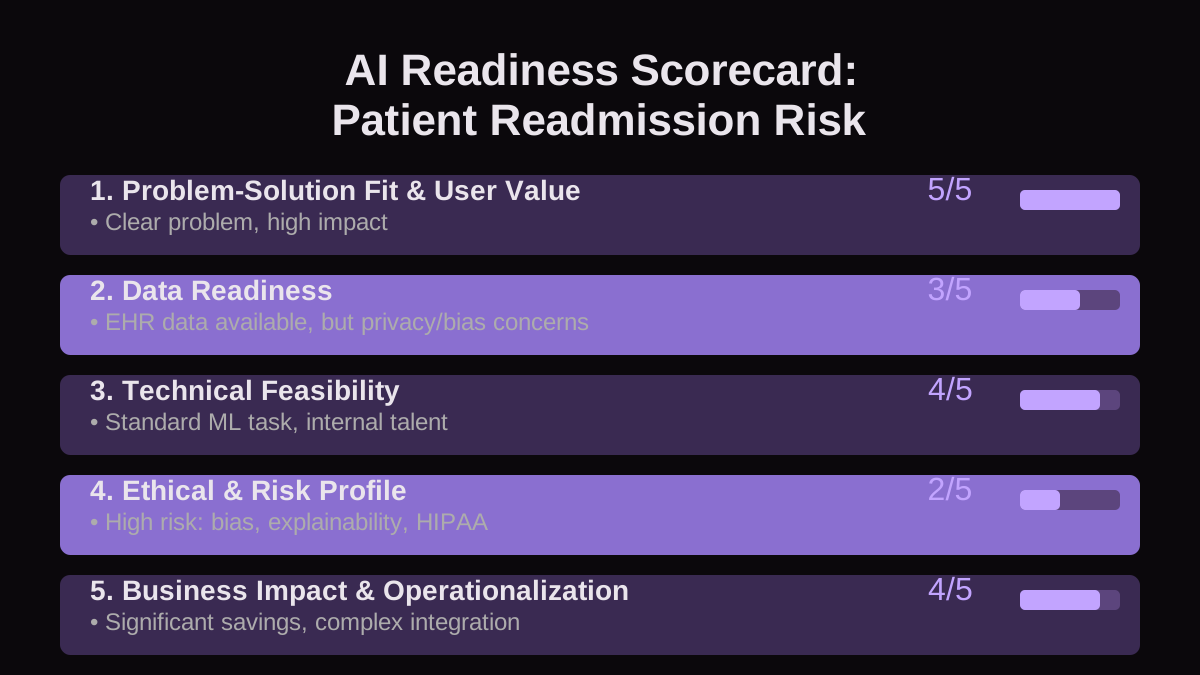
- AI Readiness Scorecard Check:
- 1. Problem-Solution Fit: High (Clear problem, significant cost/health impact, AI could improve accuracy over human intuition). Score: 5/5
- 2. Data Readiness: Medium-High (EHR data available, but requires significant privacy engineering, cleaning, and feature engineering. Bias potential exists in historical data if certain demographics received less care or had different readmission patterns). Score: 3/5
- 3. Technical Feasibility: High (Standard classification task, existing ML libraries, internal ML engineering talent). Score: 4/5
- 4. Ethical & Risk Profile: High (Patient well-being is paramount. Bias in predictions could lead to unequal treatment. Explainability is critical for clinician trust. HIPAA compliance. Potential for 'alert fatigue' if too many false positives). Score: 2/5 (High risk area, requires careful mitigation)
- 5. Business Impact & Operationalization: High (Significant cost savings, improved patient outcomes. Integration into EHR and care team workflows will be complex but feasible. Clear metrics: reduced readmission rate, improved patient satisfaction). Score: 4/5
- Phase 3: Solution Ideation & Prototyping
- Data Scientist: Suggests a gradient boosting model or a deep learning model for structured EHR data. Focus on feature engineering from various data points. Propose a basic proof-of-concept (POC) to establish a baseline accuracy.
- Engineer: Discusses integrating the model's output into a clinician dashboard or alert system within the EHR. Highlights MLOps considerations for model deployment and monitoring.
- PM/UX: Sketches out a simple dashboard prototype showing patient risk scores and key contributing factors (explainability). Discusses how clinicians would interact with the alerts.
- Phase 4: Ethical & Risk Evaluation (Deep Dive)
- Legal/Compliance: Emphasizes the need for robust bias detection and mitigation strategies. Discusses the liability if a high-risk patient is missed. Mandates clear 'human-in-the-loop' decision points, where the AI provides a recommendation, but the clinician makes the final call.
- Team: Brainstorms potential biases (e.g., underrepresentation of certain ethnic groups in historical data, leading to skewed predictions). Develops a plan for auditing model fairness and transparently reporting performance metrics, including disparate impact analysis.
- Phase 5: Validation & Next Steps
- The team agrees that while the problem is significant and data is available, the ethical and operationalization risks are high. The next steps include:
- 1. Build a basic POC to establish a baseline prediction accuracy and identify key features.
- 2. Conduct a deep dive data audit specifically for bias and data quality, especially for minority patient groups.
- 3. Develop a detailed MLOps plan, including model monitoring, retraining, and explainability mechanisms.
- 4. Prototype the clinician interface further to ensure trust and usability, incorporating explainability features.
- 5. Engage legal and clinical leadership early and often for continuous feedback and risk mitigation.
Common Mistakes in AI Product Discovery (And How to Avoid Them)
Even with the best intentions, AI discovery sprints can go off the rails. Recognizing these common pitfalls is the first step to avoiding them.
- Failure Mode 1: Treating AI like 'just another feature'.
- How it breaks: Teams might define a feature, then try to bolt AI onto it, without considering the unique data, ethical, and operational challenges. This leads to endless technical debt or a solution that never truly works.
- Detect/Avoid: Always start with the problem, not the AI technology. Ask: 'Is AI truly the best solution for this problem, or is there a simpler, deterministic approach?' Engage data scientists and ML engineers from the very beginning. Use the AI Readiness Scorecard to force a holistic evaluation.
- Failure Mode 2: Ignoring data quality and bias until deployment.
- How it breaks: Building a seemingly functional model on poor or biased data leads to inaccurate, unfair, or even harmful predictions. This erodes user trust and can incur significant reputational and legal costs, often discovered only after launch.
- Detect/Avoid: Make data readiness and ethical data sourcing a core part of your discovery sprint (Criterion 2 & 4 of the Scorecard). Dedicate time to data exploration, profiling, and bias assessment with your data scientists. Prototype with real (or representative synthetic) data, not just theoretical datasets.
- Failure Mode 3: Underestimating MLOps complexity and long-term maintenance.
- How it breaks: Focusing solely on model development and ignoring the infrastructure needed for deployment, monitoring, and continuous retraining. This results in models that can't scale, break in production, or become stale quickly, leading to high operational costs and frustrated engineering teams.
- Detect/Avoid: Involve ML engineers and DevOps specialists early. Discuss deployment pipelines, monitoring dashboards, alert systems, and retraining strategies during discovery (Criterion 3 & 5). Document assumptions about model decay and maintenance requirements.
- Failure Mode 4: Building a 'cool' AI solution without clear user value or business impact.
- How it breaks: Teams get excited about a novel AI technique and build something impressive but solves a non-existent or low-priority problem. This is a classic solution-in-search-of-a-problem trap, resulting in wasted resources and zero adoption.
- Detect/Avoid: Relentlessly focus on the user problem and measurable business outcomes (Criterion 1 & 5). Validate the problem's existence and severity independently of the AI solution. Ensure clear success metrics are defined before any model building begins. If a simpler, non-AI solution delivers 80% of the value for 20% of the effort, prioritize that.
- Failure Mode 5: Skipping ethical review or treating it as an afterthought.
- How it breaks: Deploying AI without considering its ethical implications can lead to discriminatory outcomes, privacy violations, and public backlash. Remedying these issues post-launch is expensive and often impossible, permanently damaging trust.
- Detect/Avoid: Integrate ethical considerations (Criterion 4) into every phase of discovery. Include legal, compliance, or ethics specialists in your sprint team. Conduct explicit bias audits, define fairness metrics, and establish clear guidelines for transparency and explainability. Design for human oversight where AI makes critical decisions.
Key Takeaways for Useful AI Product Discovery
- AI product discovery is fundamentally different from traditional software discovery; it demands early consideration of data, ethics, and long-term operational complexity.
- Adopt a holistic framework like the 'AI Readiness Scorecard' to systematically evaluate problem-solution fit, data readiness, technical feasibility, ethical risks, and business impact.
- Involve a diverse, cross-functional team from day one, including data scientists, ML engineers, UX designers, and legal/ethics representatives.
- Prioritize rapid experimentation and prototyping with real or representative data to validate hypotheses and uncover challenges early.
- Relentlessly focus on the user problem and measurable business value; don't build AI for AI's sake.
- Proactively address data quality, bias, and ethical implications throughout the sprint to build responsible and trustworthy AI solutions.
- Plan for the entire lifecycle of an AI product, including MLOps, continuous monitoring, and retraining, right from discovery.
- Be prepared to pivot or even abandon an AI idea if the discovery reveals insurmountable data, ethical, or technical hurdles. Not all problems are AI problems.