Agents
Evaluating AI Agent Performance: Beyond Task Completion Rates
As AI Product Managers, we often gravitate towards seemingly straightforward metrics like task completion rates. However, my 10+ years in product management across streaming, fintech, and healthcare have shown me that for AI agents, this metric alone is woefully insufficient. Evaluating an AI agent purely on whether it 'completed the task' misses crucial dimensions of performance like user experience, cost-effectiveness, ethical implications, and robustness, leading to agents that might technically 'work' but fail to deliver real value or even introduce new risks. A truly effective AI agent demands a more comprehensive evaluation framework that assesses its overall impact, not just its binary success or failure on a single task.
The complexity inherent in autonomous or semi-autonomous AI agents means their impact ripples across multiple vectors – user satisfaction, operational costs, brand trust, and even regulatory compliance. Our role as PMs is to ensure these agents not only achieve their primary goal but do so responsibly, efficiently, and in a way that truly serves the end-user and the business. This means looking beyond the 'what' to the 'how' and 'at what cost'.
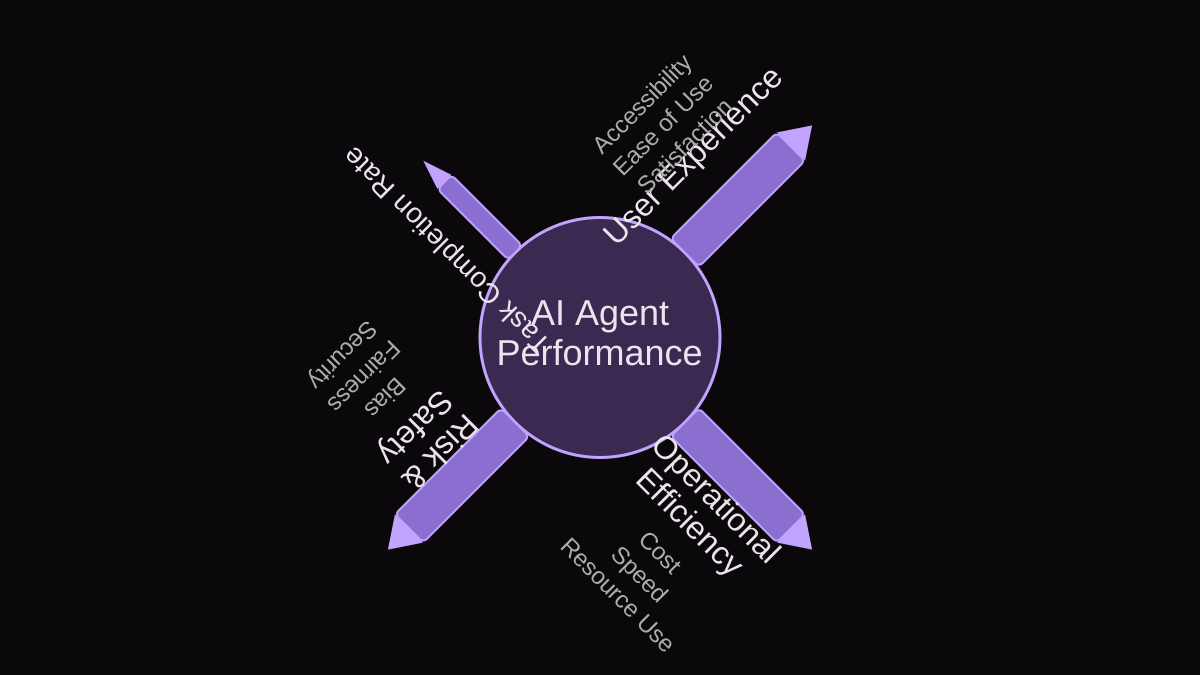
Why is 'Task Completion' an Insufficient Metric for AI Agents?
Task completion rate, while a baseline indicator, often tells only a fraction of the story. Imagine an AI agent designed to resolve customer support issues. It might log a 90% completion rate for 'password reset' requests. But what if 30% of those 'completed' tasks required the customer to re-enter information multiple times due to agent misinterpretation? Or what if the agent, in its attempt to complete a task, escalated an issue unnecessarily, leading to higher operational costs? What if it delivered a technically correct answer in a rude or unhelpful tone? These nuances are invisible to a simple task completion metric.
The limitations become clearer when we consider:
- Partial or 'Faux' Completion: The agent might complete a sub-task but fail the overarching user goal. For example, it finds an article but doesn't solve the user's specific problem articulated in a complex query.
- Quality of Outcome: Was the task completed correctly, optimally, and to a high standard? A 'completed' sales lead might be low quality or poorly qualified, wasting human sales team time.
- User Experience Degradation: How much effort did the user expend? Was the interaction frustrating, confusing, or unhelpful, even if a resolution was eventually reached? This impacts trust and retention.
- Operational Overhead: Did the agent consume excessive compute resources, API calls, or require human intervention after 'completion'? A high completion rate at an unsustainable cost is not a win.
- Safety and Ethical Breaches: Did the agent inadvertently expose sensitive data, provide biased information, or make a harmful recommendation while trying to complete its task? This is where 'completion' can become dangerous.
- Robustness and Edge Cases: How well does the agent handle ambiguity, unexpected inputs, or out-of-domain requests? A high completion rate on common paths doesn't guarantee resilience.
Without addressing these dimensions, we risk deploying agents that are technically proficient but ultimately detrimental to our users or our business. This is why a holistic approach is non-negotiable for AI PMs.
The Agent Value & Risk Scorecard (AVRS): My Holistic Evaluation Framework
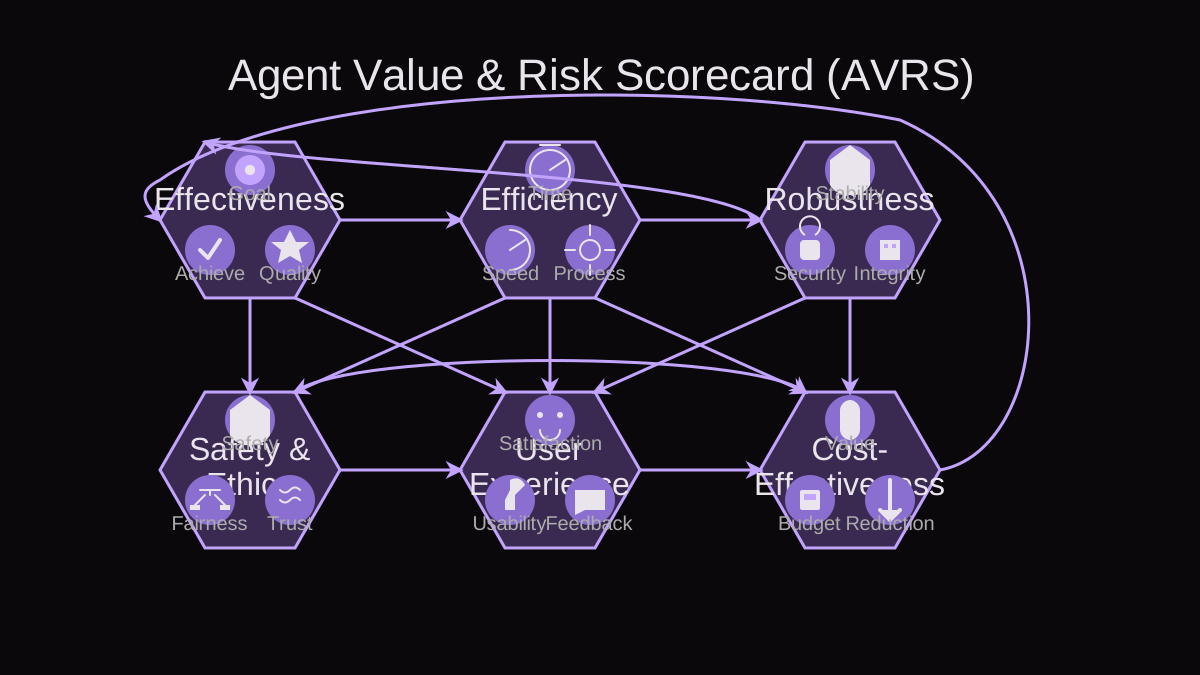
To navigate these complexities, I've developed the Agent Value & Risk Scorecard (AVRS), a framework designed to give product managers a comprehensive view of AI agent performance. It moves beyond simple metrics to assess an agent's true impact across key dimensions.
- 1. Effectiveness: Does the agent achieve its intended goal accurately and reliably?
- 2. Efficiency: How resource-intensive is the agent's operation (time, cost, compute)?
- 3. Robustness: How well does the agent handle unexpected inputs, errors, and edge cases?
- 4. Safety & Ethics: Does the agent operate without harm, bias, or unintended negative consequences?
- 5. User Experience (UX): Is the agent intuitive, helpful, and satisfying for the end-user?
- 6. Cost-Effectiveness: Does the agent deliver measurable business value relative to its total cost of ownership?
Each criterion is critical, and they are often interdependent. For instance, an agent that is highly effective but extremely expensive or causes significant user frustration might still be a net negative. The AVRS helps us balance these factors to make informed decisions about agent development, deployment, and iteration.
How Do I Measure Each Dimension in Practice?
Translating the AVRS criteria into measurable metrics requires thoughtful planning. Here's how I approach each dimension:
- Effectiveness: Beyond a binary 'success' or 'failure', I measure precision (how many identified successful tasks were actually successful?), recall (how many actual successful tasks did the agent correctly identify/complete?), and F1-score for classification tasks. For generative agents, human evaluation of output quality (e.g., relevance, coherence, factual accuracy) is crucial. We also track 'goal achievement rate' – did the user achieve their ultimate goal, not just the agent's immediate task?
- Efficiency: This involves tracking latency (response time), token usage (for LLM-based agents), API call volume, and compute consumption. These directly translate into operational costs. We might also track 'human escalation rate' – how often does the agent need to hand off to a human, indicating inefficiency in handling complex cases.
- Robustness: We measure error rates (e.g., hallucination rate, incorrect action rate), failure rates on specific edge cases (from a dedicated test suite), and resilience to ambiguous or incomplete inputs. A good metric here is 'graceful degradation rate' – how often does the agent fail gracefully (e.g., apologizes and asks for clarification) versus failing abruptly or incorrectly.
- Safety & Ethics: This is often qualitative but can be quantified through 'guardrail breach incidents' (e.g., attempts to generate harmful content, disclose PII improperly), 'bias detection scores' (using specialized tools), and 'compliance violation flags'. Regular audits and red-teaming exercises are essential to uncover potential issues.
- User Experience (UX): This is measured through user satisfaction scores (CSAT, NPS, CES - Customer Effort Score), direct user feedback, and qualitative analysis of user interaction transcripts. Key metrics include 'task completion time from user perspective', 'number of turns in a conversation', and 'user frustration signals' (e.g., repeated phrases, negative sentiment).
- Cost-Effectiveness: This is a business-level metric, often expressed as ROI. It combines the operational costs (from Efficiency) with the value delivered (e.g., savings from reduced human support, increased conversion rates, improved retention). We look at 'cost per successful interaction' or 'cost per resolution' to benchmark and optimize.
A Practical Walkthrough: Evaluating a Customer Service AI Agent
Let's apply the AVRS to a common scenario: an AI agent for a streaming service designed to help users with common issues like password resets, billing inquiries, and basic troubleshooting.
Scenario: A user contacts support via chat because they can't log in. The AI agent's task is to help them regain access, ideally through a self-service password reset or directing them to the correct account recovery flow.
Step-by-step Evaluation with AVRS:
- 1. Effectiveness: We track 'successful login after interaction' (actual user outcome) and 'correct password reset link generation rate'. If the agent correctly identifies the need for a password reset and provides a working link, that's a positive. If the user still can't log in post-interaction, it's not truly effective. We'd aim for 95%+ success rate for common flows.
- 2. Efficiency: We monitor 'average conversation turns' (ideally 2-3 for a simple reset), 'average interaction time' (under 2 minutes), and 'token usage per conversation'. We also track 'escalation rate to human agent'. If 40% of password resets escalate, it's inefficient.
- 3. Robustness: We test with variations like 'I forgot my password and my email' (ambiguous), 'My cat ate my password' (unusual phrasing), or 'I need to reset my payment method' (out-of-scope but related). We track the agent's ability to clarify, redirect, or gracefully handoff. A high 'unhandled intent rate' indicates poor robustness.
- 4. Safety & Ethics: Does the agent ever ask for the password directly (security breach)? Does it incorrectly assume gender based on a name (bias)? Does it offer solutions that violate data privacy policies? We look for zero incidents of these critical failures. Red-teaming focuses on finding ways to trick the agent into revealing sensitive info or performing unauthorized actions.
- 5. User Experience: After each interaction, we prompt for a CSAT score. We analyze transcripts for sentiment and frustration keywords. A high 'Customer Effort Score' (e.g., user had to rephrase their problem multiple times) would flag poor UX, even if the task was eventually completed. Our target might be a CSAT score of 4.5/5 and a CES below 2 (on a 1-5 scale).
- 6. Cost-Effectiveness: We compare the cost of handling this query via the AI agent (compute, API, maintenance) versus the cost of a human agent. If the AI agent resolves 80% of password resets at 1/10th the cost per resolution, that's a clear win. We calculate 'cost per resolved password reset' and ensure it's significantly lower than human intervention.
Common Pitfalls in AI Agent Evaluation and How to Avoid Them
Even with a robust framework, PMs can fall into traps. Here are some common mistakes I've observed and how to sidestep them:
- Pitfall 1: Over-reliance on Quantitative Metrics Alone. Failure Mode: You get excellent numbers on paper, but user feedback is terrible. The agent might be technically proficient but lacks empathy or context. Detection/Avoidance: Always combine quantitative metrics with qualitative insights. Conduct user interviews, analyze interaction transcripts for sentiment and pain points, and perform usability testing. Numbers tell you 'what', qualitative tells you 'why'.
- Pitfall 2: Ignoring Unintended Side Effects. Failure Mode: The agent optimizes for one goal but creates new problems, like increased operational costs for escalations, legal risks from biased output, or brand damage from poor interactions. Detection/Avoidance: Implement comprehensive monitoring for all AVRS dimensions, not just a few. Proactively red-team your agent for potential harms and biases. Set up alerts for out-of-norm behavior or excessive resource consumption.
- Pitfall 3: Static Evaluation. Failure Mode: An agent performs well initially but degrades over time as user behavior changes or data drifts. What worked yesterday might not work tomorrow. Detection/Avoidance: Establish continuous monitoring and A/B testing frameworks. Regularly retrain and fine-tune your agent with fresh data. Implement feedback loops from users and human agents to identify new failure modes quickly.
- Pitfall 4: Not Defining 'Success' Clearly Before Building. Failure Mode: You launch an agent without clear, agreed-upon success metrics and KPIs, leading to endless debates about its value and direction. Detection/Avoidance: Before a single line of code is written, align with stakeholders on what 'success' looks like for each AVRS dimension. Define specific, measurable targets and the methodology for tracking them. This clarity guides development and evaluation.
- Pitfall 5: Optimizing for the Agent, Not the User. Failure Mode: The agent's performance looks good, but it's forcing users into specific interaction patterns that are convenient for the agent rather than natural for the user. Detection/Avoidance: User-centered design principles must be paramount. Observe users interacting with the agent in their natural environment. Prioritize user effort and satisfaction metrics as highly as technical performance. The agent serves the user, not the other way around.
Key Takeaways for AI Product Managers
- Task completion rate is a baseline, not a full picture: AI agents require a multi-dimensional evaluation beyond simple binary success.
- Adopt a holistic framework like the Agent Value & Risk Scorecard (AVRS): Focus on Effectiveness, Efficiency, Robustness, Safety & Ethics, User Experience, and Cost-Effectiveness.
- Translate each dimension into measurable metrics: Use a mix of quantitative data (e.g., latency, error rates) and qualitative insights (e.g., CSAT, user feedback).
- Integrate continuous monitoring and feedback loops: AI agents evolve, and so should their evaluation. Static assessment leads to degradation.
- Prioritize safety, ethics, and user experience: These are not secondary considerations; they are foundational to building trusted and valuable AI products.
- Define success early and clearly: Align with stakeholders on what good performance looks like across all critical dimensions before development begins.
- Avoid common pitfalls by combining data with human insights, monitoring for unintended consequences, and always keeping the user at the center of your evaluation strategy.