Agents
Designing Memory Architectures for LLM Agents: A PM's Guide
The core of truly intelligent, stateful LLM agents lies not just in their large language models, but in their ability to remember, learn, and adapt over time. As AI Product Managers, our challenge is to move beyond stateless, single-turn interactions and design memory architectures that enable agents to maintain context, store experiences, and evolve their behavior. This requires a strategic approach to managing both short-term conversational context and long-term knowledge, allowing agents to develop a persistent identity and learn from past interactions to improve future performance.
Effective memory architecture is crucial for building robust LLM agents. It allows agents to carry forward context, understand user preferences, execute complex multi-step tasks, and continually improve through reflective learning. Without it, agents remain confined to generic, one-off responses, unable to engage in meaningful, ongoing relationships or complex problem-solving.
Why is Memory Critical for LLM Agents?
Large Language Models, while incredibly powerful, are inherently stateless. Each prompt is processed in isolation, meaning the model starts fresh with no recollection of previous turns in a conversation or prior interactions. This fundamental limitation makes it impossible to build truly intelligent agents that can maintain context, personalize interactions, or execute multi-step tasks without a dedicated memory system. As PMs, we quickly realize that a sophisticated LLM alone cannot deliver the desired user experience for complex applications.
Consider a customer support agent. Without memory, it would ask for the user's account number in every single turn, completely forgetting what was just discussed. Or imagine a personal assistant agent that can't remember your preferences, past requests, or even the current state of a task it's helping you with. Such agents would be frustratingly inefficient and fundamentally limited. Memory provides the persistence needed for context, the ability to learn and adapt based on user feedback or task outcomes, and the foundation for personalized, coherent, and effective interactions over time. It's what transforms a powerful but static language model into a dynamic, evolving agent.
What Types of Memory Do LLM Agents Need? The Adaptive Memory Design Framework
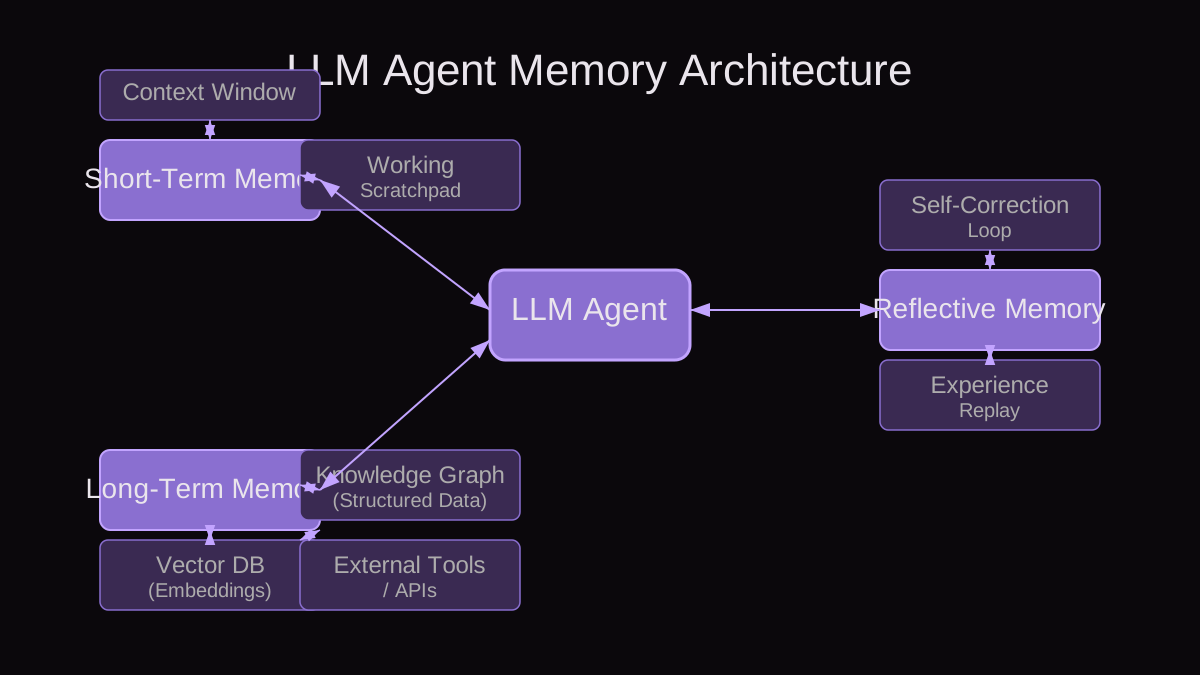
To enable stateful behavior, we typically design agents with a combination of memory types, each serving a distinct purpose. I use what I call The Adaptive Memory Design Framework to categorize and plan these components. This framework helps ensure we cover all necessary aspects of an agent's memory, from immediate context to long-term learning.
- 1. Short-Term (Contextual) Memory: This is the agent's working memory, primarily for immediate conversational context and transient reasoning. It's often the LLM's own context window itself, augmented by small, fast data stores.
- Criteria: Low latency, high throughput, limited capacity, transient (session-bound).
- Use cases: Current conversation turn, immediate task steps, scratchpad for thought processes (e.g., Chain-of-Thought reasoning).
- Technologies: LLM context window, in-memory data structures, Redis cache for active session data.
- 2. Long-Term (Episodic/Semantic) Memory: This stores persistent knowledge, past interactions, user profiles, and domain-specific information. It's what allows an agent to remember details over days, weeks, or even months.
- Criteria: High capacity, durable, searchable (semantic and keyword), moderate latency, cost-effective for large datasets.
- Use cases: User preferences, historical conversations, past purchases, domain-specific knowledge bases, tool usage logs, summaries of long interactions.
- Technologies: Vector databases (e.g., Pinecone, Weaviate), traditional databases (e.g., PostgreSQL for structured data), knowledge graphs (e.g., Neo4j for relationships).
- 3. Reflective (Meta-Cognitive) Memory: This is where the agent learns and adapts. It enables self-correction, strategy evolution, and the improvement of the agent's core capabilities based on past experiences and outcomes.
- Criteria: Analytical, episodic, triggers agent self-reflection, updates long-term memory, potentially involves separate learning loops.
- Use cases: Identifying common failure modes, improving prompt strategies, refining tool usage, generating summaries of successful or unsuccessful interactions for future recall, updating knowledge base relevancy.
- Technologies: Separate LLM calls for reflection and analysis, structured logging for experience replay, reinforcement learning components, meta-prompts.
How Do We Architect Memory for Practical Applications? A Worked Example
Let's walk through a concrete example: an AI-powered healthcare assistant, which we'll call MedBot, designed to manage patient inquiries, schedule appointments, and provide general medical information. This scenario highlights the need for diverse memory types and careful integration, especially with sensitive data.
Worked Example: MedBot's Memory Architecture
- Step 1: Define Memory Requirements
- Goal: Provide personalized, context-aware support, remember patient history (anonymized/summarized), and learn from interactions while ensuring strict data privacy.
- Short-Term: Must retain the current conversation thread (e.g., symptoms described, preferred appointment times, current query context).
- Long-Term: Needs access to anonymized patient medical history, previous consultations (summarized), common FAQs, doctor availability schedules, and relevant medical knowledge articles.
- Reflective: Should learn from ambiguous patient queries, successful diagnostic pathways, and unsuccessful appointment bookings (e.g., no availability for preferred doctor/time).
- Step 2: Technology Selection
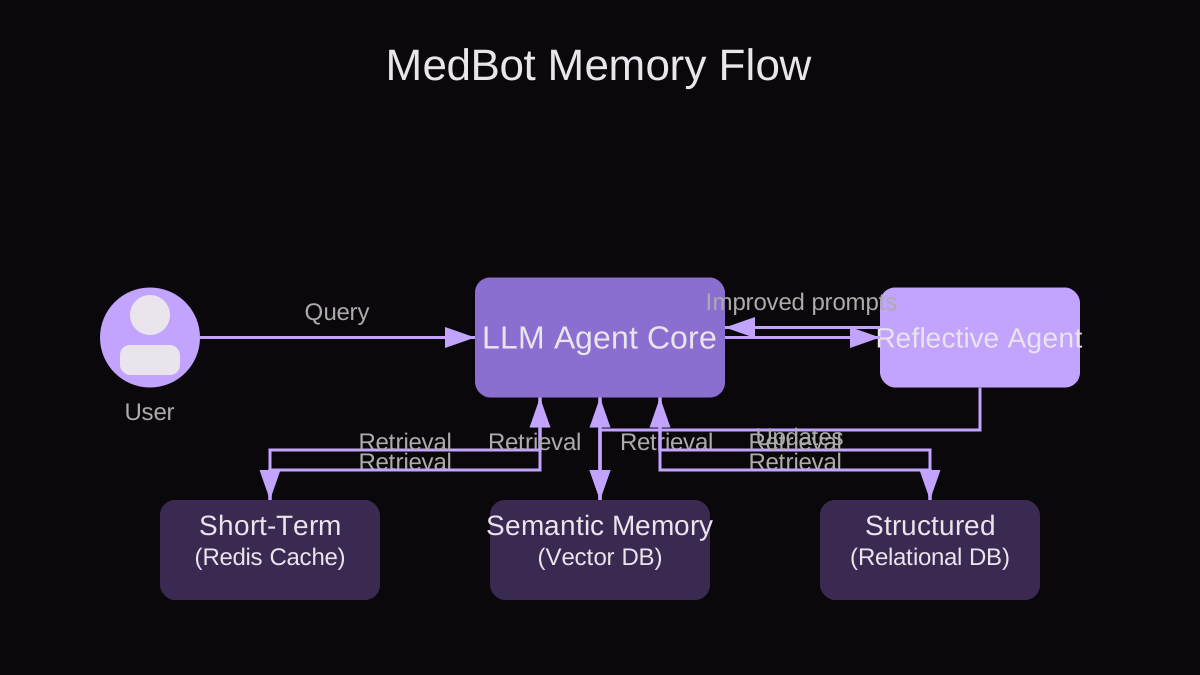
- Short-Term Memory: We'll use the LLM's context window for the immediate turn, augmented by a Redis cache to store the last N turns of the conversation for quick retrieval, preventing context window overflow for longer chats.
- Long-Term Memory: A vector database (e.g., using embeddings) will store anonymized patient history summaries and medical knowledge articles, enabling semantic search for relevant information. A traditional relational database (e.g., PostgreSQL) will manage structured data like doctor schedules, appointment bookings, and anonymized patient profiles, crucial for transactional consistency.
- Reflective Memory: A separate, asynchronous agent process will periodically review chat logs (after anonymization). This reflective agent uses another LLM call to summarize key learnings, identify common gaps in the knowledge base, or suggest improvements to retrieval prompts. These insights are then used to update the vector database (e.g., by adding new Q&A pairs) or refine the core agent's prompt instructions.
- Step 3: Integration and Flow
- User Query: A patient asks, 'I have a persistent cough and fever, and I'd like to see Dr. Smith.'
- Short-Term Retrieval: MedBot first checks the Redis cache for previous turns to understand the immediate context (e.g., if the user previously mentioned being ill or discussed Dr. Smith).
- Long-Term Retrieval (Semantic): The agent performs a semantic search on the vector database for 'persistent cough and fever' to retrieve relevant medical information or similar anonymized patient cases.
- Long-Term Retrieval (Structured): Concurrently, it queries the relational database for 'Dr. Smith's availability' and the patient's existing appointment history.
- Synthesis and Response: The core LLM synthesizes information from all memory sources. It might respond, 'I see you're experiencing a cough and fever. Dr. Smith has an opening next Tuesday at 10 AM. Would that work for you? I've also found some information on common remedies for persistent coughs.'
- Memory Update: The current conversation turn is stored in Redis. If an appointment is booked, the relational database is updated.
- Reflective Loop: Later, the reflective agent analyzes this interaction. If 'persistent cough and fever' was a common query leading to a specific diagnosis, it might update the vector database with a new, highly relevant knowledge chunk or refine the embedding for similar queries, improving future responses.
Common Pitfalls in Designing Agent Memory and How to Avoid Them
Even with a sound framework, building effective memory systems for LLM agents comes with its own set of challenges. As product managers, anticipating these pitfalls is crucial for delivering reliable and performant AI products.
- 1. Context Window Overload
- Failure Mode: The agent 'forgets' earlier parts of long conversations, leading to incoherent responses, repetition, or a lack of understanding of the user's overall goal.
- Detection: Users complain the agent is not remembering previous statements, the agent asks for information it was already provided, or responses lack depth as conversation progresses.
- Avoidance: Implement summarization techniques (LLM-based or heuristic) to condense past interactions before feeding them into the context window. Use hierarchical memory, moving older, summarized context to long-term memory while keeping recent, detailed context in short-term. Dynamically adjust context window size based on interaction complexity or user intent.
- 2. Stale or Irrelevant Information Retrieval
- Failure Mode: The agent retrieves outdated facts or information that doesn't pertain to the current query, resulting in factual errors, irrelevant suggestions, or 'hallucinations' based on bad data.
- Detection: Agent provides incorrect or unhelpful information, high rates of factual errors, or responses that clearly miss the user's intent.
- Avoidance: Establish robust data update pipelines for long-term memory. Implement effective embedding strategies and clear metadata for filtering retrieval results. Use re-ranking algorithms to prioritize the most relevant chunks. Regularly audit and refresh your knowledge base.
- 3. Over-reliance on a Single Memory Type
- Failure Mode: Using only short-term memory limits an agent's depth and personalization. Relying solely on long-term memory without sufficient short-term context can lead to generic or overly verbose responses that don't address the immediate user need.
- Detection: Agent lacks personalization, struggles with multi-turn reasoning, or gives overly verbose long-term data dumps without synthesizing it into the current conversation flow.
- Avoidance: Design for hybrid memory architectures, orchestrating retrieval from multiple sources. Understand the strengths and weaknesses of each memory type and ensure they complement each other. Clearly define when each memory type should be accessed.
- 4. Cost and Latency Blowout
- Failure Mode: Excessive API calls for every memory retrieval, complex vector searches, or multiple LLM calls for reflection can lead to high operational costs and slow response times, degrading the user experience.
- Detection: High cloud API bills, slow agent response times (e.g., exceeding 2-3 seconds), frequent user complaints about lag.
- Avoidance: Implement caching mechanisms for frequently accessed long-term memory chunks or common responses. Adopt a tiered memory approach (fast/small cache vs. slow/large database). Optimize retrieval queries and indexing. Use prompt engineering to guide the LLM to efficiently use its context and external tools, minimizing redundant LLM calls.
Optimizing Memory for Performance and Cost
Designing a functional memory architecture is one thing; making it efficient and cost-effective is another. As product managers, we must constantly balance functionality with operational realities. Here are some strategies for optimizing your agent's memory system:
- Hierarchical Memory Management: Implement a system where detailed, recent interactions reside in short-term memory, while summarized or key facts are moved to long-term memory. This keeps the active context lean and relevant, reducing processing load.
- Dynamic Retrieval: Instead of always querying all memory sources, design your agent to dynamically decide when and which long-term memory to access. This can be based on confidence scores, explicit tool calls, or keyword triggers, reducing unnecessary lookups.
- Summarization and Compression: Leverage LLMs themselves to summarize long conversations, documents, or knowledge chunks before storing them in long-term memory. This reduces storage footprint and the cost/latency of retrieving and processing larger amounts of data.
- Caching Mechanisms: Implement caching for frequently accessed long-term memory items. If a particular piece of knowledge or a user's preference is accessed often, store it in a fast, temporary cache to avoid repeated expensive database or vector store lookups.
- Tool-Augmented Generation (TAG): Treat memory lookups as specific 'tool calls' that the agent can choose to execute. This gives the agent more control over its memory access, enabling it to retrieve information only when genuinely needed, rather than pulling everything into the context window by default.
- Prompt Engineering for Memory Efficiency: Design your agent's core prompts to guide the LLM in efficient memory usage. For example, explicitly instruct the LLM on when to 'search the knowledge base' or 'recall user preferences' rather than implicitly expecting it to know.
- Asynchronous Processing for Reflection: Make reflective memory processes asynchronous. Running reflection in the background, perhaps in batches, ensures it doesn't add latency to real-time user interactions while still allowing the agent to learn and improve over time.
Key Takeaways
- Memory is foundational for building truly intelligent, stateful LLM agents that can learn, adapt, and provide personalized experiences.
- Distinguish between short-term (contextual), long-term (episodic/semantic), and reflective (meta-cognitive) memory, understanding their distinct purposes and requirements.
- Utilize structured approaches like the Adaptive Memory Design Framework to systematically plan and integrate your agent's memory architecture.
- Integrate diverse technologies—such as LLM context windows, Redis, vector databases, and relational databases—to support different memory needs effectively.
- Proactively address common pitfalls like context window overload, stale information, and over-reliance on a single memory type through robust design and continuous monitoring.
- Prioritize cost and performance optimization by employing strategies like summarization, caching, dynamic retrieval, and efficient prompt engineering.
- Building successful LLM agents requires a holistic view of memory, treating it as a core architectural component, not just an add-on feature.