Agents
Designing AI Agent Guardrails: Usefulness Without Compromise
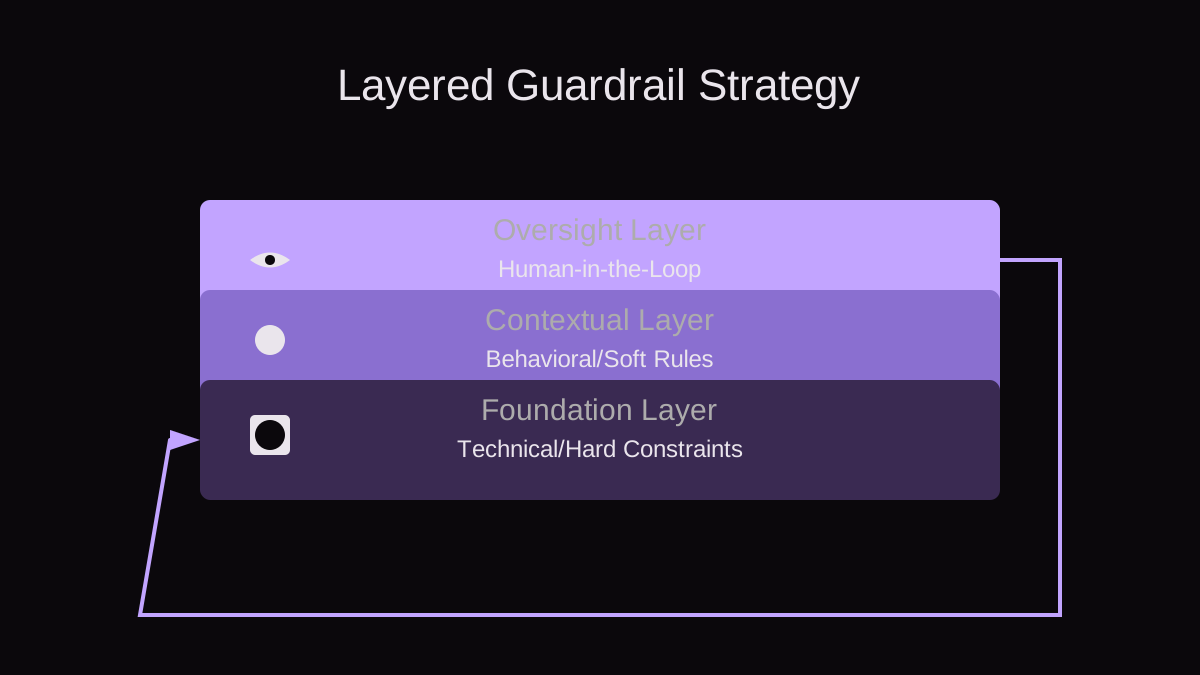
Building agentic products that deliver real utility without spiraling into unpredictable or unsafe behavior is perhaps the most critical challenge facing AI product managers today. The core answer lies in designing guardrails not as static, restrictive fences, but as dynamic, adaptive systems that guide agent behavior within acceptable bounds while preserving its core ability to act autonomously and achieve user goals. This requires a layered approach, integrating technical constraints, contextual rules, and continuous human-in-the-loop oversight, all developed iteratively to ensure usefulness isn't sacrificed for safety, nor safety for utility.
My years in product management, spanning streaming, fintech, and healthcare, have consistently reinforced a simple truth: products thrive when they solve real problems reliably and safely. With agents, reliability and safety take on new dimensions. We're not just managing features; we're managing capabilities, intent, and potential consequences. This guide will walk you through actionable strategies for designing guardrails that foster agent utility, rather than stifle it.
Why Aren't Simple Rules Enough for Agentic Products?
The allure of simple, hard-coded rules for AI agents is strong. Just tell it 'don't do X' or 'always do Y.' But this approach quickly breaks down with agentic systems because their very nature is to adapt, learn, and operate in dynamic environments. Simple rules are brittle; they fail to account for edge cases, novel situations, or nuanced interpretations of user intent. An agent designed to optimize a complex process might encounter an unforeseen variable that a static rule set simply can't handle, leading to either paralysis (if the rule is too strict) or undesirable actions (if it's too lax).
The 'why it breaks' here is crucial: agents operate on emergent behavior. Their utility comes from their ability to chain actions, synthesize information, and make decisions in ways we haven't explicitly pre-programmed. When we impose overly rigid rules, we effectively turn an agent into a deterministic script, stripping away its core value proposition. The goal isn't to prevent all emergent behavior, but to guide it towards desirable outcomes and away from undesirable ones.
How to Use the Agent Autonomy-Risk Matrix (AARM) for Guardrail Design
To effectively design guardrails, we first need to understand the inherent risk and desired autonomy of the agent. I've found the Agent Autonomy-Risk Matrix (AARM) to be an invaluable tool. It helps product teams categorize agent tasks and functionalities, guiding the selection of appropriate guardrail types. The matrix assesses two dimensions: the potential impact of an agent's failure (Risk Level) and the degree of independent decision-making the agent needs (Autonomy Level).
Here's how to apply the AARM:
- Define the agent's core purpose and key actions it can take.
- For each key action or capability, assess its Potential Impact of Failure: Low (e.g., suggesting a wrong movie), Medium (e.g., mismanaging a non-critical task), High (e.g., financial loss, health risk, data breach).
- For each key action, determine the Required Autonomy Level: Low (requires explicit human approval for every step), Medium (can execute routine tasks, flags exceptions), High (can execute complex, multi-step tasks with minimal oversight).
- Map these assessments onto a 2x2 or 3x3 matrix. This categorization will dictate your guardrail strategy. High Risk/High Autonomy scenarios demand the most robust, multi-layered guardrails with significant human oversight and intervention points.
- Use the matrix to prioritize guardrail development, focusing first on high-risk areas, regardless of autonomy level.
Designing Guardrails: A Step-by-Step Worked Example
Let's consider an AI financial planning agent designed to help users manage their personal investments. Its core utility is to analyze a user's financial goals, risk tolerance, and existing portfolio, then suggest adjustments or new investment opportunities. This is a high-stakes domain, so robust guardrails are non-negotiable.
- Step 1: Define Core Agent Capabilities and AARM Assessment. The agent needs to: 1. Analyze portfolio (Medium Autonomy, Low-Medium Risk - if analysis is wrong, it leads to bad suggestions, but no direct action). 2. Suggest investment changes (Medium Autonomy, High Risk - directly impacts user's money). 3. Execute trades (Low Autonomy, High Risk - direct financial action, requires explicit human approval). 4. Answer financial questions (High Autonomy, Low-Medium Risk - if advice is wrong, could mislead, but no direct action).
- Step 2: Implement Foundation Layer (Technical/Hard Constraints). For the 'Execute trades' capability, the agent absolutely cannot directly access trading APIs. It can prepare a trade order, but it must be routed through a secure, user-facing interface that requires explicit, multi-factor authenticated approval from the user. For data access, it must only use encrypted, anonymized data, and adhere to strict data privacy regulations (e.g., GDPR, CCPA). Rate limits on external API calls prevent accidental spamming or excessive querying.
- Step 3: Implement Contextual Layer (Behavioral/Soft Rules). For 'Suggest investment changes,' the agent's prompt instructions include directives like 'Always prioritize long-term growth and diversification over speculative gains,' 'Never recommend products not available in the user's jurisdiction,' and 'Always flag potential tax implications.' We also build in sentiment analysis to detect user distress and trigger a human handover. The agent is trained on a curated corpus of financial best practices and regulatory guidelines.
- Step 4: Implement Oversight Layer (Human-in-the-Loop). For 'Suggest investment changes,' all high-value or high-risk suggestions (e.g., reallocating more than 20% of a portfolio) are automatically flagged for a human financial advisor's review before being presented to the user. Users also have an 'Undo' button for any suggested changes before execution. A real-time monitoring system tracks agent actions for deviations from expected behavior, such as unusually aggressive recommendations or repeated attempts to access restricted data. Anomalies trigger alerts for human review. User feedback loops are prominent, allowing users to report undesirable agent behavior directly.
- Step 5: Iterative Testing and Refinement. We run extensive red-teaming exercises where financial experts and ethical hackers try to break the agent, coaxing it into making bad recommendations or attempting unauthorized actions. A/B testing different guardrail configurations helps us fine-tune the balance between utility and safety. User acceptance testing (UAT) with real users provides invaluable insights into practical usability and unexpected failure modes.
This multi-layered approach ensures that even if one guardrail fails, others are in place to mitigate the risk, allowing the agent to provide valuable financial guidance without putting user assets at undue risk.

Common Mistakes in Guardrail Design and How to Avoid Them
Even with the best intentions, guardrail design can go awry. Here are some frequent pitfalls I've observed and how to navigate them.
- Mistake: Over-Constraining Agent's Intent. Failure Mode: The agent becomes useless, unable to perform its core function because too many rules prevent it from taking necessary actions or adapting to nuances. It's like telling a chef exactly how to chop every vegetable for every dish. Detection: Low task completion rates, frequent 'I cannot fulfill this request' responses, high user frustration. Avoidance: Shift from 'how to do' rules to 'what not to do' or 'what outcome to achieve' rules. Focus guardrails on undesirable outcomes or critical safety boundaries, giving the agent freedom within those bounds. Use positive reinforcement in training over purely negative constraints.
- Mistake: Under-Constraining High-Risk Actions. Failure Mode: The agent causes unintended, potentially severe harm (financial loss, data breach, reputational damage) because critical decision points lack sufficient oversight or hard limits. Detection: Incidents of unauthorized actions, data leakage, or actions that violate policy. Avoidance: Apply the AARM rigorously. For high-risk actions, always implement multiple, redundant guardrails across the foundation, contextual, and oversight layers. Ensure human-in-the-loop validation for any action with irreversible consequences or significant impact.
- Mistake: Static, Non-Adaptive Rules. Failure Mode: Guardrails become outdated as the agent learns, the environment changes, or new threats emerge, leading to either unnecessary restrictions or gaping security holes. Detection: Increasing false positives (agent unnecessarily blocked) or false negatives (agent performs undesirable action unnoticed) over time. Avoidance: Design guardrails with continuous feedback loops. Implement monitoring systems that track guardrail effectiveness and trigger reviews. Regularly update and retrain guardrails based on new data, incident reports, and evolving regulatory landscapes. Treat guardrails as living components of your product.
- Mistake: Opaque Guardrails. Failure Mode: Users, and even product teams, don't understand why an agent behaved a certain way or why an action was blocked, leading to a lack of trust and difficulty debugging. Detection: High rates of user complaints about 'unexpected' agent behavior, difficulty reproducing issues, lack of clarity in incident reports. Avoidance: Build explainability into your guardrails. When an agent's action is blocked or modified by a guardrail, provide a clear, concise reason to the user and for internal logging. This transparency builds trust and aids in debugging and refinement.
Key Takeaways
- Guardrails for agentic products must be dynamic and adaptive, not static and overly restrictive, to preserve utility.
- Adopt a layered guardrail strategy: Foundation (technical), Contextual (behavioral), and Oversight (human-in-the-loop).
- Utilize the Agent Autonomy-Risk Matrix (AARM) to systematically assess agent capabilities and prioritize guardrail design based on potential impact and required autonomy.
- For high-risk actions, implement hard technical constraints and mandatory human validation points.
- For behavioral guidance, use contextual rules, prompt engineering, and curated training data.
- Build continuous monitoring and feedback loops into your guardrail system, treating them as living components that evolve with the agent and its environment.
- Prioritize transparency: ensure users and internal teams understand why an agent's action was guided or blocked by a guardrail.
- Avoid over-constraining the agent's intent; focus guardrails on preventing undesirable outcomes rather than dictating every step.
- Regularly red-team your agent and guardrails to proactively identify and address vulnerabilities.