AI Product
Data Governance for AI PMs: Compliance & Quality Guide
For AI Product Managers, data governance is the strategic framework that ensures data used throughout the AI product lifecycle is of high quality, compliant with regulations, ethically sourced, and securely managed. It’s not a bureaucratic hurdle but a fundamental enabler for building AI products that are trustworthy, performant, and resilient. My experience across streaming, fintech, and healthcare has consistently shown that proactive data governance mitigates significant risks, prevents costly rework, and ultimately unlocks greater value from our AI investments. Ignoring it is like building a skyscraper on sand; it might stand for a while, but failure is inevitable.
As PMs, we sit at the intersection of business, technology, and user needs. This unique position means we are uniquely responsible for championing data governance from the very first discovery call to post-launch monitoring. It directly impacts our product roadmap, feature prioritization, and the very viability of our AI solutions. Let’s dive into how you can make data governance a competitive advantage.
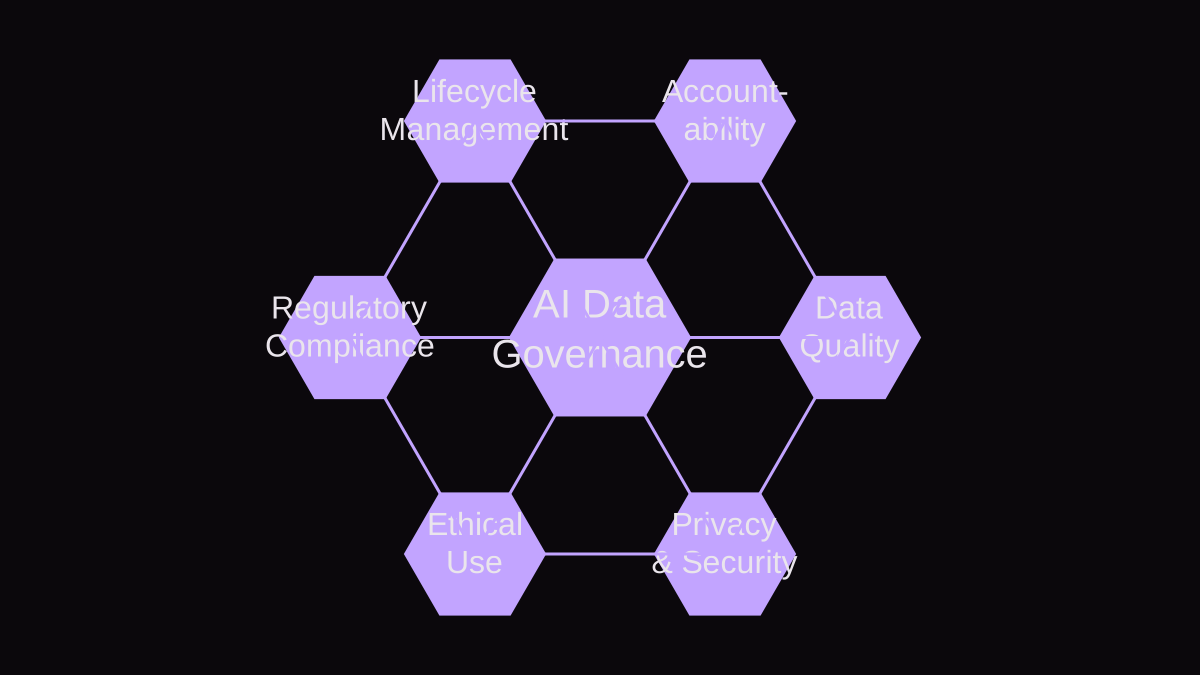
Why is Data Governance a PM's Problem, Not Just Legal's?
Many PMs, especially those new to AI, might view data governance as a compliance chore best left to legal or security teams. This is a critical misconception. While those teams are essential partners, the AI Product Manager must own the integration of governance requirements into the product itself. Why? Because poor data governance directly impacts every facet of your AI product's success.
Consider the direct impact: if your data is biased, your model will be biased, leading to unfair outcomes and potentially alienating a significant portion of your user base. If data privacy isn't baked in, you face massive regulatory fines, reputational damage, and a complete loss of user trust. If data quality is poor, your model performance will suffer, leading to inaccurate predictions, unreliable features, and a product that simply doesn't deliver its promised value. These aren’t legal issues; they are product issues that directly affect adoption, retention, and market viability.
When data governance breaks, it often manifests in ways that cripple the product. I've seen product launches delayed by months due to newly discovered privacy non-compliance, AI models failing in production because training data drift wasn't monitored, and entire features scrapped due to unmitigated bias. As the PM, these failures land squarely on your desk. You're responsible for the product's success, and that success is intrinsically tied to the quality, integrity, and compliant use of its underlying data. This means you need to translate regulatory requirements and ethical principles into concrete product features, data pipelines, and operational processes.
How Do I Embed Data Quality & Compliance Early On? The AI Data Integrity Rubric
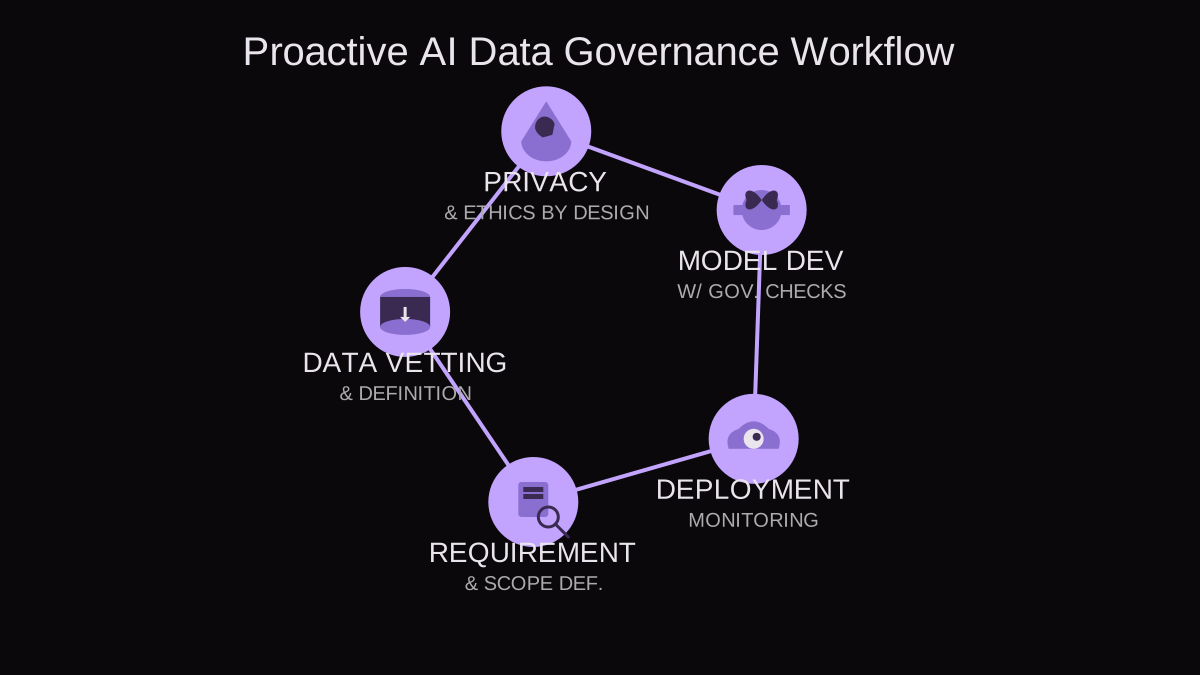
To proactively embed data governance, I’ve developed a practical framework called The AI Data Integrity Rubric. This isn't just a checklist; it's a decision-making tool you can apply at every stage, from ideation to deployment. Here are its core criteria:
- 1. Data Source Vetting & Provenance: Understand where your data comes from, its collection methods, and any inherent biases. This includes assessing its reliability, representativeness, and legal permissibility for your intended AI use case. Ignoring provenance can lead to models that perpetuate societal biases or violate data usage agreements.
- 2. Data Definition & Schema Consistency: Ensure every data point has a clear, consistent definition, schema, and versioning across your entire data ecosystem. Ambiguous definitions lead to misinterpretations, integration errors, and models trained on inconsistent data. This impacts model accuracy and debugging capabilities significantly.
- 3. Privacy & Security by Design: Integrate privacy-preserving techniques (like anonymization, pseudonymization, differential privacy) and robust security controls (access management, encryption) from the ground up. Don't add these as an afterthought. Failing here exposes you to massive regulatory penalties and user distrust.
- 4. Ethical Use Assessment: Actively assess your data for potential biases, fairness concerns, and the risk of discriminatory outcomes. This goes beyond legal compliance to include ethical considerations around how your AI might impact different user groups. Ignoring this can lead to reputational damage and social harm.
- 5. Data Lifecycle Management: Define clear policies for data retention, archival, and deletion. Data should only be kept as long as necessary for its intended purpose and legal requirements. Unmanaged data sprawl increases security risks, storage costs, and regulatory exposure (e.g., GDPR, CCPA).
- 6. Data Monitoring & Auditing: Establish mechanisms for continuous monitoring of data quality, drift, and usage patterns. This includes tracking data lineage, auditing access logs, and regularly validating that data adheres to defined governance policies. Without monitoring, issues can silently corrupt your AI’s performance over time.
Applying this rubric early forces you to ask critical questions about your data's journey and impact. It transforms data governance from a reactive burden into a proactive component of product excellence.
A Worked Example: Launching a Predictive Healthcare AI
Let’s walk through a concrete scenario: you're an AI PM building a new AI product designed to predict patient readmission risk for hospitals. This AI will analyze electronic health records (EHR) to flag high-risk patients, allowing early intervention. Here's how The AI Data Integrity Rubric guides the process:
Step 1: Data Source Vetting & Provenance. Your team needs to access historical EHR data. As the PM, you work with legal and data engineering to ensure consent was properly obtained for this secondary use of data, and that data usage agreements are in place. You investigate if the historical EHR data reflects a diverse patient population or if it's skewed towards a specific demographic, which could introduce bias. You’d ask: Was this data collected from a representative sample of hospitals? Are there known issues with data entry or missing values in specific fields?
Step 2: Data Definition & Schema Consistency. EHR data is notoriously complex. You define clear, standardized schemas for patient demographics, diagnosis codes (e.g., ICD-10), medication lists, and visit types. You ensure that different hospitals’ data, even if from disparate systems, is mapped to a consistent internal representation. This prevents issues where 'medication' means different things across datasets, leading to model confusion and inaccurate predictions. You mandate version control for these schemas, so changes are tracked and communicated.
Step 3: Privacy & Security by Design. HIPAA compliance is non-negotiable. You specify requirements for robust de-identification techniques, like k-anonymity or l-diversity, to protect patient identities. You ensure that access to the raw, identified data is strictly controlled and audited, only granted to authorized personnel for specific, approved purposes. The AI model itself should only operate on de-identified data in production, and all data transfers must be encrypted both in transit and at rest. As PM, you drive features like data masking in development environments.
Step 4: Ethical Use Assessment. You proactively work with data scientists to identify potential biases. For example, if the historical data shows higher readmission rates for certain socioeconomic groups due to systemic healthcare disparities, your AI might perpetuate these biases. You require the team to analyze model performance across different demographic slices (age, gender, ethnicity, income) and mandate fairness metrics. You also champion explainability features to help clinicians understand why a patient was flagged, rather than just receiving a black-box prediction, enhancing trust and preventing harmful automated decisions.
Step 5: Data Lifecycle Management. You define how long patient data can be retained based on regulatory requirements and the product's purpose. For instance, you might decide to retain de-identified data used for model training for 7 years for auditing purposes, but automatically purge certain sensitive attributes after a shorter period. You specify secure deletion protocols to ensure data is irrecoverably removed when its retention period expires, avoiding data sprawl and minimizing risk.
Step 6: Data Monitoring & Auditing. Post-deployment, you set up dashboards and alerts to monitor the incoming data stream for drift (e.g., changes in patient demographics, new diagnosis codes not seen in training). You audit who accesses which data, when, and why. You also monitor model predictions against actual readmission rates, continuously validating the model’s efficacy and ensuring it’s not subtly failing for specific patient cohorts. This continuous feedback loop ensures long-term product health and compliance.
By following these steps, you’re not just building an AI; you’re building a responsible, ethical, and compliant AI product that truly serves its users and stakeholders.
What are the Common Data Governance Mistakes AI PMs Make?
Even with the best intentions, AI PMs often stumble when it comes to data governance. Recognizing these pitfalls is the first step to avoiding them.
Failure Mode 1: Treating governance as a post-development checklist.
Detection: You find yourself scrambling to answer legal queries or privacy impact assessments right before a launch, leading to costly delays or last-minute feature cuts. Compliance issues are discovered by external auditors rather than internally. Your engineers are constantly refactoring data pipelines to meet new, late-stage requirements.
Avoidance: Integrate governance into your product discovery, design, and sprint planning from day one. Use frameworks like The AI Data Integrity Rubric during initial requirement gathering and continuously throughout the development lifecycle. Make governance a non-functional requirement for every feature, just like performance or scalability.
Failure Mode 2: Over-reliance on technical teams for ethical considerations.
Detection: Your data science team builds a highly accurate model, but it exhibits unexplainable or biased behavior in certain edge cases. There’s a lack of clear documentation on how fairness metrics were chosen or how bias mitigation techniques were implemented. User feedback points to discriminatory outcomes that the technical team didn't anticipate.
Avoidance: As the PM, you are the voice of the user and the advocate for ethical AI. You must drive the ethical requirements, facilitating discussions between data scientists, legal, and ethicists. Your role is to define the ethical guardrails, ensure the team is equipped to measure and mitigate bias, and validate that these considerations are reflected in the product's design and behavior.
Failure Mode 3: Ignoring data lineage and provenance.
Detection: When a model's performance degrades, it's nearly impossible to trace back whether the issue stems from the original data source, a transformation step, or a new feature being introduced. You have multiple versions of the 'same' dataset with no clear understanding of their differences or origins. Debugging data-related issues becomes a time sink.
Avoidance: Mandate clear documentation and tooling for data lineage. Ensure that every transformation, aggregation, and feature engineering step is tracked and versioned. This provides an audit trail for your data, making it easier to diagnose problems, ensure reproducibility, and comply with data traceability requirements. Treat data like code: it needs version control and clear documentation.
Failure Mode 4: Neglecting data retention and deletion policies.
Detection: Your data storage costs are skyrocketing, with petabytes of old, unused data accumulating. When a user requests data deletion (e.g., under GDPR or CCPA), your team struggles to locate and permanently remove all instances of their data. Security breaches expose vast amounts of data that should have been purged long ago.
Avoidance: Define clear data retention schedules for all data assets, categorized by sensitivity and regulatory requirements. Implement automated processes for data archiving and secure deletion. As the PM, ensure these policies are translated into engineering requirements for data pipelines and storage systems. This proactive approach minimizes risk, reduces costs, and ensures compliance.
Key Takeaways for AI Product Managers
- Data governance is a core PM responsibility, not just a compliance task. It directly impacts your AI product's success, user trust, and market viability.
- Embed governance principles and requirements (like The AI Data Integrity Rubric) from the discovery phase through to deployment and beyond.
- Proactive data quality, privacy, and ethical considerations prevent costly failures, mitigate risks, and build lasting user trust.
- Understand and actively manage data lineage, provenance, and lifecycle management for robust, auditable, and debuggable AI systems.
- Foster strong cross-functional collaboration with legal, data science, engineering, and security teams on all governance matters.
- Implement continuous monitoring and auditing of data and model performance to ensure long-term compliance, quality, and ethical operation of your AI products.