AI Product
Crafting PRDs for LLM-Powered Features: A PM's Definitive Guide
Listen — audio summary in Nehal Vyas's voice
Transcript
Hello everyone! Today, I want to talk about crafting Product Requirements Documents, or PRDs, specifically for features powered by large language models. As an AI Product Manager, I've found these PRDs are fundamentally different from traditional ones, mainly due to the probabilistic and often opaque nature of LLMs. Instead of just defining exact functionalities, we must specify acceptable ranges of model behavior and robust guardrails. I detail my 'LLM Outcome Definition Rubric' to systematically capture desired output ranges, acceptable error rates, crucial guardrail conditions, and fallback mechanisms, ensuring clear alignment across engineering, data science, and design teams. A robust LLM PRD also demands a comprehensive model and data strategy. This means going beyond 'just use an LLM' to specify model selection, prompt engineering, and Retrieval Augmented Generation (RAG) plans. Equally important are detailed strategies for data collection, quality, governance, and how feedback loops will continuously improve the model. Finally, success for an LLM feature requires unique evaluation and monitoring. We need specific metrics for relevance, factual consistency, safety, and hallucination rates, alongside qualitative human feedback and continuous drift detection. It’s about ensuring our products learn and adapt responsibly. To dive deeper into this holistic approach, I invite you to read the full article on hinehal.com.
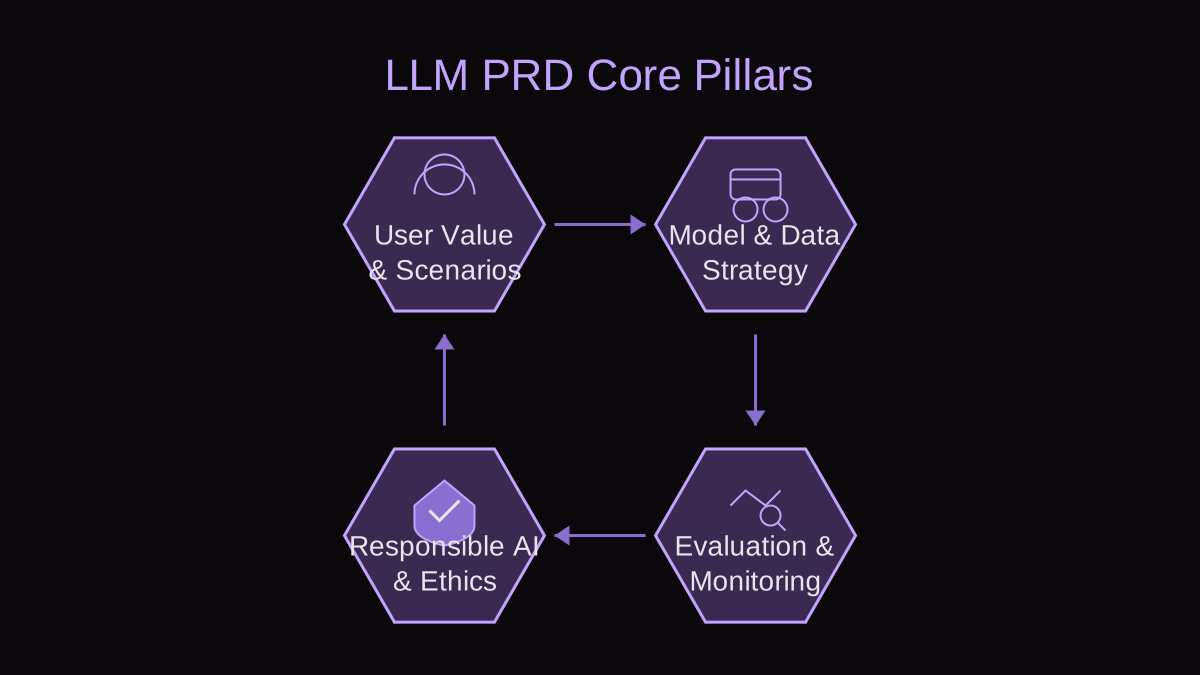
As an AI Product Manager, I've learned that a Product Requirements Document (PRD) for an LLM-powered feature requires a holistic approach, extending significantly beyond traditional software PRDs. It must explicitly address the probabilistic nature of AI, detail a robust data strategy, plan for model explainability, and integrate responsible AI principles from the very outset. Rather than merely defining desired user outcomes, an LLM PRD must articulate the acceptable range of model behaviors, specify the data required for training and fine-tuning, and establish comprehensive, LLM-specific monitoring and evaluation metrics.
This isn't just about adding a new technology; it's about fundamentally rethinking how we define, build, and measure success for products that learn and adapt. The ambiguities inherent in large language models necessitate a level of clarity and foresight in your PRD that ensures alignment across engineering, data science, legal, and design teams, all while managing user expectations.
What Makes LLM PRDs Unique?
What makes writing a PRD for an LLM-powered feature fundamentally different from a traditional software feature? The core distinction lies in the probabilistic, data-driven, and often opaque nature of large language models. Unlike deterministic software, where an input consistently yields a predictable output, LLMs operate within a spectrum of probabilities. This introduces unique challenges. The output is often a matter of 'good enough,' 'relevant,' or 'safe,' not simply 'right' or 'wrong.' Performance is intrinsically tied to data quality, quantity, and bias, plus prompt engineering. Ethical implications like bias, fairness, privacy, and misuse are more pronounced. As PMs, we must shift from specifying exact functionalities to defining acceptable performance ranges, robust guardrails, and continuous learning loops.
Defining User Value and Scenarios for Probabilistic AI
How do we define success when the output isn't perfectly predictable? For LLM-powered features, our PRD must go beyond listing features to deeply articulate the user problem, the core job-to-be-done, and the specific scenarios where the LLM provides value. We also need clear boundaries of acceptable performance and guardrails to prevent undesirable outputs. I use 'The LLM Outcome Definition Rubric' to systematically capture these critical aspects, ensuring all stakeholders understand the LLM's purpose, limitations, and management.
- 1. User Problem and Core Job-to-be-Done: Clearly define the user pain point or inefficiency. What is the user achieving, and how does the LLM help?
- 2. Desired Output Range and Quality Criteria: Define 'good' output characteristics. Describe the acceptable spectrum of responses (accuracy, conciseness, tone, factual consistency). Provide examples of desired and undesirable outputs.
- 3. Acceptable Error Rate and Tolerance: Quantify the maximum acceptable error rate. Is it 1% factual inaccuracy, 5% hallucination, or a specific F1 score?
- 4. Guardrail Conditions and Safety Protocols: Specify when the LLM should not respond, defer to human, or provide safe response. Includes sensitive topics, out-of-scope queries, or potential misuse. Detail escalation.
- 5. Fallback Mechanism: Describe what happens when the LLM fails guardrails or produces unacceptable output. Revert to search, human agent, or state inability to assist? Crucial for trust.
- 6. Explainability Requirements (if applicable): If understanding 'why' an output was produced is needed, define the level. E.g., source attribution or reasoning traces, critical in regulated domains.
The Model and Data Strategy: Beyond Just 'Use an LLM'
Simply writing 'Use an LLM' in your PRD is a recipe for disaster. A robust LLM PRD must include a detailed strategy for the model and its data, requiring close collaboration with ML Engineers and Data Scientists.
Model Strategy:
- Model Selection & Architecture: Choose public, open-source, or proprietary. Justify based on cost, performance, privacy, task. Will you fine-tune or use API?
- Prompt Engineering Strategy: Detail crafting prompts (few-shot, chain-of-thought) and versioning.
- Retrieval Augmented Generation (RAG): If grounding in specific info is needed, outline the RAG strategy.
- Model Size and Cost Trade-offs: Guide decisions balancing size, performance, latency, and operational cost for high-usage features.
Data Strategy:
- Training and Fine-tuning Data: Specify types, sources, quantity, and quality requirements. Include collection, annotation, and preprocessing.
- Evaluation Datasets: Define specific datasets and benchmarks for model performance evaluation.
- Data Governance and Privacy: Outline sensitive data handling: anonymization, regulatory adherence (GDPR, HIPAA), security protocols.
- Feedback Loops and Data Refresh: Describe user/human feedback collection for model improvement, and data refresh frequency.
How to Define Success: LLM Evaluation and Monitoring
Defining 'success' for an LLM feature goes beyond traditional uptime. Your PRD must articulate a comprehensive evaluation and monitoring plan unique to generative AI.
Quantitative Metrics for LLMs:
- Traditional Metrics: Latency, throughput, cost per inference, uptime.
- LLM-Specific Metrics: Relevance, factual consistency (RAG adherence), fluency, coherence, conciseness, safety scores (toxicity, bias), hallucination rate, goal completion rate.
Qualitative Evaluation and Human-in-the-Loop (HITL):
- Expert Review: Define processes for human experts to evaluate outputs.
- User Feedback Loops: How will users provide feedback (e.g., thumbs-up/down)? How is it collected, analyzed, and integrated?
- A/B Testing Strategy: Outline testing different model versions, prompts, or RAG configurations.
Continuous Monitoring Strategy:
- Performance Monitoring: Track quantitative metrics in real-time, with alerts.
- Data and Model Drift Detection: Monitor data and outputs for shifts degrading performance.
- Safety and Bias Monitoring: Continuously scan outputs for undesirable content. Define escalation.
- Cost Monitoring: Track usage and cost against budget.
A Worked Example: Enhancing a Healthcare Platform with AI-Powered Patient Summary Generation
Let's walk through a concrete example using The LLM Outcome Definition Rubric for a hypothetical feature: automatically generating draft patient summaries for clinicians within a healthcare platform.
Scenario: Clinicians spend significant time manually summarizing patient notes, clinical observations, and test results into a concise summary for handovers, referrals, or quick review. This is time-consuming and prone to human error.
Applying The LLM Outcome Definition Rubric:
- 1. User Problem and Core Job-to-be-Done: Clinicians face high administrative burden and potential information loss when summarizing patient records. The AI should rapidly generate accurate, concise, and clinically relevant draft summaries for review and finalization, acting as a force multiplier.
- 2. Desired Output Range and Quality Criteria: Output: A bulleted list or short paragraph (150-300 words) of key patient info (diagnosis, treatment, allergies, meds, recent events) from EMR data. Quality: 100% factual consistency, conciseness, clinical relevance, professional tone, and source attribution for each point.
- 3. Acceptable Error Rate and Tolerance: Factual Inaccuracy: 0% tolerance. Omission of Critical Information (allergies, active diagnoses, meds): 0% tolerance. Hallucination: 0% tolerance. Non-Critical Formatting/Fluency Issues: Max 2-3% tolerance if not impeding understanding.
- 4. Guardrail Conditions and Safety Protocols: Confidentiality: LLM must adhere to HIPAA, securing PHI. Out-of-Scope Queries: System must state it's a summary tool, not for diagnosis. Ambiguous/Incomplete Input: LLM flags insufficient data. Bias Detection: Continuous monitoring for language bias.
- 5. Fallback Mechanism: If summary triggers guardrail (e.g., hallucination, PHI leak), system should: not display summary, notify clinician to summarize manually, log incident for review, and provide issue reporting pathway.
- 6. Explainability Requirements: Source Attribution: Every key fact in the summary must link back to its original EMR section (e.g., 'From Progress Note'). This is non-negotiable for clinical trust.
Common Mistakes in LLM PRDs and How to Avoid Them
Even with the best intentions, critical missteps in LLM PRDs are common. Here are pitfalls and how to steer clear:
- Mistake 1: Treating LLMs as Deterministic Black Boxes. Failure Mode: Expecting perfectly predictable outputs, leading to brittle features. How to Detect/Avoid: Embrace probabilistic nature. Define acceptable ranges of behavior, not single-point outcomes, using the Outcome Definition Rubric. Plan robust monitoring.
- Mistake 2: Neglecting a Comprehensive Data Strategy. Failure Mode: Assuming high-quality data will magically appear, resulting in biased or low-performing models. How to Detect/Avoid: Dedicate a significant PRD section to 'Data Strategy.' Detail sources, collection, quality, governance, and privacy. Collaborate early with data scientists.
- Mistake 3: Insufficient LLM-Specific Evaluation Metrics. Failure Mode: Relying only on traditional software metrics, missing crucial performance nuances like factual accuracy, relevance, or safety. How to Detect/Avoid: Include diverse quantitative and qualitative LLM-specific metrics. Define baseline targets and deviation ranges. Implement human-in-the-loop (HITL).
- Mistake 4: Ignoring Responsible AI Principles from Day One. Failure Mode: Treating bias, fairness, transparency, and safety as afterthoughts, leading to discriminatory outputs or reputational damage. How to Detect/Avoid: Integrate 'Responsible AI & Ethics' as a core pillar. Address biases, define fairness, outline transparency, and establish safety guardrails. Engage legal and ethics teams early.
- Mistake 5: Over-relying on LLM 'Magic' to Solve Undefined Problems. Failure Mode: Deploying an LLM without a clear, well-defined user problem, resulting in features with poor adoption or commercial non-viability. How to Detect/Avoid: Start with the 'User Problem and Core Job-to-be-Done' from the Outcome Definition Rubric. Validate the problem extensively, articulating why an LLM is the optimal solution.
Key Takeaways
- An LLM PRD is fundamentally different from a traditional software PRD, requiring a shift in mindset to embrace probabilistic outcomes and data-centric development.
- Clearly define user value and acceptable performance using a structured framework like 'The LLM Outcome Definition Rubric' to set realistic expectations and guardrails.
- Develop a detailed 'Model and Data Strategy' that specifies model choices, prompt engineering, RAG, data sources, quality, governance, and feedback loops.
- Implement comprehensive 'LLM-Specific Evaluation and Monitoring' metrics, combining quantitative analysis with qualitative human-in-the-loop processes.
- Integrate 'Responsible AI Principles' as a core design pillar from the outset, proactively addressing bias, fairness, transparency, and safety.
- Avoid common pitfalls by acknowledging LLM's probabilistic nature, prioritizing data strategy, using robust evaluation, and ensuring the LLM solves a real, well-defined user problem.