AI Product
Crafting a Compelling AI Product Vision: A PM's Strategic Guide
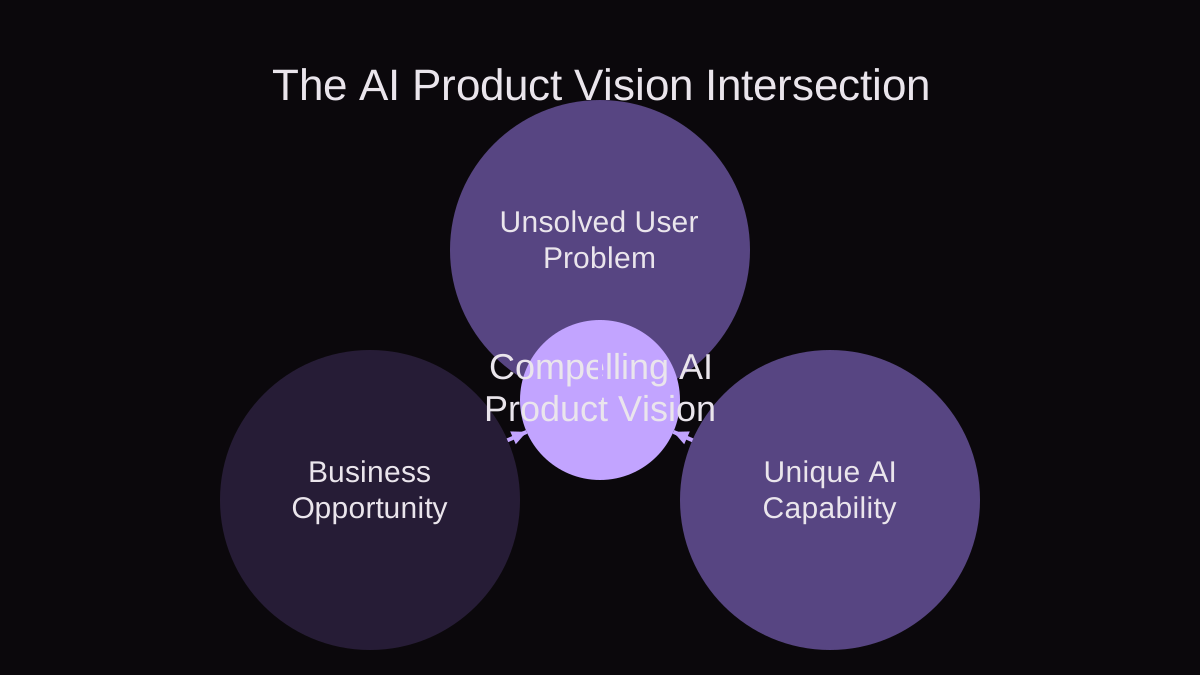
Crafting a compelling AI product vision begins with deeply understanding the intersection of unsolved user problems, viable business opportunities, and the unique capabilities of AI. It's not just about what AI can do, but what specific, high-value problem it can solve for a defined user segment, aligning clearly with your organization's overarching strategic goals. My experience across streaming, fintech, and healthcare has consistently shown that a clear, resonant vision is the compass that navigates the complexities of AI development, ensuring we build products that deliver tangible value and avoid becoming mere technological novelties.
A strong AI product vision acts as an anchor, guiding every decision from data strategy to model deployment and feature prioritization. Without it, teams risk chasing fleeting trends, building solutions looking for problems, or creating products that fail to integrate seamlessly into user workflows or business operations. This guide is built from years in the trenches, designed to equip product managers and aspiring AI PMs with a practical roadmap to define, validate, and articulate an AI product vision that truly sets the stage for success.
What Defines a Robust AI Product Vision, and Why is it Crucial?
At its core, an AI product vision is a concise, inspirational statement outlining the future state your AI product aims to create for its users and the business. What makes it robust, especially in the AI domain, is its ability to account for the unique characteristics of AI: its reliance on data, its probabilistic nature, its ethical implications, and its capacity for continuous learning and evolution. It should paint a clear picture of the ultimate impact, not just the features.
The 'why' is simple: AI products are inherently more complex than traditional software. They deal with data dependencies, model interpretability challenges, potential biases, and a longer time-to-value. A clear vision provides strategic alignment across diverse teams—data scientists, engineers, designers, and business stakeholders. It helps prioritize investments, articulate value to customers, and, critically, manage expectations around what AI can and cannot do. Without a robust vision, you risk building a technically impressive solution that solves no real problem, or worse, one that creates unintended negative consequences.
When this breaks, you see teams struggling with scope creep, constant shifts in direction, and a lack of shared understanding. The engineering team might focus on optimizing model accuracy while the business team needs explainability. The data science team might be exploring new algorithms while the real bottleneck is data quality or availability. A weak vision leads to fragmented efforts and delayed or failed product launches, burning resources and eroding trust.
How Do You Identify the Right Problem and User for Your AI Product?
This is where many AI initiatives falter: starting with the technology rather than the problem. My approach always begins with rigorous problem identification and deep user understanding. It's about finding a significant, persistent pain point or an unmet need that, when addressed, unlocks substantial value for a specific user segment. This isn't unique to AI, but AI offers novel ways to solve problems that were previously intractable or highly inefficient.
- Start with the user, not the algorithm: Conduct user research, interviews, and observational studies to uncover genuine pain points. What tasks are frustrating, time-consuming, or impossible without AI assistance?
- Quantify the problem's impact: How many users are affected? How frequently? What is the cost (time, money, missed opportunities) of this problem going unsolved? A significant problem warrants a significant solution.
- Assess business alignment: Does solving this problem align with your organization's strategic objectives? Will it open new revenue streams, reduce costs, improve efficiency, or enhance customer satisfaction in a measurable way?
- Evaluate AI's unique fit: Is AI truly the best or only way to solve this problem effectively? Could a simpler, non-AI solution achieve similar results? AI should be an enabler, not a forced solution. Look for problems involving pattern recognition, prediction, optimization, or personalization at scale.
When you skip this step, you risk building a 'solution looking for a problem.' I've seen countless projects where brilliant AI models were developed, only to find no real market demand or user adoption because they didn't address a critical need. This leads to wasted engineering cycles, demoralized teams, and a perception that AI is overhyped or too expensive for the return it provides. The key is to be brutally honest about whether AI offers a distinct advantage over traditional methods.
Applying the AI Value-Fit Framework for Vision Validation
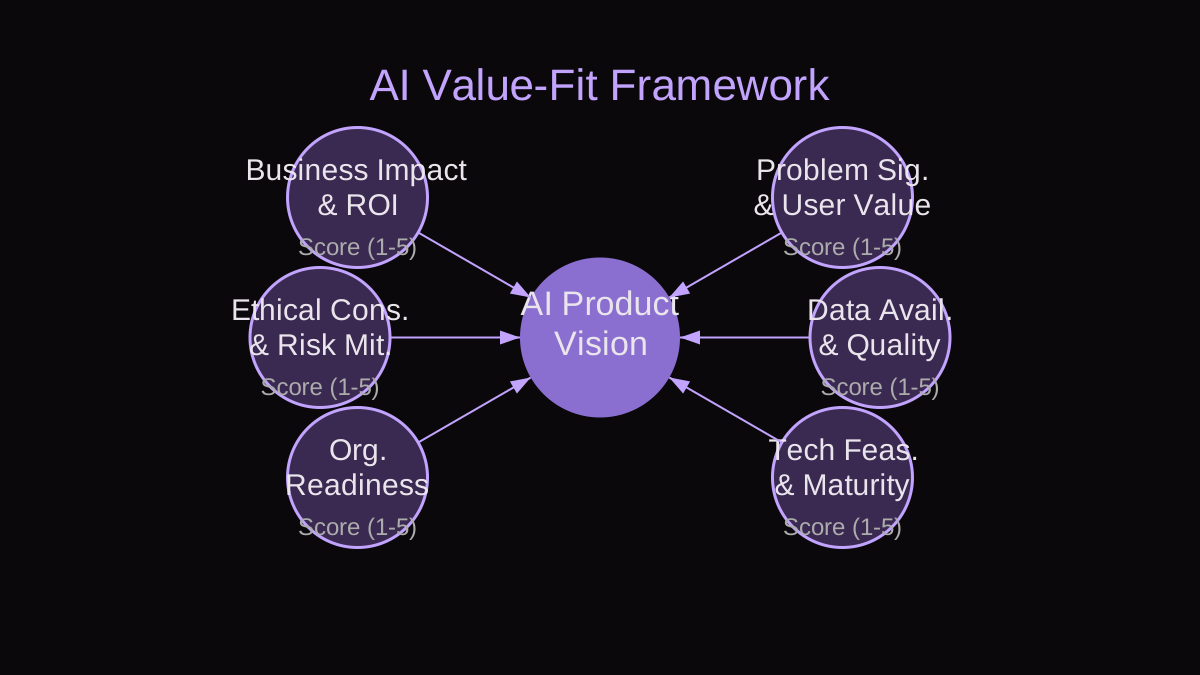
To systematically validate an AI product vision, I use a framework I call the 'AI Value-Fit Framework.' This rubric helps assess the viability and potential impact of an AI solution by considering multiple critical dimensions. It provides a structured way to evaluate whether your proposed AI product vision holds water before significant investment.
- 1. Problem Significance and User Value: Does the vision address a genuinely high-impact problem for a clearly defined user segment? Is the potential value to the user significant enough to drive adoption? (Score 1-5: 1=Low impact, 5=Transformative impact)
- 2. Data Availability and Quality: Do we have access to the necessary data (volume, variety, velocity, veracity) to train and operate the AI model effectively? What is the cost and effort of acquiring and preparing this data? (Score 1-5: 1=No data/poor quality, 5=Abundant/high quality)
- 3. Technical Feasibility and Model Maturity: Is the core AI capability achievable with current technology and our team's expertise? Are there existing models or research that support the approach? What is the expected accuracy and explainability required? (Score 1-5: 1=Highly speculative, 5=Proven tech/easy lift)
- 4. Business Impact and ROI: How will this AI product generate revenue, reduce costs, or create strategic advantage for the organization? Is the projected return on investment (ROI) compelling? (Score 1-5: 1=Negative ROI/cost center, 5=High ROI/strategic differentiator)
- 5. Ethical Considerations and Risk Mitigation: What are the potential ethical implications (bias, privacy, fairness, transparency) of this AI system? Can these risks be mitigated effectively? What regulatory compliance is required? (Score 1-5: 1=High unmitigated risk, 5=Low risk/clear mitigation strategy)
- 6. Organizational Readiness: Do we have the necessary organizational support, infrastructure, and change management capabilities to successfully build, deploy, and integrate this AI product? (Score 1-5: 1=Significant internal barriers, 5=High readiness)
Each criterion forces a crucial conversation and helps expose potential weaknesses in your vision. A low score in any key area signals a red flag that needs to be addressed, either by refining the vision, reassessing the problem, or acknowledging that the timing or resources aren't right. This framework ensures a holistic evaluation, moving beyond just technical feasibility to consider the broader ecosystem.
Worked Example: Crafting a Vision for a Healthcare AI Product
Let's walk through an example. Imagine we're at a large healthcare provider, and the problem is frequent patient readmissions for specific chronic conditions, leading to poor patient outcomes and significant financial penalties for the hospital. Our potential AI product aims to predict high-risk patients for readmission and enable proactive intervention.
- Step 1: Identify the Core Problem and User. The problem is preventable patient readmissions; the users are care coordinators and nurses who need to prioritize outreach, and patients who need better support. The impact is better health outcomes and reduced costs. This feels significant.
- Step 2: Initial Vision Statement (Draft 1). 'To use AI to predict patient readmissions.' This is too vague. It lacks specificity on who, what, and why.
- Step 3: Refine with AI's Unique Capability. AI's unique capability here is processing vast amounts of patient data (medical history, lab results, social determinants) to identify complex patterns beyond human capacity, providing predictive insights. Traditional methods rely on simpler rules and human judgment, which are less precise and scalable.
- Step 4: Incorporate User Value and Business Impact. For care coordinators, it's about efficient prioritization and proactive intervention. For patients, it's about improved health and fewer hospital visits. For the hospital, it's about cost savings and improved quality metrics.
- Step 5: Apply the AI Value-Fit Framework.
- 1. Problem Significance and User Value: High (5). Readmissions are a major issue with significant human and financial costs. Proactive intervention offers substantial value.
- 2. Data Availability and Quality: Moderate (3). Electronic Health Records (EHRs) exist, but data quality can be inconsistent (missing fields, unstructured notes). Requires significant data cleaning and integration effort.
- 3. Technical Feasibility and Model Maturity: High (4). Predictive modeling for readmissions is a well-researched area. Off-the-shelf models exist but will need customization and validation with our specific patient population.
- 4. Business Impact and ROI: High (5). Direct impact on hospital finances (reduced penalties) and reputation (improved patient outcomes). Clear ROI potential.
- 5. Ethical Considerations and Risk Mitigation: Moderate-High (2). Significant risks of bias (e.g., socioeconomic factors leading to unfair predictions), privacy concerns with patient data. Requires robust ethical AI guidelines, transparency, and careful validation to ensure fairness. This is a critical area to address.
- 6. Organizational Readiness: Moderate (3). Clinical teams are open to tools that improve care, but integration with existing workflows (EHRs, care management systems) will be complex and require change management. Data governance and IT infrastructure need strengthening.
Step 6: Final Vision Statement. Based on the framework, we see strong potential but also critical areas like data quality, ethical risks, and organizational readiness that need dedicated focus. Our refined vision might be: 'To empower healthcare providers with an intelligent system that accurately predicts high-risk patient readmissions for chronic conditions, enabling proactive, personalized interventions to improve patient outcomes and significantly reduce preventable hospital costs.' This vision is specific, impactful, and implicitly acknowledges the need to address ethical and integration challenges.
Common Mistakes in AI Product Visioning
Even with frameworks, it's easy to stumble. Here are the common pitfalls I've observed and how to avoid them:
- Failure Mode: Solutionism without a Problem. Building an AI solution because the technology is 'cool' or 'everyone else is doing it' without a clear, validated problem. How to detect: The vision statement focuses heavily on the technology ('We will build a large language model to...') instead of the user outcome ('We will enable users to...'). How to avoid: Always start with extensive user research and problem validation before considering AI. Can a non-AI solution solve this problem effectively?
- Failure Mode: Ignoring Data Realities. Assuming data will magically appear or be perfectly clean and ready for AI model training. How to detect: The team struggles to articulate specific data sources, data quality metrics, or the effort required for data preparation during initial discussions. How to avoid: Conduct a thorough data audit early. Understand data availability, accessibility, quality, and governance. If data isn't there, the vision needs to change or wait.
- Failure Mode: Overlooking Ethical Implications. Focusing solely on performance metrics (accuracy) while neglecting potential biases, fairness, privacy, or transparency issues. How to detect: Ethical considerations are an afterthought, or only discussed by one specific team member. How to avoid: Integrate ethical AI principles from day one. Design for interpretability, ensure diverse data sets, establish clear human-in-the-loop strategies, and perform bias audits proactively.
- Failure Mode: Lack of Organizational Alignment. The vision is compelling to the product team but not embraced by sales, marketing, operations, or leadership. How to detect: Resistance or confusion from other departments when discussing the AI product, or difficulty securing cross-functional resources. How to avoid: Involve key stakeholders from across the organization early and continuously. Articulate the vision in terms of their departmental impact and benefits. Gain buy-in at every level.
- Failure Mode: Stagnant Vision. Treating the vision as a static document, especially in the rapidly evolving AI landscape. How to detect: The vision hasn't been revisited or updated despite significant changes in technology, market conditions, or user feedback. How to avoid: Treat the vision as a living document. Regularly review and refine it, perhaps annually or bi-annually, to ensure it remains relevant and ambitious in light of new possibilities and challenges.
Key Takeaways
- An AI product vision must clearly articulate the high-value user problem solved, the business opportunity, and AI's unique role in addressing it.
- Always start with deep user and problem research; resist the urge to lead with technology.
- Utilize frameworks like the AI Value-Fit Framework to systematically validate your vision across critical dimensions: user value, data, feasibility, business impact, ethics, and organizational readiness.
- A compelling vision provides strategic alignment, guides prioritization, and manages expectations across all stakeholders.
- Actively mitigate common pitfalls such as solutionism, ignoring data realities, overlooking ethical concerns, and lacking organizational buy-in.
- Treat your AI product vision as a living document, subject to review and refinement as the AI landscape and user needs evolve.