AI Product
Building an AI Data Strategy: A PM's Guide to Acquisition & Labeling
For AI Product Managers, a well-defined data strategy for acquisition and labeling is not just a technical detail; it is the foundational pillar determining an AI product's performance, scalability, and ultimate market fit. Without a deliberate, strategic approach to sourcing, preparing, and refining the data that fuels our models, even the most innovative algorithms will underperform, leading to wasted resources, ethical concerns, and missed opportunities to deliver impactful solutions.
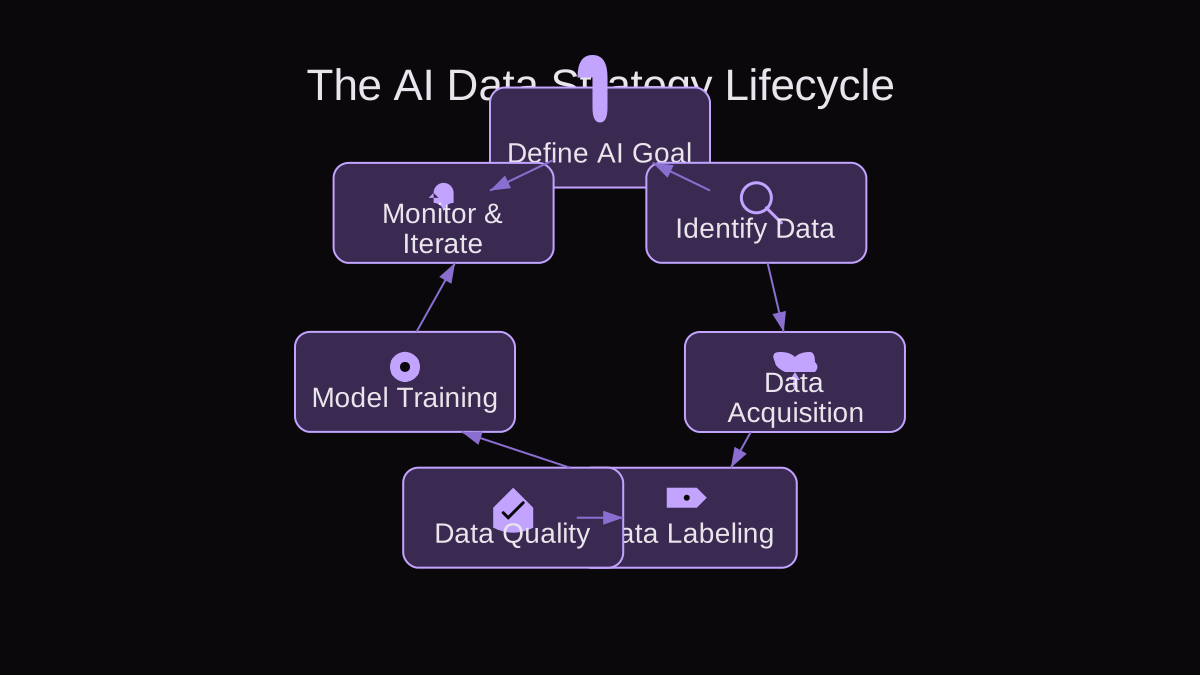
Why is an AI Data Strategy Essential for Product Managers?
As AI Product Managers, we are ultimately accountable for the success of our products. In the AI domain, product success is inherently tied to two core components: the model and the data. While engineering teams focus on model architecture and training, the data – its acquisition, quality, and ethical use – largely falls within the PM's domain alongside feature definition and user experience. My experience across streaming, fintech, and healthcare has consistently shown me that neglecting data strategy is a direct path to product failure.
A robust data strategy directly impacts several critical product dimensions: user experience, model performance, time-to-market, operational costs, and regulatory compliance. Without it, you risk building an AI product that is biased, inaccurate, fragile, or even illegal. When it breaks, you might find your models making poor recommendations, misdiagnosing conditions, or failing to generalize to real-world scenarios, leading to user dissatisfaction, reputational damage, and costly reworks. A proactive data strategy minimizes these risks and sets the stage for sustainable AI innovation.
How Do I Define My AI Data Needs? The Data Readiness Rubric
The first critical step in building any AI product is translating your product vision and user problems into specific data requirements. It is not enough to say, 'we need data.' You need to precisely define the type, quantity, quality, and diversity of data necessary to train a performant model. To guide this, I use a framework I call the Data Readiness Rubric for AI Products. It helps assess the suitability of potential data sources against key criteria.
- 1. Relevance: Does the data directly address the specific problem the AI model is solving? For example, if you are building a customer churn prediction model, you need historical customer behavior and interaction data, not just general demographic information. Irrelevant data adds noise and cost without value.
- 2. Representativeness: Does the data accurately reflect the real-world distribution of inputs the model will encounter in production? If your target users are globally diverse, your training data must not be skewed towards one region or demographic. Lack of representativeness leads to models that perform poorly on specific segments of your user base.
- 3. Quantity: Is there enough data to train a robust model for the complexity of the task? Deep learning models, especially for tasks like image recognition or natural language processing, often require massive datasets. Simpler models might need less, but the quality must be exceptionally high. Underestimating quantity leads to overfitting and poor generalization.
- 4. Quality & Consistency: Is the data accurate, complete, and free from noise, errors, or missing values? Are features consistently defined, measured, and formatted across all data points? Inconsistent or dirty data is 'garbage in, garbage out,' leading to unpredictable model behavior.
- 5. Accessibility & Privacy: Can we legally, ethically, and technically acquire and use this data? What are the implications for user privacy, data security, and compliance with regulations like GDPR, HIPAA, or CCPA? Ignoring these can lead to severe legal penalties and loss of user trust.
- 6. Cost & Effort: What is the estimated cost and effort for acquiring, cleaning, labeling, and maintaining this data? Is it sustainable within your project budget and timeline? High-cost data might require strategic trade-offs or alternative approaches like synthetic data generation.
To use this rubric, I recommend scoring each potential data source against these criteria (e.g., on a 1-5 scale) and identifying the gaps. This allows you to prioritize acquisition efforts, identify areas where data generation or augmentation might be necessary, and clearly articulate data requirements to your engineering and data science teams. When it breaks here, it means you collect data that is either irrelevant, insufficient for your model's needs, or so expensive to acquire and maintain that it renders the project unfeasible.
What Are the Most Effective Data Acquisition Strategies?
Once your data needs are clearly defined, the next challenge is sourcing that data. There are three primary avenues for data acquisition, and in practice, most successful AI products leverage a combination of these strategies to build comprehensive and robust datasets.
Internal Data: This refers to data that your organization already owns or generates through its operations. This includes user behavior logs, transactional data, customer support tickets, sensor data from IoT devices, enterprise resource planning (ERP) systems, and more. The primary advantage is that this data is often directly relevant to your business context and user base, and you generally have more control over its usage (within your organization's privacy policies). However, internal data often resides in silos, comes in inconsistent formats, or is stored in legacy systems, making extraction and integration challenging. When it breaks, your internal data might be incomplete for the AI's specific needs, or require immense engineering effort to make usable due to schema inconsistencies or lack of proper governance.
External Data: This category encompasses data obtained from outside your organization. This can include publicly available datasets (e.g., ImageNet, SQuAD, government datasets), commercial data providers, or data acquired through web scraping (with careful legal and ethical considerations). External data can provide rapid access to large volumes of diverse information, fill gaps in internal datasets, and offer benchmarks. The downsides include significant costs for commercial datasets, licensing restrictions, potential relevance mismatches (the data might not perfectly align with your specific problem), and inherent biases from the original collection process. When it breaks, you might end up with data that is either too generic, violates intellectual property or privacy laws, or introduces unexpected biases from its source that are difficult to mitigate.
Synthetic Data: This is artificially generated data designed to mimic the statistical properties and patterns of real-world data without being derived from actual observations. Synthetic data can be created through various techniques, from rule-based generation to advanced generative AI models (like GANs or VAEs). The advantages are significant: it can address privacy concerns (as it contains no real personal information), scale rapidly to create massive datasets, help balance imbalanced datasets, and simulate rare or dangerous scenarios for which real data is scarce. However, generating high-quality synthetic data that accurately captures the complexity and nuances of real data is challenging. When it breaks, synthetic data might fail to capture critical real-world variations or edge cases, leading to models that perform poorly when deployed to actual users, a phenomenon known as the 'domain gap'.
How Do I Plan for Effective Data Labeling? A Step-by-Step Example
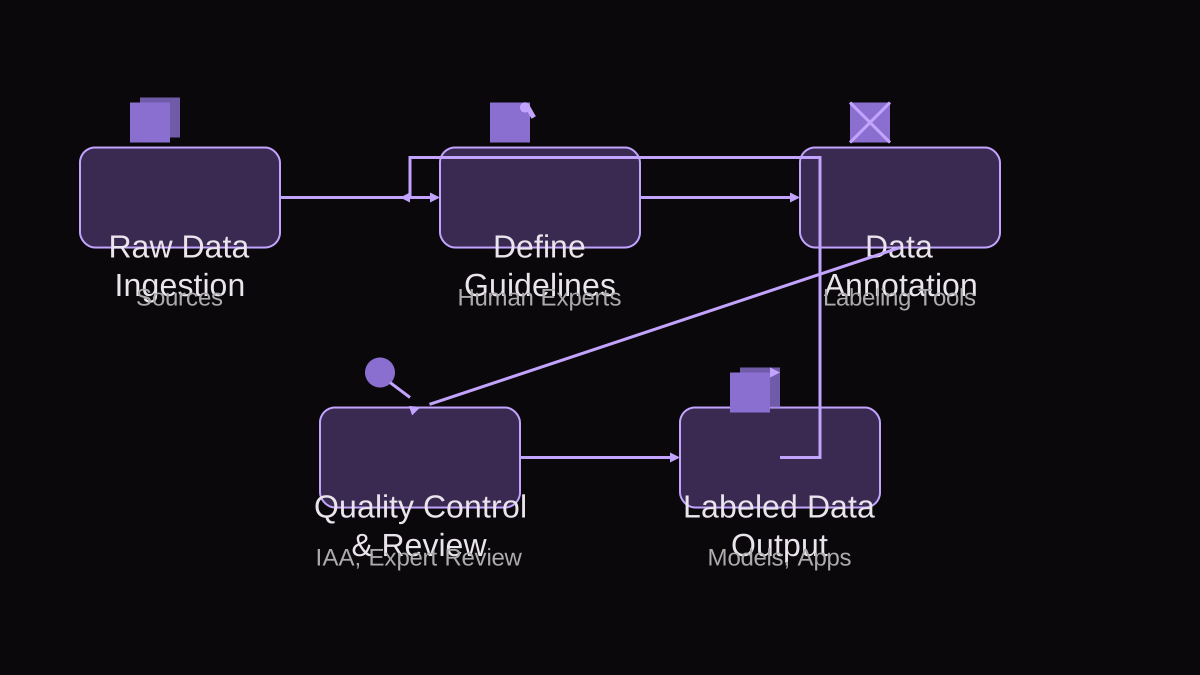
Raw data, whether acquired internally, externally, or synthetically, is rarely in a format directly usable for supervised machine learning. This is where data labeling, or annotation, comes in. It transforms raw data into a machine-readable format by assigning meaningful tags or labels. This is often the most time-consuming and expensive part of an AI project, demanding significant PM oversight. Let's walk through an example: building a medical image classifier for early detection of a rare condition, specifically detecting polyps in colonoscopy images.
Step 1: Define Annotation Guidelines. This is arguably the most critical step. For our polyp detection model, we need extremely precise instructions on what constitutes a polyp, how to mark its boundaries (e.g., using segmentation masks), size thresholds, and how to handle ambiguous cases (e.g., image artifacts, shadows, or lesions that are not clearly polyps). These guidelines must be developed in close collaboration with domain experts – in this case, experienced gastroenterologists. We would iterate on these guidelines by testing them on a small batch of images and refining them based on annotator feedback and disagreements. When it breaks, ambiguous or incomplete guidelines lead to inconsistent labels, which directly results in a confused model with poor performance.
Step 2: Choose Labeling Strategy & Workforce. Given the highly specialized and sensitive nature of medical imaging, generic crowdsourcing is inappropriate. We need a workforce of certified medical professionals, ideally radiologists or gastroenterologists. We have two main options: an in-house team or a specialized external vendor. For a rare condition, an in-house team might be too slow or prohibitively expensive to scale. A specialized vendor with a network of certified radiologists, expertise in medical image annotation, and robust security protocols would likely be the most efficient and quality-driven choice. We would also need to select appropriate labeling tools – not generic bounding box tools, but medical image annotation software capable of precise segmentation and integration with DICOM (Digital Imaging and Communications in Medicine) standards.
Step 3: Implement Quality Control. Labeling quality is paramount. My strategy here would involve several layers: Inter-Annotator Agreement (IAA) where a subset of images is labeled by multiple experts, and consistency is measured. Significant disagreements trigger a review session to refine guidelines. Additionally, a lead radiologist would conduct expert reviews on a percentage of all labeled images to catch errors and ensure adherence to standards. We might also employ active learning, where the model identifies samples it is uncertain about, prioritizing them for human review, thus optimizing the labeling effort. When it breaks, a lack of rigorous quality control means 'garbage in, garbage out,' leading to a model that cannot reliably detect polyps.
Step 4: Iterative Labeling & Model Feedback. Data labeling is not a one-time task. We would label an initial batch of images, train a preliminary model, and then evaluate its performance. If the model performs poorly on certain types of polyps, specific image qualities, or patient demographics, we would analyze the data and labels, refine our guidelines, potentially acquire more specific data, and re-label or augment existing labels. This continuous feedback loop between model performance and data labeling is crucial for building a robust and adaptable AI product.
How Can I Avoid Common Pitfalls in AI Data Strategy?
Even with the best intentions and a solid plan, AI data strategy is fraught with common pitfalls. As a PM, anticipating and mitigating these issues is crucial for project success and sanity. Here are some of the most frequent mistakes I've encountered and how to detect or avoid them:
- Mistake: Underestimating the Cost and Effort of Labeling.
- Failure Mode: Budget overruns, significant project delays, and ultimately, poor data quality due to rushed or cheap labeling.
- Detect/Avoid: Conduct pilot labeling projects to accurately estimate effort. Get quotes from multiple specialized vendors. Factor in not just annotation time but also guideline development, quality control, and iteration cycles. Secure dedicated budget for data operations, not just model development.
- Mistake: Ignoring Data Bias.
- Failure Mode: Discriminatory models that perform poorly or unfairly for specific user groups, leading to ethical and legal repercussions, and brand damage.
- Detect/Avoid: Actively audit data sources for demographic, historical, and sampling biases. Ensure your acquisition strategy promotes representativeness across all relevant user segments. Employ diverse labeling teams who can identify cultural or contextual nuances. Continuously analyze model performance across different subgroups to detect disparities.
- Mistake: Lack of Clear Annotation Guidelines.
- Failure Mode: Inconsistent labels across annotators, low inter-annotator agreement, model confusion during training, and extensive time wasted in re-labeling or debugging.
- Detect/Avoid: Involve domain experts from the outset. Provide abundant examples of both correct and incorrect annotations. Run small test batches with annotators, review their work, and iteratively refine guidelines based on their questions and discrepancies. Treat guidelines as living documents.
- Mistake: One-Time Data Acquisition.
- Failure Mode: Data drift (real-world data changes over time), model degradation in production, and an inability to adapt the AI product to new use cases or evolving user behavior.
- Detect/Avoid: Plan for continuous data acquisition pipelines from the start. Establish monitoring for data drift in production. Implement feedback loops from your live models to identify new data needs or changes in data distribution, allowing for proactive data refreshes and model retraining.
- Mistake: Neglecting Data Governance and Versioning.
- Failure Mode: Inability to reproduce model results, compliance issues with privacy regulations, difficulty debugging production models, and lack of clarity on data ownership and access.
- Detect/Avoid: Implement robust data versioning tools (like DVC or MLflow) to track datasets used for each model iteration. Establish clear ownership, access controls, and data retention policies. Document data lineage – where data came from, how it was transformed, and who has access. Ensure full compliance with relevant privacy regulations like GDPR, HIPAA, or CCPA.
Key Takeaways
- Data strategy is a core responsibility for AI Product Managers, directly impacting the success and ethical deployment of AI products.
- Translate product goals into clear, actionable data needs by employing structured frameworks like the Data Readiness Rubric, focusing on relevance, representativeness, quality, and cost.
- Strategically combine internal, external, and synthetic data acquisition methods, understanding the trade-offs and 'when it breaks' scenarios for each.
- Prioritize the development of clear annotation guidelines, selection of specialized workforces, and implementation of rigorous quality control measures for effective data labeling.
- Actively manage costs, mitigate biases, and plan for continuous data lifecycle management, as data is never a 'one and done' task.
- Remember that data strategy is an iterative process; continuous monitoring, adaptation, and feedback loops are crucial for the long-term health and performance of your AI products.