AI Product
Bridging the Gap: A PM's Guide to Collaborating with AI Research
As an AI Product Manager with over a decade in product leadership, I've learned that bridging the gap between product needs and AI research capabilities is the single most critical factor for delivering impactful AI solutions. It requires a dedicated effort to understand different motivations, establish shared language, and implement structured processes that transform innovative algorithms into tangible user value. This isn't about simply handing off requirements; it's about deep, continuous collaboration from ideation through deployment.
Product Managers are uniquely positioned to translate real-world problems into research questions and then guide the research output back into product experiences. This guide is built from my experience navigating these complex dynamics across fintech, healthcare, and streaming, offering actionable strategies for PMs and aspiring AI PMs to foster robust partnerships with their AI research counterparts.
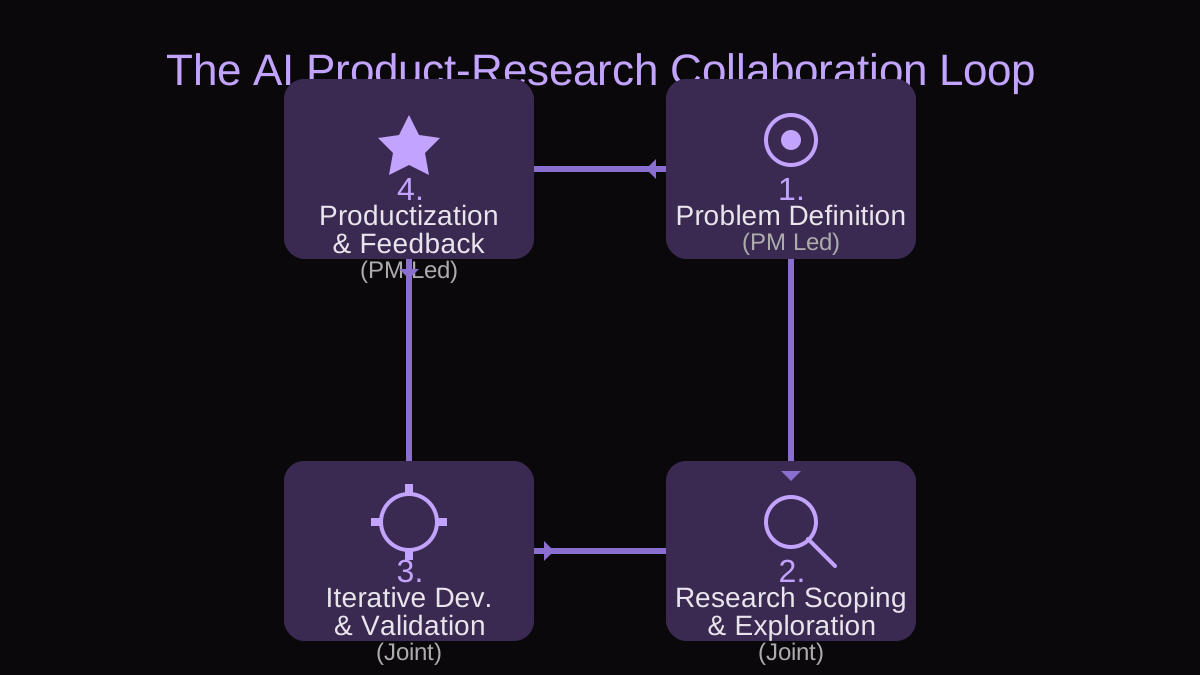
Why is it so hard to work with AI Research? Understanding the Divide.
The friction between product and research teams often stems from fundamental differences in their goals, timelines, and success metrics. Product teams are driven by market needs, user adoption, and business KPIs, operating on relatively shorter cycles focused on shipping and iteration. Research teams, conversely, are typically incentivized by novelty, pushing the boundaries of what's possible, contributing to scientific literature, and often working on longer, less predictable timelines.
This isn't a flaw; it's a natural and necessary divergence. Research needs the space to explore, fail, and discover without immediate market pressure. Product needs clarity, predictability, and a direct line to user value. The PM's role is to bridge these two worlds, ensuring that research efforts, however exploratory, eventually contribute to strategic product goals, and that product expectations are grounded in the realities of AI innovation.
- Time Horizons: Product works in sprints and release cycles; Research works in quarters or even years, often with unpredictable breakthroughs.
- Success Metrics: Product measures user engagement, revenue, retention; Research measures model performance, novelty, academic impact, generalizability.
- Risk Tolerance: Product aims for validated incremental improvements; Research embraces high-risk, high-reward exploration.
- Output Focus: Product delivers features, user experiences; Research delivers algorithms, models, proof-of-concepts, insights.
- Language and Context: Product speaks in user stories and business cases; Research speaks in mathematical formulations and algorithmic complexity.
How can PMs translate user problems into research opportunities?
Your primary role here is to articulate the 'what' and 'why' – the problem, the user pain, the business opportunity – not the 'how.' Resist the urge to suggest specific algorithms or technical approaches. Instead, frame the challenge in terms of desired outcomes and quantifiable impact. This empowers researchers to apply their expertise to the most promising technical solutions. Think of yourself as the expert on the problem space, not the solution space.
To systematically evaluate potential research projects and ensure alignment, I use a framework I call the 'AI Research Opportunity Rubric.' This helps us assess if a problem is ripe for AI research and if it aligns with our strategic objectives before committing significant resources.
- 1. Clear Problem Statement: Is the user problem or business challenge clearly defined, measurable, and impactful? Can we articulate the current state and the desired future state?
- 2. High User Value Hypothesis: Is there a strong, testable hypothesis that solving this problem with AI will deliver significant value to users or the business? What are the specific benefits?
- 3. Technical Feasibility (Initial): Based on current state-of-the-art and internal capabilities, is there a reasonable belief that AI can address this problem, even if novel research is required? Is it 'hard but possible' rather than 'impossible with current tech'?
- 4. Data Availability & Quality: Do we have access to the necessary data (or can we acquire it) at the scale and quality required for AI model training and validation? Are there privacy or ethical considerations?
- 5. Business Impact Potential: Can we quantify the potential ROI, cost savings, or competitive advantage if this research is successful and productized? Is it aligned with strategic company goals?
- 6. Alignment with AI Strategy & Capabilities: Does this research align with our broader AI strategy and leverage our unique strengths? Is it a core capability we want to own and differentiate on?
Each criterion helps initiate a structured discussion with the research team. A project scoring high across these points indicates a strong candidate for research investment. Projects scoring low often need further definition, data acquisition, or a re-evaluation of whether AI is truly the right solution.
What does effective communication look like with AI Researchers?
Effective communication with AI researchers hinges on empathy, active listening, and a shared commitment to clarity. Avoid product jargon that might obscure the core problem, and similarly, ask researchers to explain technical concepts in ways you can grasp, even if it means asking 'dumb' questions. Your goal is mutual understanding, not just information exchange. Establish a cadence of communication that balances their need for focused work with your need for updates and insight.
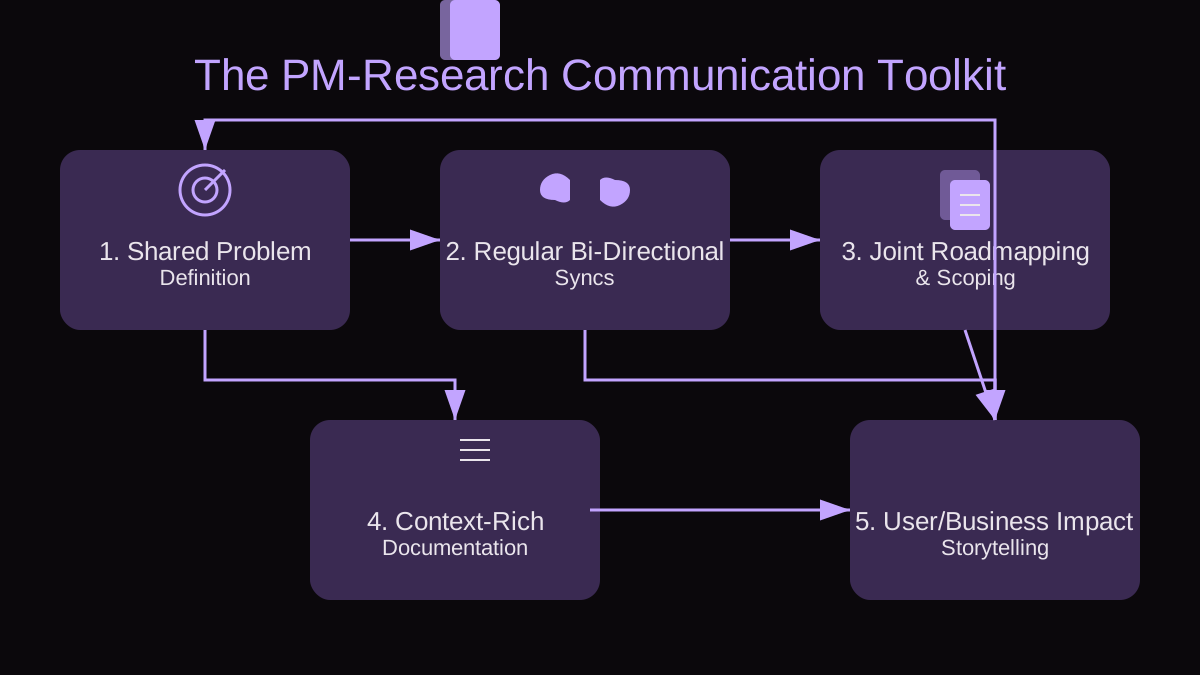
This means moving beyond one-off requirement documents. Instead, foster an environment of continuous dialogue. Regular, structured syncs (weekly or bi-weekly) are crucial, focusing on progress, roadblocks, and emerging insights. Encourage joint problem-solving sessions where product and research can whiteboard ideas together. Shared documentation, like a living Confluence page or a dedicated Slack channel, can keep everyone aligned on goals, assumptions, and key findings. Always reiterate the 'why' behind the work – connecting their technical efforts back to the user or business impact.
- Speak in problems, not solutions: Frame user needs and business opportunities clearly. Let the researchers propose technical solutions.
- Understand their constraints: Be aware of computational resources, data limitations, and the inherent uncertainty of research timelines.
- Manage expectations proactively: Clearly communicate the experimental nature of AI research to stakeholders, emphasizing potential pivots or extended timelines.
- Ask clarifying questions: If a technical term or concept is unclear, ask for an explanation or an analogy. Don't pretend to understand.
- Provide rich context: Share user research findings, market trends, and competitive analysis. This helps researchers understand the 'world' their models will operate in.
- Celebrate small wins: Acknowledge progress in model performance, novel approaches, or successful experiments, not just feature releases.
A Step-by-Step Example: Improving Healthcare Document Processing
Let's walk through a scenario: I'm a PM at a fintech company specializing in healthcare payments. Our customers, medical providers, spend countless hours manually processing Explanation of Benefits (EOB) documents from insurance companies. These documents are unstructured, varied, and critical for accurate billing and patient collections.
Step 1: Define the user problem (PM's role). My research shows providers spend an average of 10 hours per week per FTE on manual EOB processing, leading to high administrative costs and delayed payments. The core problem is the inefficiency and error rate of extracting key data (patient responsibility, payment amount, denial codes) from diverse EOB formats. My goal is to reduce manual effort by 50% and improve data extraction accuracy to over 95%.
Step 2: Translate into a research challenge using the Rubric. I present this to the AI Research team. Using our 'AI Research Opportunity Rubric,' we discuss: 1. Clear Problem Statement (Yes, clear pain). 2. High User Value (Yes, significant cost savings and faster payments). 3. Technical Feasibility (Initial assessment suggests advanced OCR and NLP might work, but EOB variability is a challenge requiring research). 4. Data Availability (Yes, we have millions of historical EOBs, but labeling is costly). 5. Business Impact (High ROI potential, competitive advantage). 6. Alignment with AI Strategy (Yes, core to automating healthcare payments). This confirms it's a strong research opportunity.
Step 3: Initial collaboration and scoping. We jointly define the research problem: 'Develop a highly accurate, generalized EOB data extraction system capable of handling diverse formats with minimal human intervention.' The research team proposes exploring advanced few-shot learning or foundation model fine-tuning given the data labeling challenge. We agree on a discovery phase: 3 months to explore feasibility, baseline performance, and potential data labeling strategies. Our shared success metrics include a target F1-score for key entity extraction on a diverse test set and a preliminary estimate of required human labeling effort.
Step 4: Iterative development and feedback loops. During the discovery phase, we have bi-weekly syncs. I provide additional EOB samples, context on common edge cases, and user feedback from manual processors. The research team shares model performance on internal benchmarks, challenges with specific EOB layouts, and ideas for model architectures. One key finding: a small, carefully curated dataset of diverse, labeled EOBs is more valuable than a large, broadly labeled one. This insight informs our data strategy and future labeling efforts, allowing us to pivot effectively.
Step 5: Transition to productization. After 3 months, the research team achieves promising baseline results (88% F1-score) with a few-shot learning approach, exceeding initial expectations given the limited labeled data. We collectively decide to move into a product development phase, focusing on integrating the model into our platform, building a human-in-the-loop validation system, and iteratively improving performance in production. My role shifts to defining the product experience around this AI capability, collecting user feedback, and planning the rollout, while the research team continues to support model refinement and explore next-generation improvements.
Common Mistakes PMs Make When Working with AI Research Teams (and How to Avoid Them)
- Mistake 1: Treating research as a feature factory. Failure Mode: Researchers feel undervalued, their expertise is underutilized, leading to burnout and irrelevant solutions. How to Avoid: Involve research early in problem definition. Frame challenges as open-ended problems, not pre-defined solutions. Respect their need for exploration and acknowledge that not every experiment will yield a shippable product.
- Mistake 2: Oversimplifying AI capabilities or timelines. Failure Mode: Unrealistic expectations from stakeholders, missed deadlines, and damaged credibility. How to Avoid: Deep dive into AI fundamentals yourself. Work with researchers to jointly scope projects, including risk assessments and potential technical hurdles. Be transparent with stakeholders about the inherent uncertainty and iterative nature of AI development.
- Mistake 3: Failing to define clear success metrics. Failure Mode: Endless experimentation without clear direction, difficulty in evaluating research outcomes, and a fuzzy path to productization. How to Avoid: Establish both research-specific metrics (e.g., model accuracy, latency, robustness) and clear product metrics (e.g., reduced manual effort, increased conversion, improved user satisfaction) from the outset. Ensure these metrics are jointly owned and regularly reviewed.
- Mistake 4: Disconnecting from the research process post-kickoff. Failure Mode: Misalignment between research output and product needs, wasted effort on solving the wrong problem, and missed opportunities for early pivots. How to Avoid: Maintain regular, structured check-ins. Participate in research demos and present user feedback. Be a proactive partner, not just a recipient of results. Your continuous context and feedback are invaluable to keep research aligned.
Building Trust and Sustaining the Partnership
Ultimately, effective collaboration comes down to building strong, trusting relationships. This means understanding and respecting each other's expertise, celebrating joint successes, and being transparent about challenges. When PMs and AI researchers operate as a unified team with shared goals, the potential for innovation and impact is truly transformative. It's about recognizing that both product and research are essential halves of the same whole, working towards a common vision of delivering exceptional AI-powered experiences.
- Be an advocate: Represent the research team's work and challenges to broader stakeholders, highlighting their contributions and explaining the complexity.
- Share the credit: Publicly acknowledge the research team's role in successful product launches and impactful features.
- Invest in understanding: Dedicate time to learn the basics of machine learning, common algorithms, and data science principles. This builds bridges.
- Provide direct user feedback: Connect researchers with users or user research findings so they can directly understand the impact of their work.
- Facilitate knowledge sharing: Encourage researchers to present their findings to the broader product and engineering teams, fostering a culture of learning.
Key Takeaways
- PMs bridge the fundamental gap between business needs and AI research capabilities by translating user problems into solvable research questions.
- Use structured frameworks like the AI Research Opportunity Rubric to evaluate and prioritize potential AI research initiatives.
- Foster continuous, empathetic communication, focusing on shared problem definition and context rather than technical solutions.
- Actively manage expectations by understanding the inherent uncertainty and iterative nature of AI research.
- Avoid common pitfalls by treating research as a strategic partner, clearly defining success metrics, and staying engaged throughout the process.
- Build trust through mutual respect, advocacy, and celebrating joint contributions to deliver impactful AI-powered products.