Product Craft
Roadmapping Under Model Release Uncertainty: An AI PM's Guide
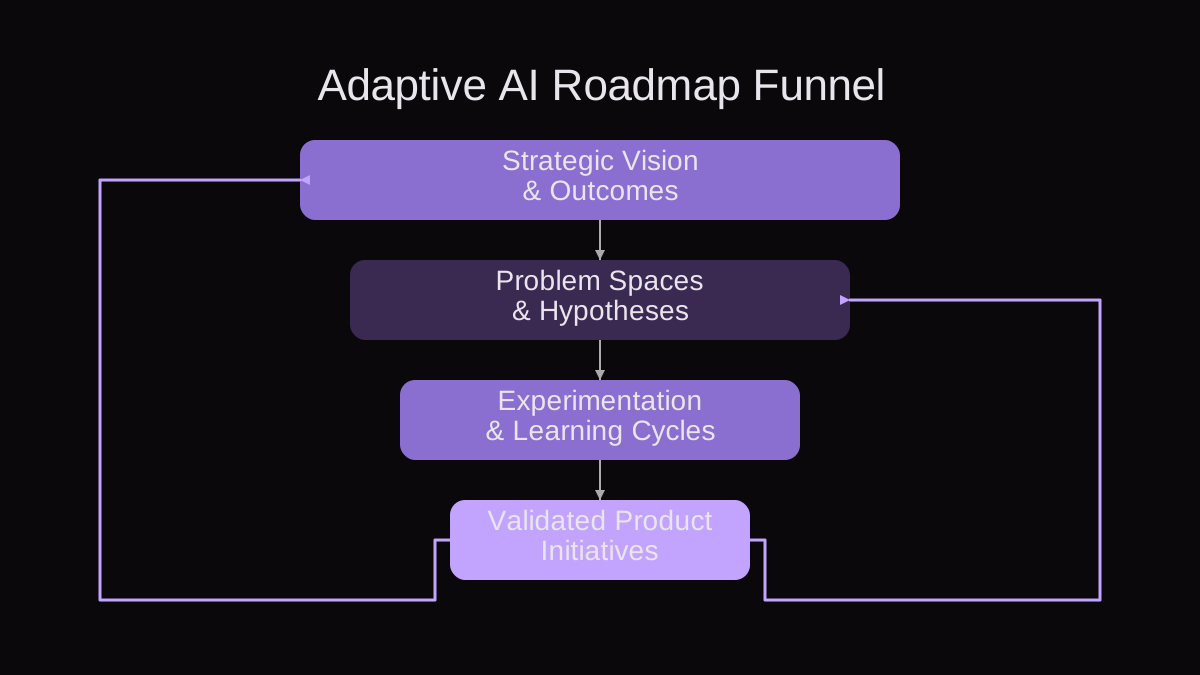
As an AI Product Manager, one of the most significant challenges I face, and one I often discuss with peers, is roadmapping when the very core of our product – the underlying AI model – is a moving target. Unlike traditional software development where feature delivery is often predictable, AI model releases, especially those from foundational models or internal research teams, come with inherent uncertainty. My answer to this challenge is to shift from output-based commitments to outcome-driven, flexible strategies, embracing experimentation, and building resilience into every layer of our product planning. It requires a mindset change, moving from rigid timelines to adaptive learning cycles, ensuring we deliver value even when the 'how' is evolving.
This isn't about throwing your roadmap out the window. It's about designing a roadmap that can absorb shocks, pivot efficiently, and still hit strategic objectives. We need to plan for the known unknowns and even the unknown unknowns, turning potential roadblocks into opportunities for innovation. This guide will walk you through how I approach this, from setting vision to tactical execution and avoiding common pitfalls.
Why Is AI Roadmapping Different? What's the Core Challenge?
Traditional software roadmapping often assumes a relatively stable underlying technology stack. We know what a new database version will do, or the capabilities of a new API. With AI, especially when dealing with large language models or complex predictive analytics, the core 'engine' is a black box that behaves probabilistically. We don't just upgrade a library; we might be waiting for a research breakthrough, a massive dataset to be curated, or a new model architecture to prove itself. This introduces several layers of uncertainty:
- Non-deterministic outcomes: A model might perform well in testing but fail in production on edge cases, or simply not achieve the desired accuracy or generalization. Success isn't guaranteed just by following steps.
- Dependency on research: Many AI product capabilities hinge on active research, which by its nature is exploratory. We can't put hard dates on 'discovering a new algorithm' or 'achieving human-level performance.'
- Data availability and quality: Models are only as good as their data. Obtaining, cleaning, and labeling data is a massive undertaking, often with unpredictable timelines and costs.
- Compute requirements: The infrastructure to train and deploy advanced models is expensive and complex, requiring careful planning and often external dependencies.
- Ethical and safety considerations: As models become more powerful, the need for robust ethical guidelines, bias detection, and safety guardrails increases, adding another layer of iterative development and validation.
The core challenge is that the 'what' (the user problem we're solving) might be clear, but the 'how' (the specific model, its performance, and release timeline) is often ambiguous. Committing to a specific feature or performance metric too early, tied to an unreleased model, is a recipe for missed deadlines and frustration.
How Do We Set Vision and OKRs When the 'How' is Unclear?
The key here is to anchor your vision and Objectives and Key Results (OKRs) firmly in user outcomes and business value, rather than specific model versions or technical outputs. Your objective should be timeless, while the key results should be measurable indicators of success that are agnostic to the exact AI model used to achieve them.
For example, instead of 'Launch version 2 of our prediction model achieving 95% accuracy,' an outcome-focused OKR would be: 'Objective: Improve patient care coordination by providing timely, accurate risk assessments. Key Result: Reduce average time-to-intervention for high-risk patients by 15%.' The specific model used to achieve that 15% reduction can then be explored through various initiatives.
To guide these decisions, I use a framework I call 'The AI Product Value Rubric.' It helps evaluate potential initiatives and model dependencies against strategic goals, even under high uncertainty. It's a structured way to ask the right questions before committing resources.
- 1. Business Value Alignment: How directly does this initiative (or potential model capability) contribute to our core strategic objectives and user problems? (Score 1-5, 5 being high).
- 2. Technical Feasibility & Model Maturity: What is the current state of the required AI model? Is it off-the-shelf, in research, or fully developed? What are the known technical risks and dependencies? (Score 1-5, 5 being high feasibility/maturity).
- 3. Data Readiness: Do we have the necessary data to train, fine-tune, or effectively use this model? Is it clean, labeled, and accessible? What's the effort required to get it ready? (Score 1-5, 5 being high readiness).
- 4. User Adoption & Impact Potential: How significant is the potential positive impact on user experience or workflow? How likely are users to adopt this new capability? (Score 1-5, 5 being high impact/adoption).
- 5. Model Evolution & Longevity: How future-proof is this approach? Will the model or capability be easily extensible or adaptable as technology evolves? Does it create a platform for future innovation? (Score 1-5, 5 being high longevity/extensibility).
- 6. Risk Profile (Ethical, Performance, Cost): What are the inherent ethical risks (bias, fairness)? What's the risk of underperformance or failure? What are the compute and operational costs? (Score 1-5, 5 being low risk/cost).
By scoring initiatives against these criteria, you get a holistic view that helps prioritize and communicate the 'why' behind your roadmap decisions, even when the underlying technology is uncertain. High scores across the board indicate a strong candidate for immediate investment, while lower scores signal areas needing more research or de-risking.
What Tactical Approaches Help Navigate Model Uncertainty?
Once you have your outcome-focused OKRs, the tactical execution needs to be flexible and built for learning. Here are several approaches I employ:
- Embrace Experimentation and Iteration: Think of your roadmap as a series of hypotheses to test. Start with Minimum Viable Products (MVPs) or Minimum Viable Capabilities (MVCs) that use simpler models or even rule-based systems to validate user need before committing to complex AI. Use A/B testing, shadow deployments, and canary releases to validate model performance in real-world scenarios incrementally.
- De-risking Strategies: Don't put all your eggs in one model basket. Consider parallel paths: a team optimizing the current model while another explores a potential future model. Build robust fallback mechanisms: if the AI model fails or underperforms, what's the graceful degradation path? Can you revert to a simpler heuristic or a human-in-the-loop workflow?
- Spikes and Research Tracks: Dedicate specific time and resources on the roadmap for 'spikes' – short, time-boxed investigations into model feasibility, data requirements, or integration challenges. These generate knowledge, not necessarily features, but are crucial for de-risking future initiatives. Maintain a dedicated research track for longer-term, higher-uncertainty model exploration.
- Flexible Backlogs and Tiered Roadmaps: Your product backlog should be a living document. For longer-term planning, use tiered roadmaps (e.g., 'Now,' 'Next,' 'Later') to communicate varying levels of certainty. 'Now' is highly committed, 'Next' has some flexibility, and 'Later' is primarily directional, waiting for more information on model maturity or market shifts. This prevents over-commitment on distant, uncertain items.
Let's walk through a concrete example using these tactics and the AI Product Value Rubric:
Worked Example: Healthcare AI for Patient Risk Prediction
Scenario: You're a PM for a healthcare platform aiming to predict patient risk of readmission to improve patient outcomes and reduce hospital costs. Your current model provides decent, but not great, accuracy. There are strong rumors of a new, highly advanced foundation model (FM) specialized in medical text analysis being released by a major AI lab in 6-12 months, promising significantly better performance. Details are scarce, and access isn't guaranteed.
- Step 1: Define Current Problem/Goal. Objective: Reduce 30-day patient readmission rates. Key Result: Decrease readmission rates by 5% within the next year, specifically for high-risk patients. This is outcome-focused, not model-dependent.
- Step 2: Identify Current Solution & Limitations. Current model (Model A) uses structured EHR data, achieving 75% accuracy. It struggles with nuances in unstructured clinical notes.
- Step 3: Acknowledge Uncertainty. The new FM (Model B) promises 90%+ accuracy on medical text, but its release date, cost, and specific API capabilities are unknown.
- Step 4: Roadmap Options & Rubric Application:
- Option 1: Optimize Current Model A. Focus on feature engineering from existing structured data, or a smaller, internal NLP model for specific note sections. Apply Rubric: Business Value (4/5), Feasibility (5/5), Data Readiness (5/5), User Impact (3/5 - incremental), Evolution (2/5), Risk (5/5 - low). Overall: Good for incremental, low-risk gains.
- Option 2: Go All-In on Model B. Halt Model A improvements and dedicate all resources to preparing for Model B. Apply Rubric: Business Value (5/5 - if it works), Feasibility (1/5 - highly uncertain), Data Readiness (3/5 - need to preprocess unstructured text, but Model B handles it), User Impact (5/5 - if it works), Evolution (4/5 - potentially a platform), Risk (1/5 - very high uncertainty, cost, potential failure). Overall: High reward, extremely high risk.
- Option 3: Parallel Track & De-risk (Hybrid Approach). Continue incremental improvements on Model A with one team (Option 1). Simultaneously, dedicate a small team to a 'spike' for Model B: research its capabilities as details emerge, prepare unstructured clinical note data, explore potential API integrations, and prototype with open-source alternatives. Apply Rubric: This isn't a single score but a strategy to improve scores over time. It balances immediate value with future potential while mitigating risk.
- Step 5: Decision based on Rubric. Option 3 is the most balanced. It ensures continuous value delivery with Model A while strategically positioning for Model B. The 'spike' reduces feasibility and data readiness risks for Model B without full commitment. We don't over-commit to a model that might not materialize or perform as expected.
- Step 6: Define Success Metrics for Each Path. For Model A efforts: specific accuracy improvements on current datasets. For Model B spike: successful integration with a prototype API, clear understanding of data requirements, and a go/no-go decision criteria for full adoption when Model B details solidify.

How Do We Communicate AI Roadmaps to Stakeholders?
Transparency and setting clear expectations are paramount. Stakeholders, especially non-technical ones, need to understand the inherent uncertainty of AI projects without losing confidence in your ability to deliver. Here's how I approach it:
- Be Upfront About Uncertainty: Don't sugarcoat it. Explain that AI development involves research and experimentation, which means outcomes and timelines can shift. Frame it as an advantage: flexibility allows us to adapt to new breakthroughs and optimize for the best possible outcome.
- Focus on Outcomes, Not Outputs: When communicating with executives, focus on the business value and user problems you're solving. Instead of 'We're building an XYZ model,' say 'We're aiming to reduce customer churn by 10% using advanced personalization, and we're exploring several AI approaches to achieve that.'
- Scenario Planning: Present best-case, worst-case, and most-likely scenarios for key initiatives. This helps stakeholders understand the range of potential outcomes and prepares them for different eventualities. For instance, 'If Model B performs as rumored, we could see a 15% reduction in readmissions; if it underperforms, our fallback using Model A optimizations will still yield 3%.'
- Tiered Communication: Tailor your communication. Executives need the strategic 'why' and high-level outcomes. Engineering teams need the tactical details, technical risks, and research questions. Sales and marketing need market-facing benefits and a clear understanding of what's available when.
- Explain the 'Why' Behind the 'What': When decisions are made to pivot or delay, explain the reasoning. 'We're delaying full integration of Model B because early spike results showed data readiness issues that would significantly impact its performance, so we're focusing on improving our data pipeline first, which will benefit future models too.' This builds trust and shows strategic thinking.
Common Mistakes in AI Roadmapping (and How to Avoid Them)
Even with the best intentions, it's easy to fall into traps when roadmapping AI products. Recognizing these pitfalls is the first step to avoiding them.
- Mistake 1: Over-committing to specific model performance or release dates.
- Failure Mode: Missed deadlines, eroded stakeholder trust, wasted engineering effort on premature optimizations or integrations that may never materialize. You build features for a model that changes or never ships.
- How to Detect/Avoid: Use ranges for performance expectations (e.g., 'aiming for 85-90% accuracy'). Communicate probabilities for model availability. Use 'explore' or 'research spike' in your roadmap instead of 'deliver model X'. Focus on outcome-based OKRs rather than model-specific outputs.
- Mistake 2: Treating AI projects like traditional software projects.
- Failure Mode: Underestimating the time and resources required for research, data preparation, experimentation, and model validation. Rigid waterfall approaches that don't allow for discovery and iteration.
- How to Detect/Avoid: Budget explicit time for data acquisition, cleaning, and labeling. Allocate dedicated resources for AI research spikes. Embrace an iterative, agile approach with continuous learning loops. Recognize that model development is often non-linear.
- Mistake 3: Neglecting ethical AI considerations early on.
- Failure Mode: Costly rework late in the development cycle, reputational damage due to biased or unfair model behavior, potential regulatory issues, and loss of user trust.
- How to Detect/Avoid: Integrate AI ethics, fairness, privacy, and bias detection into every stage of your roadmap and product lifecycle. Involve legal, compliance, and ethics experts from day one. Design for transparency and explainability where appropriate.
- Mistake 4: Not building fallbacks or graceful degradation mechanisms.
- Failure Mode: Catastrophic user experience when models fail, underperform, or encounter out-of-distribution data. High-impact outages, leading to customer churn or safety risks.
- How to Detect/Avoid: Design for model failure. What happens if the API is down? What if the model returns a low confidence score? Implement human-in-the-loop workflows, simpler rule-based systems, or default safe actions as fallbacks. Ensure monitoring and alerting are robust for model performance and data drift.
Key Takeaways
- Embrace uncertainty as a core characteristic of AI product development, not an anomaly.
- Anchor your roadmap in outcome-based OKRs and business value, de-coupling from specific model versions.
- Utilize frameworks like the AI Product Value Rubric to make structured decisions under uncertainty.
- Implement tactical approaches like experimentation, de-risking strategies, parallel tracks, and flexible backlogs.
- Communicate transparently with stakeholders, focusing on scenarios and the 'why' behind strategic choices.
- Actively avoid common pitfalls like over-commitment, treating AI as traditional software, neglecting ethics, and failing to build fallbacks.