AI Product
Managing the AI Product Lifecycle: From Launch to Iteration and Sunset
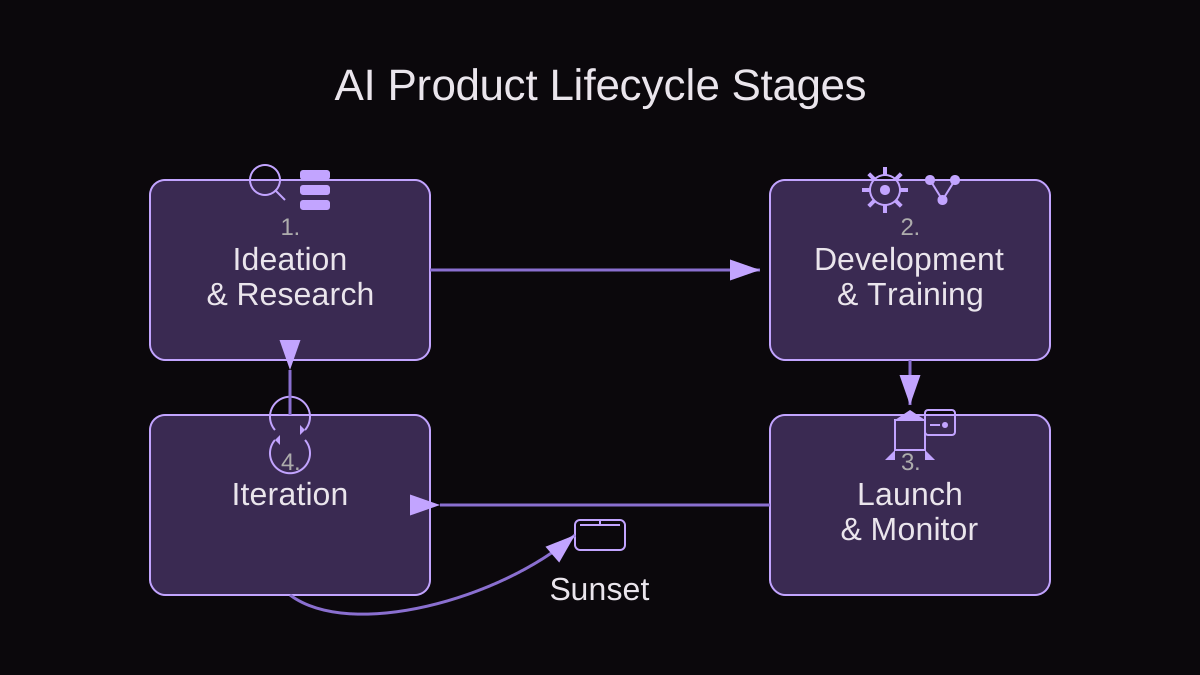
Managing the AI product lifecycle, from its initial launch through continuous iteration and eventual sunset, is fundamentally different from traditional software product management. The core distinction lies in the dynamic nature of AI models, their reliance on evolving data, and the inherent uncertainty in their performance over time. Effective AI product management requires a proactive, iterative, and ethically conscious approach that integrates MLOps, continuous monitoring, and strategic planning at every stage to ensure sustained value and responsible deployment.
As an AI Product Manager, I have seen firsthand that neglecting these unique aspects leads to model drift, user dissatisfaction, and wasted resources. My experience across streaming, fintech, and healthcare has reinforced that success hinges on understanding these differences and building processes tailored to the AI product's specific needs, not just porting over traditional agile frameworks.
What Makes AI Product Lifecycle Management Different?
The primary differentiator for AI products is their inherent probabilistic nature and dependence on external data. Unlike deterministic software, an AI model's output is not always 100% predictable, and its performance can degrade without direct code changes. This introduces several unique challenges for product managers.
- Data Dependency and Drift: AI models learn from data, and if the real-world data distribution shifts (data drift) or the relationship between inputs and outputs changes (concept drift), the model's performance will suffer. This requires continuous monitoring and retraining strategies.
- Model Explainability and Trust: Many advanced AI models are black boxes, making it difficult to understand why a particular decision was made. This impacts user trust, regulatory compliance, and debugging efforts. Product managers must consider explainability from the outset.
- Ethical and Bias Considerations: AI systems can inadvertently perpetuate or amplify biases present in their training data, leading to unfair or discriminatory outcomes. Identifying, mitigating, and continuously monitoring for bias is a critical, ongoing responsibility.
- Continuous Learning and Adaptation: The 'launch and forget' mentality is fatal for AI products. They often require continuous learning, model updates, and infrastructure adjustments to maintain relevance and performance.
- MLOps Integration: The operationalization of machine learning models (MLOps) is crucial. This includes automated pipelines for data ingestion, model training, deployment, and monitoring, which are far more complex than traditional CI/CD for software.
Ignoring these differences is a common pitfall. If you treat an AI product like a standard software application, you risk launching a product that degrades silently, loses user trust, and ultimately fails to deliver its intended value over time.
How to Ensure a Successful AI Product Launch?
Launching an AI product is not just about releasing code; it is about deploying a living system that will interact with real-world data and users. A successful launch focuses heavily on post-launch readiness and establishing robust feedback loops from day one.
- Define Clear Success Metrics (and Failure Modes): Beyond adoption, what specific AI performance metrics (e.g., precision, recall, F1-score for classification; RMSE for regression) will indicate success? Equally important, define the thresholds that signal a problem or failure mode, triggering immediate action.
- Robust MLOps Pipeline: Ensure you have automated systems for model deployment, monitoring, and potential rollback. Manual processes are unsustainable and prone to error when dealing with dynamic models. This includes data validation at ingestion.
- Monitoring and Alerting Infrastructure: Set up dashboards and alerts for data drift, concept drift, model performance degradation, and system health. These need to be integrated into your operational workflows, not just an afterthought.
- Responsible AI Checklist: Before launch, verify that ethical considerations (bias, fairness, transparency, privacy) have been addressed and documented. How will you monitor these post-launch? What is your plan for addressing issues if they arise?
- Phased Rollout Strategy: Consider a canary release or A/B testing approach to gradually expose the AI feature to users. This allows for real-world validation and minimizes the impact of unforeseen issues.
- User Feedback Mechanisms: Integrate direct feedback channels for users. AI products can sometimes behave unexpectedly; providing users with a clear way to report issues or provide suggestions is invaluable for iteration.
Worked Example: Launching a Personalized Content Recommendation Engine
Imagine launching a new AI-powered recommendation engine for a streaming service. Your goal is to increase user engagement (watch time, content discovery). Here is how you might approach the launch:
- Step 1: Define Metrics. Success metrics: 5% increase in session watch time, 10% increase in unique content viewed, 2% decrease in churn for users exposed to recommendations. Failure modes: Recommendations showing irrelevant content (high bounce rate from recommended items), user complaints about repetitive or biased suggestions.
- Step 2: Establish MLOps. Build an automated pipeline that ingests new user interaction data daily, retrains the model weekly, and deploys it without downtime. Include data quality checks to prevent bad data from poisoning the model.
- Step 3: Implement Monitoring. Dashboards track click-through rates (CTR) on recommendations, diversity of recommended content, and model latency. Alerts trigger if CTR drops below a threshold, or if certain demographics consistently receive similar recommendations (potential bias).
- Step 4: Phased Rollout. Initially, expose 5% of new users to the AI recommendations. Monitor their engagement against a control group for two weeks. If positive, expand to 20% of existing users, then gradually to the full user base, always keeping a control group for comparison.
- Step 5: Feedback Loops. Add a 'Was this recommendation helpful?' button on recommended items and monitor responses. Integrate this data into future model iterations and as a signal for potential issues.
Iterating on AI Products: The Continuous Improvement Loop
Iteration for AI products is not just about adding new features; it is about continuously improving model performance, adapting to new data, and ensuring ethical behavior. This requires a systematic approach to monitoring, evaluation, and redeployment.
The core of effective AI iteration is a robust feedback loop that cycles through observation, analysis, action, and validation. This is where your MLOps infrastructure truly shines, allowing you to quickly deploy improved models or roll back problematic ones.
- Continuous Model Performance Monitoring: Track key performance indicators (KPIs) and AI-specific metrics. Look for trends, sudden drops, or unexplained changes. Set up automated alerts for when performance drifts beyond acceptable thresholds.
- Data Pipeline Health: Monitor the quality, freshness, and completeness of your input data. Data issues are often the root cause of model degradation. Implement data validation steps at every stage.
- A/B Testing AI Variations: Test different model architectures, feature sets, or hyperparameter tunings against each other or a baseline. This allows you to quantitatively measure the impact of changes on user behavior and business metrics.
- User Feedback Analysis: Systematically collect and analyze qualitative and quantitative user feedback. Look for patterns in complaints or suggestions that point to model biases, irrelevance, or unexpected behavior.
- Retraining Strategy: Based on monitoring and feedback, decide when and how to retrain your models. This could be on a fixed schedule, triggered by performance degradation, or when significant new data becomes available.
- Model Versioning and Rollback: Maintain a clear version history of your models and have the capability to quickly revert to a previous, stable version if a new deployment causes issues.
Framework: The AI Product Health Scorecard
To guide iteration, I use an 'AI Product Health Scorecard' – a simple rubric to evaluate an AI product's readiness for continued operation or immediate action. This helps in prioritizing engineering and product efforts.
- 1. Model Performance (Accuracy/Relevance): Is the model meeting its target KPIs (e.g., 90% accuracy, 75% precision, 5% RMSE)? If current performance is below 80% of target, it is a critical alert.
- 2. Data Integrity & Freshness: Is the input data consistently clean, complete, and updated with required frequency? Any significant deviation (e.g., 10% missing values, stale data over 24 hours) is a red flag.
- 3. Bias & Fairness: Are the model's outputs fair across defined demographic groups? Regular audits and metrics (e.g., equal opportunity, demographic parity) should show no statistically significant bias. If bias metrics deviate by more than 5% from baseline, investigate immediately.
- 4. Operational Stability (Latency/Throughput): Is the model serving predictions within acceptable latency and handling current query volumes? If latency spikes by 20% or errors occur on more than 0.1% of requests, it indicates an operational issue.
- 5. User Satisfaction & Feedback: Is user feedback generally positive, and are specific AI-related complaints low? A sudden increase in negative feedback or specific feature complaints about AI behavior warrants investigation.
- 6. Cost Efficiency: Is the cost to operate the model (compute, storage, data labeling) within budget? If operational costs exceed budget by more than 15% without a proportional increase in value, re-evaluate efficiency.
Each criterion is scored, and a composite score guides decisions: high score means business as usual, medium suggests optimization, and low indicates a need for immediate intervention or potential sunsetting.

When and How to Sunset an AI Product?
Sunsetting an AI product, feature, or even a specific model version is an inevitable part of the lifecycle. Unlike software, where a feature might simply be deprecated, an AI model can become not just irrelevant but actively detrimental if left unmanaged. Knowing when to pull the plug and how to do it responsibly is crucial.
- Performance Degradation: The most common reason. If the model consistently fails to meet its performance KPIs despite iteration efforts, and the cost of maintaining it outweighs its diminishing value, it is time to consider sunset.
- Market Shift or User Needs Change: The problem the AI was designed to solve may no longer exist, or user behavior might have evolved beyond the model's capabilities. A classic example is a recommendation engine built for a specific content format when the market shifts to another.
- High Operational Costs: If the compute, data labeling, or MLOps overhead for a model becomes prohibitively expensive relative to the value it delivers, especially if a simpler, more cost-effective solution exists.
- Ethical or Regulatory Concerns: New regulations or emergent ethical issues (e.g., discovery of deep-seated biases that are unfixable) might necessitate immediate sunsetting of a product.
- Technological Obsolescence: The underlying technology or architecture might become outdated, making maintenance difficult and preventing integration with newer systems.
- Product Strategy Pivot: The AI product no longer aligns with the overall company strategy or core product vision.
Sunsetting responsibly involves a clear communication plan, data migration strategies, and ensuring users are not left in the lurch. This includes:
- Communicate Early and Clearly: Inform internal stakeholders and affected users well in advance. Explain the reasoning and provide alternatives if applicable.
- Data Archiving and Governance: Securely archive any sensitive data used by the AI model. Ensure compliance with data retention policies and privacy regulations.
- Migration Path: If the sunsetted AI feature is being replaced, provide a smooth transition for users to the new solution. Minimize disruption.
- Post-Sunset Monitoring: Even after sunset, monitor for any residual impact or unexpected side effects that might arise from the removal of the AI component.
Common Mistakes in AI Product Lifecycle Management
My years in product management have taught me that avoiding common pitfalls is often more critical than seeking out revolutionary wins. Here are some frequent mistakes I have observed and how to sidestep them.
- Mistake 1: Ignoring MLOps from Day One. Failure Mode: Unmanageable deployments, inconsistent model performance, lack of reproducibility. Detection/Avoidance: Treat MLOps as a core component of your product infrastructure from the ideation phase. Budget for it, staff for it, and integrate it into your definition of 'done' for any AI feature.
- Mistake 2: Over-Reliance on Initial Model Performance. Failure Mode: Model drift goes unnoticed, leading to silent degradation and user dissatisfaction. Detection/Avoidance: Implement rigorous, continuous monitoring for data drift, concept drift, and model performance. Set up automated alerts and scheduled reviews of key metrics.
- Mistake 3: Neglecting Ethical Implications and Bias. Failure Mode: AI product causes harm, damages brand reputation, or faces regulatory scrutiny. Detection/Avoidance: Integrate responsible AI principles throughout the lifecycle. Conduct bias audits pre-launch and continuously monitor for fairness metrics. Have a clear escalation path for ethical concerns.
- Mistake 4: Poor Data Governance. Failure Mode: Model trained on stale, incorrect, or biased data, leading to flawed outputs. Detection/Avoidance: Establish clear data ownership, quality standards, and validation processes. Invest in data pipelines that ensure data freshness, accuracy, and appropriate handling of PII.
- Mistake 5: Lack of Clear Sunset Criteria. Failure Mode: Products remain live past their utility, consuming resources and potentially causing user frustration. Detection/Avoidance: Define clear sunset triggers (performance thresholds, cost limits, market changes) during the product's planning phase. Regularly review these criteria as part of your iterative process.
- Mistake 6: Treating AI as a 'Set It and Forget It' Solution. Failure Mode: Product becomes obsolete or irrelevant as market conditions and data evolve. Detection/Avoidance: Embrace a mindset of continuous learning and adaptation. Plan for regular model retraining, feature updates, and strategic re-evaluation based on monitoring and user feedback.
Key Takeaways
- AI product management is distinct due to data dependency, model drift, and ethical considerations.
- A successful AI launch requires robust MLOps, continuous monitoring, and responsible AI principles from the start.
- Iteration on AI products is a continuous loop of observation, analysis, action, and validation, driven by performance, data, and user feedback.
- Utilize frameworks like the AI Product Health Scorecard to systematically evaluate and prioritize ongoing AI product efforts.
- Define clear sunset triggers and plan for responsible decommissioning to avoid resource drain and negative user impact.
- Proactively avoid common pitfalls by prioritizing MLOps, continuous monitoring, ethical AI, strong data governance, and clear sunset criteria.