Career
The AI PM Interview: What Hiring Managers Truly Evaluate
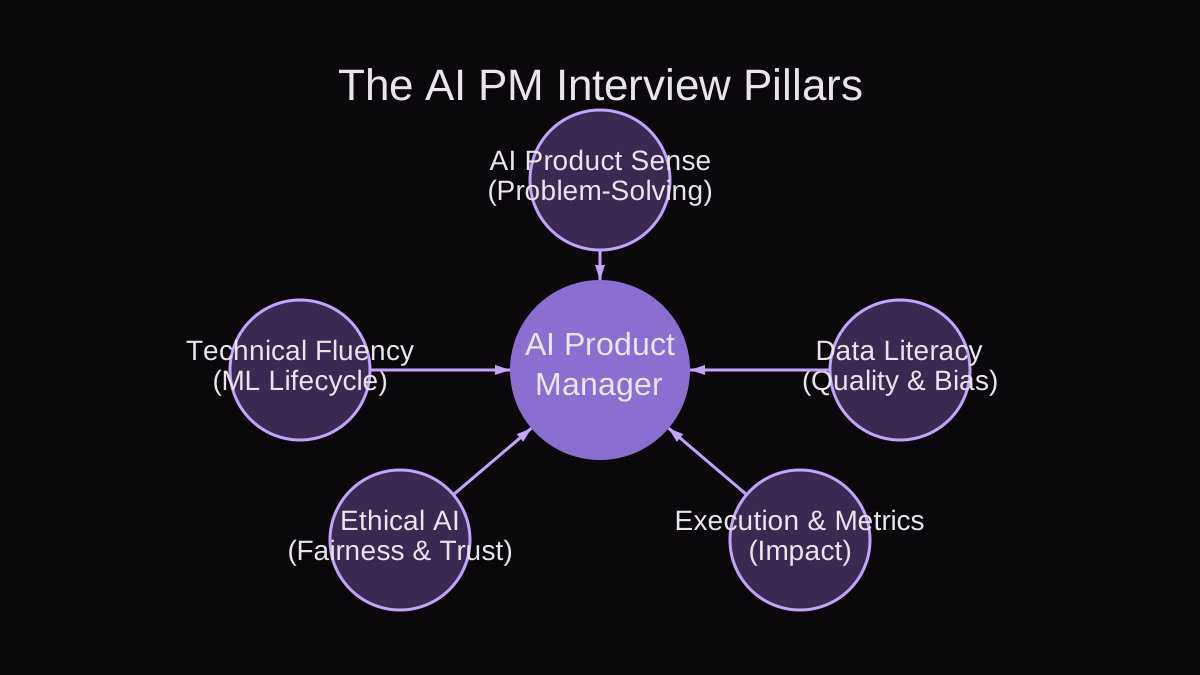
When you interview for an AI Product Manager role, hiring managers aren't just looking for someone who can recite definitions of machine learning models or throw around terms like "large language models" and "generative AI." What they are actually testing for is a robust blend of core product management principles applied through an AI lens: your ability to identify valuable problems AI can solve, understand the technical and data nuances of building AI systems, navigate complex ethical landscapes, and ultimately drive successful execution from concept to impact.
This isn't about becoming a data scientist or an ML engineer. It's about demonstrating a unique hybrid skill set that bridges the gap between customer needs, business objectives, and the unique capabilities and constraints of AI technology. My experience across streaming, fintech, and healthcare has shown me that the best AI PMs are master translators, strategists, and problem-solvers who can articulate the "why," "what," and "how" of AI products in a way that resonates with both technical and non-technical stakeholders.
What is 'AI Product Sense' and Why Does it Matter?
Product sense for an AI PM extends beyond traditional user empathy. It's about discerning which user or business problems are genuinely amenable to an AI solution, and equally important, which are not. Hiring managers want to see if you can move beyond the hype and anchor your thinking in real-world value. This means asking critical questions: Is there sufficient data? Will an AI solution genuinely improve the user experience or business outcome, or will it overcomplicate it? Can the solution be explained to users? Can it be trusted?
You'll be tested on your ability to articulate a problem, propose an AI-driven solution, define its scope, identify key success metrics, and anticipate potential challenges. They are looking for your structured thinking, your ability to prioritize, and your user-centricity, even when dealing with complex algorithms. When this breaks, you end up with AI solutions looking for problems, or models built in a vacuum that fail to deliver any meaningful impact. It also manifests as building features that users don't need or trust, leading to low adoption and wasted resources. A strong AI product sense means understanding both the art of the possible with AI and the art of the desirable for the user.
- Can you clearly define the user problem and the business opportunity?
- Do you consider alternative solutions, not just AI?
- How do you measure success for an AI-powered feature?
- What are the ethical implications of your proposed solution?
- How would you balance accuracy, interpretability, and user experience?
How Technical Fluency Differs for an AI PM (and Why it's Not Coding)
Let's be clear: technical fluency for an AI PM does not mean you need to write production-ready code or train neural networks from scratch. It means understanding the lifecycle of an ML model, from data ingestion and feature engineering to model training, deployment, monitoring, and retraining. You should be conversant with concepts like supervised vs. unsupervised learning, common model types (e.g., regression, classification, clustering, transformers), the difference between inference and training, and the fundamentals of MLOps.
Hiring managers want to see if you can effectively communicate with data scientists and ML engineers, ask informed questions, and understand the trade-offs involved. This includes understanding the impact of data quality, model complexity, latency requirements, and computational costs. Can you discuss why one model might be chosen over another for a specific use case? Can you articulate the challenges of maintaining AI in production? When this breaks, you'll find yourself unable to properly scope projects, set realistic timelines, or challenge technical assumptions, leading to scope creep, missed deadlines, and strained relationships with your engineering team. It can also result in making poor product decisions based on a superficial understanding of technical constraints.
- Explain the typical stages of an ML project lifecycle.
- Discuss the trade-offs between model accuracy and interpretability.
- Describe how you would work with data scientists to define model requirements.
- What are the key challenges in deploying and maintaining an AI model in production?
- How do you think about data drift or concept drift and their impact on a live model?
Mastering Data Literacy and Ethical AI Product Design
Data is the fuel for AI, and as an AI PM, you must be data literate. This goes beyond just looking at dashboards; it involves understanding data sources, collection methods, quality issues, potential biases, and the implications of feature engineering. You need to be able to critically evaluate whether the data available is sufficient, representative, and clean enough to build a reliable AI product.
Crucially, you must also demonstrate a strong grasp of ethical AI principles. This means proactively considering issues like fairness, bias (in data and models), privacy, security, transparency, and accountability. Hiring managers are testing whether you can foresee potential harms, design guardrails, and build products that foster user trust. They want to see if you can integrate ethical considerations into the entire product development lifecycle, not just as an afterthought.
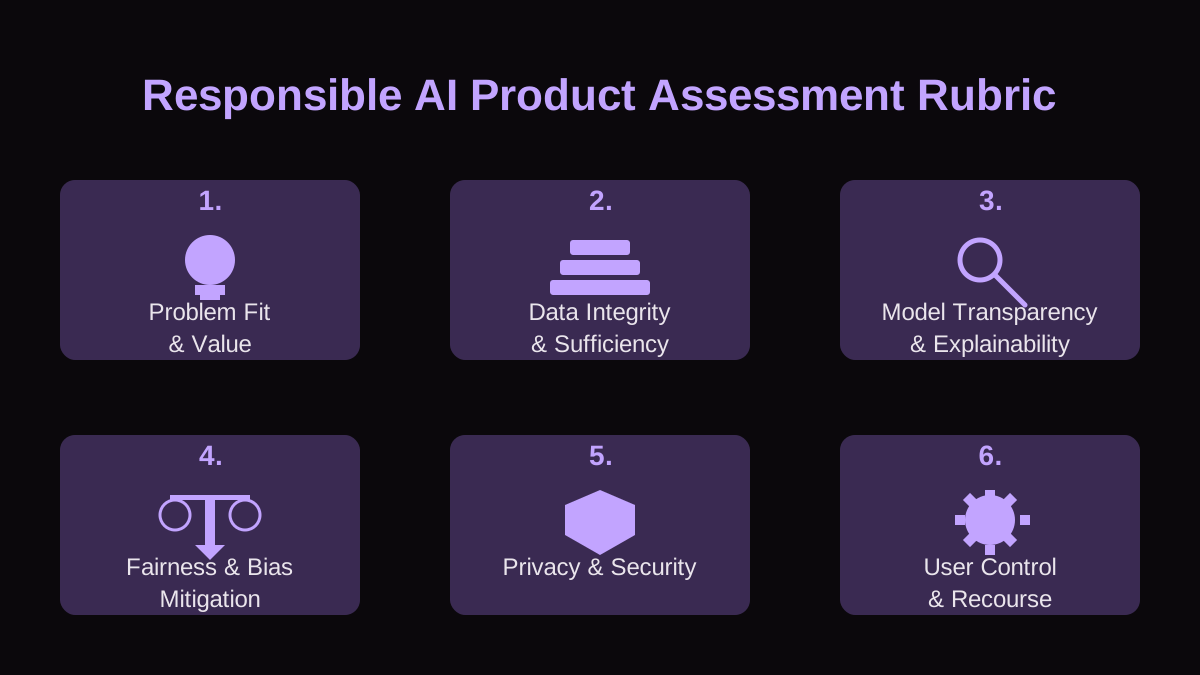
To help structure this thinking, I often use a framework I call the "Responsible AI Product Assessment Rubric." It provides a structured way to evaluate AI product ideas against key ethical and practical criteria, ensuring a holistic view before significant investment.
- 1. Problem Fit & Value: Is this a problem AI should solve? Does it create clear user or business value without excessive risk?
- 2. Data Integrity & Sufficiency: Is the necessary data available, high-quality, representative, and ethically sourced? Are there potential biases in the data?
- 3. Model Transparency & Explainability: Can the model's decisions be understood and explained to users or regulators? What level of explainability is required?
- 4. Fairness & Bias Mitigation: Has the product been designed to identify and mitigate unfair biases across different user groups? What are the potential disparate impacts?
- 5. Privacy & Security: Does the solution protect user data privacy? Is it secure against attacks or misuse?
- 6. User Control & Recourse: Do users have appropriate control over their data and interactions with the AI? Is there a clear path for recourse if the AI makes an error?
Worked Example: Building a Smart Search for a Healthcare Platform
Let's walk through a scenario: You're tasked with improving the search functionality for a healthcare platform used by doctors to find patient records, research papers, and diagnostic guidelines. The current search is keyword-based and often returns irrelevant results.
1. Problem Definition: Doctors waste valuable time sifting through irrelevant search results, leading to slower diagnoses and potential patient care delays. The goal is to provide highly relevant results quickly, reducing cognitive load and improving efficiency.
2. AI Opportunity: Natural Language Processing (NLP) models could understand the intent behind a doctor's query, recognize medical terminology, and contextualize searches based on patient history or current research trends. This moves beyond simple keyword matching to semantic search.
3. Data Needs: We'd need a vast corpus of medical texts (research papers, patient notes, diagnostic codes, drug information) to train or fine-tune an NLP model. Crucially, patient data used for context must be de-identified and handled with the utmost security and privacy. Labeled data (e.g., pairs of queries and highly relevant documents) would be essential for supervised learning approaches to rank results.
4. Applying the Responsible AI Product Assessment Rubric:
- Problem Fit: High. Clear value in improving doctor efficiency and patient outcomes. AI is a strong fit for semantic understanding.
- Data Integrity: Critical. Data sources must be accurate, up-to-date, and free from bias. De-identification is paramount for patient data.
- Model Transparency: Important. Doctors need to understand why certain results are shown. Can we highlight keywords or sections that led to a match? Explainability is key in healthcare for trust and accountability.
- Fairness & Bias: Crucial. Are certain demographics or medical conditions underrepresented in training data, leading to biased results? Could a search algorithm inadvertently deprioritize information relevant to minority groups? We need to actively test for this.
- Privacy & Security: Absolute top priority. All patient data must comply with HIPAA and other regulations. Robust access controls and encryption are non-negotiable.
- User Control & Recourse: Doctors should be able to provide feedback on search results. What happens if the AI gives a wrong result? How can they manually override or refine?
5. Success Metrics: Reduced search time, increased click-through rate on top results, higher user satisfaction scores, fewer 'no results found' queries, and ultimately, improved patient outcomes (though this is harder to directly attribute).
This example shows how an AI PM must weave together technical understanding, data requirements, user needs, and ethical considerations into a coherent product strategy.
Common Mistakes AI PMs Make in Interviews (and How to Avoid Them)
I've seen many talented candidates stumble over predictable pitfalls. Knowing these can help you sidestep them.
- Failure Mode: Buzzword Bingo. Candidates often list AI terms without demonstrating a deep understanding or applying them contextually. How to Detect/Avoid: Don't just name models; explain their underlying principles, strengths, and weaknesses for specific use cases. Show you understand the 'why' behind using a particular AI technique.
- Failure Mode: Ignoring Data Quality and Availability. Many candidates propose brilliant AI solutions but neglect to consider if the necessary, high-quality data actually exists or can be ethically sourced. How to Detect/Avoid: Always ask probing questions about data. "What data sources are available? What's the quality? How is it collected? Are there privacy concerns?" This shows a practical understanding of AI's foundational dependency.
- Failure Mode: Overlooking Ethical Implications. A common oversight is failing to proactively discuss potential biases, fairness issues, or privacy risks of an AI product. How to Detect/Avoid: Integrate ethical considerations into your solution from the start. Use frameworks like the Responsible AI Product Assessment Rubric. Show that you think about potential negative impacts and mitigation strategies.
- Failure Mode: Lack of Clear Success Metrics. Proposing an AI solution without defining how its success will be measured, both qualitatively and quantitatively, is a major red flag. How to Detect/Avoid: Always propose specific, measurable, achievable, relevant, and time-bound (SMART) metrics. Think beyond just model accuracy to business and user outcomes.
- Failure Mode: Underestimating MLOps Complexity. Many focus on the model training but ignore the challenges of deploying, monitoring, maintaining, and retraining AI models in a production environment. How to Detect/Avoid: Demonstrate awareness of the entire ML lifecycle, including operational aspects. Discuss how you'd work with MLOps engineers, what monitoring would entail, and how you'd handle model drift.
Key Takeaways
- Hiring managers test for a holistic AI PM skill set, not just technical knowledge or product generalism.
- Develop your AI product sense by focusing on real problems, not just chasing AI trends. Always ask 'why AI?'
- Cultivate technical fluency by understanding the ML lifecycle and communicating effectively with engineers, not by coding.
- Become data literate, recognizing the paramount importance of data quality, availability, and ethical sourcing.
- Integrate ethical AI design principles (like fairness, transparency, and privacy) into every stage of your product thinking.
- Use structured frameworks, like the Responsible AI Product Assessment Rubric, to guide your evaluation and communication.
- Practice articulating complete solutions, including problem definition, data needs, technical considerations, ethical implications, and clear success metrics.
- Be prepared to discuss common pitfalls and how to proactively avoid them in AI product development.