AI Product
AI Model Monitoring for PMs: Detecting Drift & Ensuring Performance
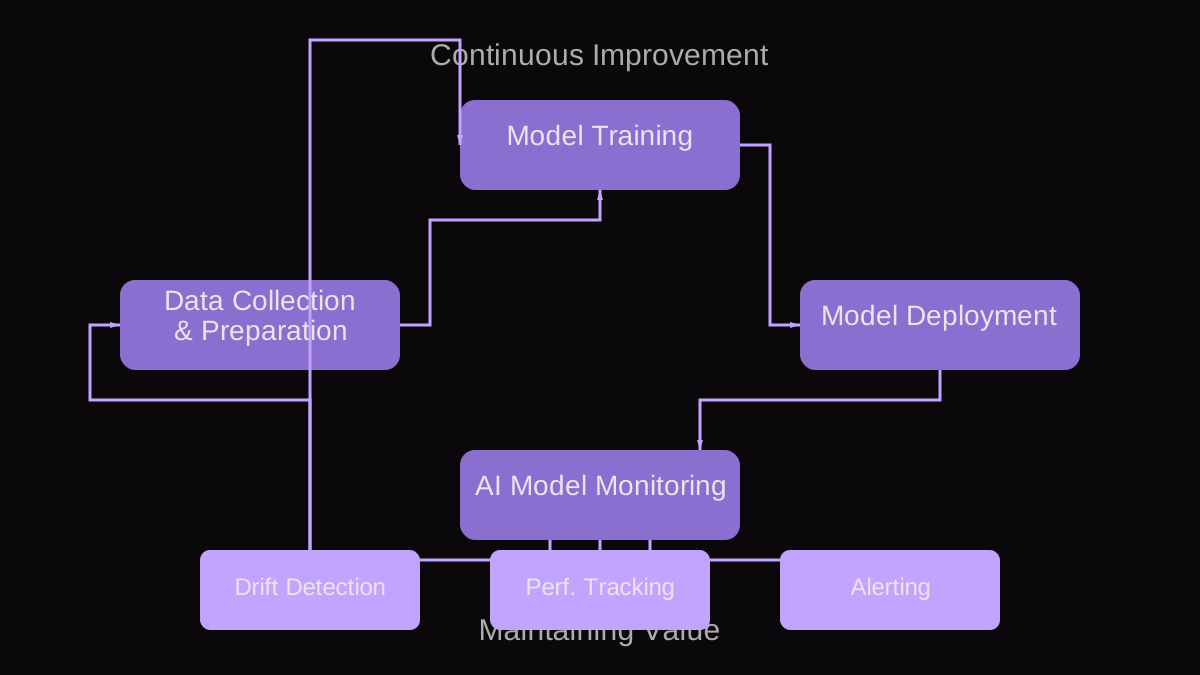
For product managers, especially those of us navigating the complex world of AI, ensuring our models perform as expected long after deployment is not just a technical detail; it is a core product responsibility. AI model monitoring is how we proactively detect when a model's performance degrades due to shifts in the real-world data it processes or changes in the underlying relationships it learned. This vigilance is essential to sustain product value, maintain user trust, and ultimately, protect the business outcomes our AI products are designed to deliver.
In my experience spanning over a decade in product management across diverse sectors like streaming, fintech, and healthcare, the lifecycle of an AI product truly begins post-deployment. The initial excitement of a successful launch quickly gives way to the ongoing challenge of maintaining its efficacy in dynamic environments. Ignoring robust monitoring is akin to launching a ship without a navigator; you might start strong, but you are ill-prepared for the inevitable storms and shifting currents ahead.
What is AI Model Drift and Why Should PMs Care?
Model drift refers to the degradation of an AI model's performance over time due to changes in the data it encounters or the underlying relationships between inputs and outputs. For product managers, understanding drift is paramount because it directly impacts user experience, business metrics, and the overall value proposition of your AI-powered product. When a model drifts, it means the product is no longer delivering the expected quality, accuracy, or relevance, leading to user dissatisfaction, financial losses, or even regulatory non-compliance in critical applications like fintech or healthcare.
There are primarily three types of drift that PMs need to be aware of:
- Data Drift (or Feature Drift): This occurs when the statistical properties of the input data change over time. For example, if a model predicts loan default rates based on income and credit score, and suddenly there is a significant economic downturn causing a shift in average income or credit scores in the target population, the model's assumptions about the input distribution become invalid. Why it matters: The model is now making predictions based on data it was not trained on, leading to inaccurate outputs. As a PM, you will see this manifest as a decline in conversion rates, increased customer churn, or a rise in incorrect predictions.
- Concept Drift: This is perhaps the most challenging type of drift for PMs to detect because it involves a change in the relationship between the input variables and the target variable. The meaning of the target itself might change. For instance, in a fraud detection system, what constitutes 'fraud' might evolve as fraudsters develop new tactics. The input data might look the same, but the true label associated with it has shifted. Why it matters: The model's learned rules are no longer relevant to the current reality, leading to a fundamental breakdown in its decision-making. This can be devastating for critical applications, resulting in significant financial losses or safety compromises.
- Label Drift: A specific form of concept drift where the meaning or distribution of the target variable (labels) itself changes. For example, in a medical diagnosis AI, new diagnostic criteria might emerge for a disease, meaning what was previously labeled 'negative' might now be 'positive'. Why it matters: The ground truth against which the model is evaluated has shifted, making its previous predictions obsolete. This often requires re-annotation of historical data and retraining.
As a PM, your role isn't to diagnose the technical specifics of drift but to understand its potential impact on your product and users. You must advocate for robust monitoring systems, define the key performance indicators (KPIs) that signal drift, and work with engineering and data science teams to establish clear response protocols. Neglecting drift means accepting a decaying product, which is unacceptable in competitive markets.
How Do We Detect Model Drift? Key Metrics and Signals
Detecting model drift requires a combination of technical metrics and product-level KPIs. As PMs, we need to ensure our monitoring dashboards reflect both, allowing us to quickly identify whether a dip in product performance is merely a statistical anomaly or a deeper model issue. The goal is to catch drift early, before it significantly impacts users or business outcomes.
- Statistical Metrics for Data Drift: These measure changes in the distribution of input features or model predictions. Common techniques include Population Stability Index (PSI) and Kullback-Leibler (KL) divergence. PSI, for example, quantifies how much a variable's distribution has changed from a baseline period. A high PSI score for a feature indicates significant data drift. Other methods like statistical hypothesis tests (e.g., Kolmogorov-Smirnov test) can compare two distributions to see if they are statistically different. PMs should understand that unusual spikes in these metrics are red flags requiring investigation.
- Performance Metrics for Concept Drift: These are standard model evaluation metrics like accuracy, precision, recall, F1-score, RMSE (Root Mean Squared Error), ROC AUC, etc. A decline in any of these, especially when coupled with stable input data distributions, is a strong indicator of concept drift. It means the model is no longer correctly mapping inputs to outputs, even if the inputs themselves haven't changed. PMs must establish clear thresholds for these metrics that, when crossed, trigger alerts and a predefined response plan.
- Business Metrics and KPIs: This is where the PM's perspective is invaluable. Ultimately, a model's performance matters only insofar as it impacts business goals. Monitor metrics like conversion rates, user engagement (click-through rates, time on page), churn rates, revenue generated, customer satisfaction scores, or even the rate of manual overrides if your AI system has human-in-the-loop components. A sudden drop in a key business metric that correlates with the deployment of a model or a specific time period can often be the first practical signal of drift, even before technical metrics catch up.
- Prediction Drift: Monitor the distribution of the model's output predictions. If a model designed to output probabilities between 0 and 1 suddenly starts predicting very high or very low probabilities more frequently, or if its output distribution shifts significantly, it suggests a change in its internal logic or the data it is processing. This is particularly useful when true labels are delayed or hard to obtain, as it provides an early warning signal.
To systematically approach monitoring, I often recommend using a tiered approach to monitoring, leveraging what I call the 'AI Model Health Check Rubric'. This rubric helps prioritize monitoring efforts and defines clear actions based on the severity and type of drift detected.
- AI Model Health Check Rubric:
- 1. Critical Impact Models (e.g., credit scoring, medical diagnosis): Require real-time monitoring of all core input features (data drift - PSI/KL), model performance (accuracy, F1, RMSE), and direct business KPIs (fraud rate, diagnostic accuracy). Threshold breaches must trigger immediate automated alerts to ML engineers and PMs, leading to emergency investigation and potential rollback or retraining.
- 2. High Impact Models (e.g., recommendation engines, dynamic pricing): Require near real-time monitoring of key input features, core performance metrics, and daily/weekly business KPIs (user engagement, conversion rates, revenue per user). Threshold breaches trigger alerts for data scientists and PMs for deeper analysis and scheduled retraining or model updates.
- 3. Moderate Impact Models (e.g., content categorization, internal search ranking): Require daily/weekly monitoring of aggregated input feature distributions, relevant performance metrics, and monthly business KPIs (content discoverability, search relevance). Threshold breaches trigger alerts for data scientists and PMs for investigation during regular maintenance cycles.
- 4. Low Impact Models (e.g., internal administrative tasks, minor personalization features): Require monthly/quarterly checks on input data stability and overall system health. Drift detection here typically informs future model improvements rather than urgent interventions.
The PM's Playbook: Responding to Detected Drift (Worked Example)
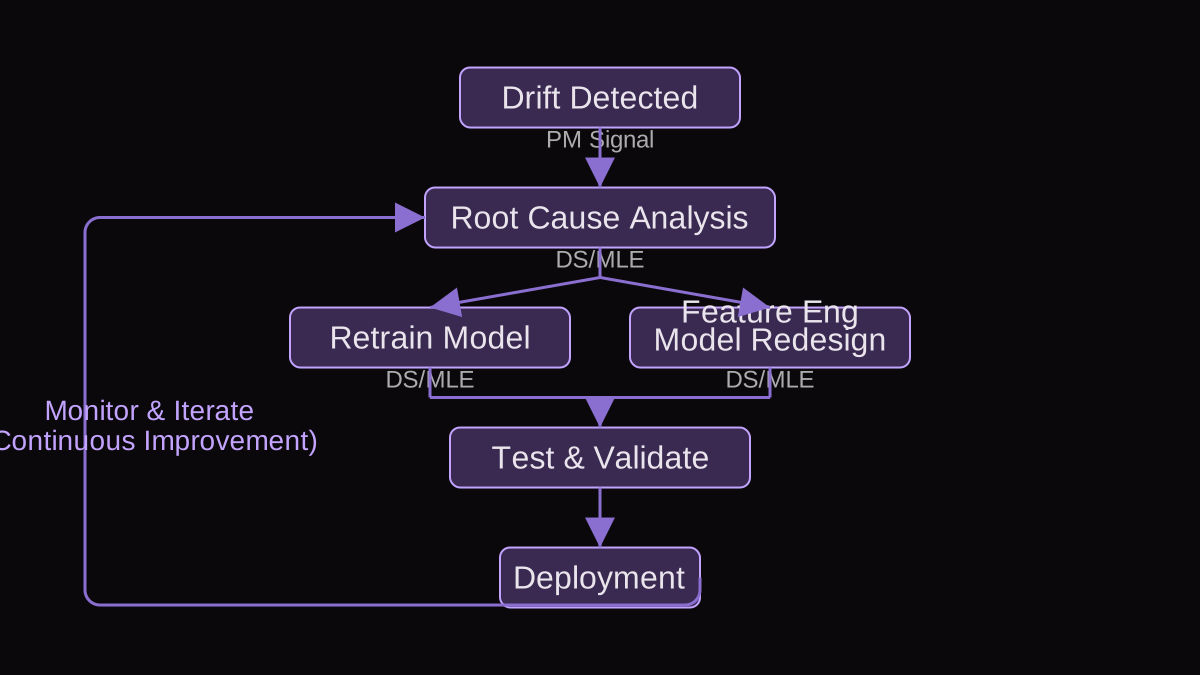
Once drift is detected, the PM's role shifts from monitoring to leading the response. This involves a collaborative effort with data scientists, ML engineers, and sometimes even marketing or business development teams. A clear, predefined playbook ensures a swift and effective response, minimizing negative impact.
Worked Example: Personalized Content Recommendation Engine
Scenario: You manage a streaming service with an AI-powered recommendation engine. Recently, you've noticed a consistent 15% drop in average watch time per user and a 10% decrease in click-through rates (CTR) on recommended content over the past two weeks. This model is categorized as 'High Impact' by our rubric.
- Step 1: Initial Business Metric Alert (PM's First Signal). The daily dashboard for your recommendation engine shows a sustained decline in average watch time and CTR. This is your initial alert. As the PM, you immediately escalate this to the data science and ML engineering teams.
- Step 2: Technical Drift Investigation (Data Scientist/ML Engineer). The data science team investigates. They check:
- a. Data Drift: They analyze the distribution of input features (user demographics, content consumption history, content metadata like genre, release date) using PSI scores. They find a significant PSI spike for 'content release date' and 'user interaction frequency with new genres'. It turns out a new content acquisition strategy brought in a massive influx of older, niche content, and users are exploring new genres more aggressively than before.
- b. Concept Drift: They check model performance metrics (e.g., RMSE for rating prediction, recall of relevant items). They observe a slight dip in RMSE but a more significant drop in recall for newly released content, indicating the model is struggling to recommend fresh items effectively. The relationship between 'user preference' and 'content novelty' seems to have shifted.
- c. Prediction Drift: They notice the model's output distribution of 'recommended content novelty score' has become skewed towards older content, even for users who historically preferred new releases.
- Step 3: Root Cause Analysis (Collaborative). The teams collaborate. The PM provides context on the new content strategy. Data science confirms the data distribution shift and concept drift related to content novelty. ML engineering confirms the model is not adapting well to the influx of older content and changing user behavior.
- Step 4: Decision on Remediation (PM-led). As the PM, you weigh the options with your team:
- a. Retraining: The fastest option is to retrain the existing model with the new, diverse data. This addresses the data drift.
- b. Model Update/Redesign: Given the concept drift around 'content novelty', a simple retraining might not be enough. The model might need architectural changes or new features (e.g., 'novelty score', 'genre exploration tendency') to better capture the evolving user preferences. This is a longer-term solution.
- c. Rollback/Temporary Fix: If the performance degradation were more severe, a rollback to a previous, stable model version might be considered, or a temporary rule-based system could be implemented for new content while a permanent fix is developed. In this case, the impact is significant but not catastrophic enough for an immediate rollback.
- Decision: You decide on immediate retraining with the new data, followed by a prioritized project to enhance the model with new features to better handle content novelty and genre exploration. The retraining can be done within 24-48 hours, while the enhancement project is scheduled for the next sprint.
- Step 5: Deployment and Verification. The retrained model is deployed. Monitoring dashboards are closely watched. Within days, average watch time and CTR begin to recover, confirming the remediation was effective. The new model enhancement project proceeds.
- Step 6: Post-Mortem and Prevention. A review is conducted. Key learning: the new content acquisition strategy should have triggered a proactive review of the recommendation model's input features and training data strategy. The team updates the monitoring system to include specific alerts for significant shifts in content metadata distributions and user interaction with new content types, integrating a 'content strategy impact assessment' into future product launches.
Common Mistakes in AI Model Monitoring and How to Avoid Them
Even with the best intentions, PMs and their teams can fall into common traps when implementing AI model monitoring. Avoiding these pitfalls is crucial for building a resilient and high-performing AI product.
- Failure Mode 1: Relying Solely on Technical Metrics and Ignoring Business KPIs. Engineers often focus on F1-score or RMSE, which are critical. However, a model can maintain good technical performance while failing to deliver business value. For instance, a fraud detection model might have high accuracy but flags too many legitimate transactions, leading to customer frustration and lost revenue. How to detect/avoid: As PM, ensure your monitoring dashboards prominently display both technical performance metrics AND key business metrics. Establish clear thresholds for business KPIs, not just technical ones. Regularly review these dashboards with cross-functional teams.
- Failure Mode 2: Static Monitoring Thresholds. Setting a fixed threshold for PSI or accuracy at deployment and never adjusting it. The real world is dynamic; what constitutes 'normal' drift can evolve. For example, during a holiday season, user behavior (and thus data distributions) might naturally shift without indicating a permanent drift problem. How to detect/avoid: Implement dynamic thresholds or adaptive baselines that account for seasonality, known events, or gradually evolving distributions. Periodically review and adjust thresholds based on observed data patterns and business context. Work with data scientists to understand what 'acceptable' variance looks like.
- Failure Mode 3: Not Having a Clear Response Plan. Detecting drift is only half the battle. Without a predefined playbook for investigation, remediation, and communication, teams will react chaotically, leading to delays and further performance degradation. How to detect/avoid: Develop a clear, tiered response plan (like the 'AI Model Health Check Rubric' we discussed). Define who is responsible for what at each stage (PM, DS, MLE), what communication channels to use, and what the decision-making process is for retraining, rollback, or redesign. Practice this plan with drills or post-mortems of past incidents.
- Failure Mode 4: Over-Monitoring Everything. Attempting to monitor every single feature, every single metric, in real-time. This leads to alert fatigue, high infrastructure costs, and distracts from truly important signals. Not all data drift is equally impactful. How to detect/avoid: Prioritize monitoring based on feature importance (as determined by model explainability) and business impact. Focus on core features and critical performance/business metrics. Use a tiered monitoring approach (as in the rubric) to allocate resources effectively. Start simple and add complexity as needed.
- Failure Mode 5: Lack of Collaboration and Communication. Monitoring is often seen as a purely technical task for ML engineers. However, successful monitoring and response require deep collaboration between PMs (business context), Data Scientists (drift analysis, model improvements), and ML Engineers (infrastructure, deployment). How to detect/avoid: Foster a culture of shared ownership. Establish regular sync meetings to review monitoring dashboards. Ensure PMs articulate the business impact of drift, and technical teams explain the underlying causes in accessible terms. Transparency is key.
Building a Robust Monitoring Strategy: Tools, Teams, and Culture
A robust AI model monitoring strategy isn't just about selecting the right tools; it is about establishing the right processes, empowering your teams, and cultivating a proactive culture. From a PM perspective, this means defining the 'why' and the 'what' and then trusting your technical teams with the 'how'.
- Tools for Monitoring: The market offers a range of solutions, from open-source libraries to commercial platforms. Open-source options like Evidently AI, Fiddler AI (partially open-source), or custom solutions built on standard data analysis libraries (Pandas, SciPy) are good for initial exploration or smaller projects. Commercial platforms (e.g., DataRobot, Sagemaker Model Monitor, WhyLabs, Arize) offer more comprehensive features like automated drift detection, explainability, lineage tracking, and integration with various ML stacks. As a PM, you need to assess the trade-offs: cost vs. features, ease of integration, scalability, and the level of customization required for your specific use cases. Focus on tools that provide clear, actionable insights for both technical and business stakeholders.
- Team Structure and Responsibilities: Effective monitoring requires clear roles. The Product Manager defines business KPIs, sets performance thresholds, owns the response plan, and communicates impact to stakeholders. Data Scientists are responsible for identifying relevant technical metrics, conducting deeper drift analysis, and proposing model retraining or re-engineering solutions. ML Engineers build and maintain the monitoring infrastructure, integrate tools, manage alerts, and handle model deployment/rollback. A dedicated MLOps team can streamline these processes. Cross-functional collaboration is non-negotiable.
- Cultivating a Proactive Monitoring Culture: This is perhaps the most critical element. It starts with leadership emphasizing the importance of ongoing model health. Encourage a 'monitor early, monitor often' mindset. Celebrate successful drift detection and remediation stories. Build a learning culture where post-mortems are not about blame but about identifying systemic improvements. Integrate monitoring into the full AI product development lifecycle, from initial design discussions to continuous operations. Make it a standard part of your product reviews and retrospectives. Ensure that the business impact of drift is clearly understood by all teams, creating a shared sense of urgency and responsibility.
By investing in these three pillars – appropriate tools, clear team responsibilities, and a proactive culture – PMs can build AI products that not only launch successfully but also thrive and adapt in the ever-changing real world.
Key Takeaways
- AI model monitoring is a core product management responsibility, essential for maintaining product value and user trust post-deployment.
- Understand and differentiate between Data Drift, Concept Drift, and Label Drift, as each impacts your product differently.
- Detect drift using a combination of statistical metrics (e.g., PSI), model performance metrics (e.g., accuracy), and crucial business KPIs (e.g., conversion rates).
- Implement a structured 'AI Model Health Check Rubric' to prioritize monitoring efforts based on model impact and define clear response actions.
- Develop a predefined response playbook for detected drift, ensuring clear roles, responsibilities, and communication channels across PM, Data Science, and ML Engineering teams.
- Avoid common mistakes like relying solely on technical metrics, using static thresholds, lacking a response plan, over-monitoring, and poor cross-functional communication.
- Invest in appropriate monitoring tools, establish clear team responsibilities, and foster a proactive, collaborative culture around model health to ensure long-term AI product success.