Agents
AI Agent Security: Mitigating Prompt Injection & Data Leakage
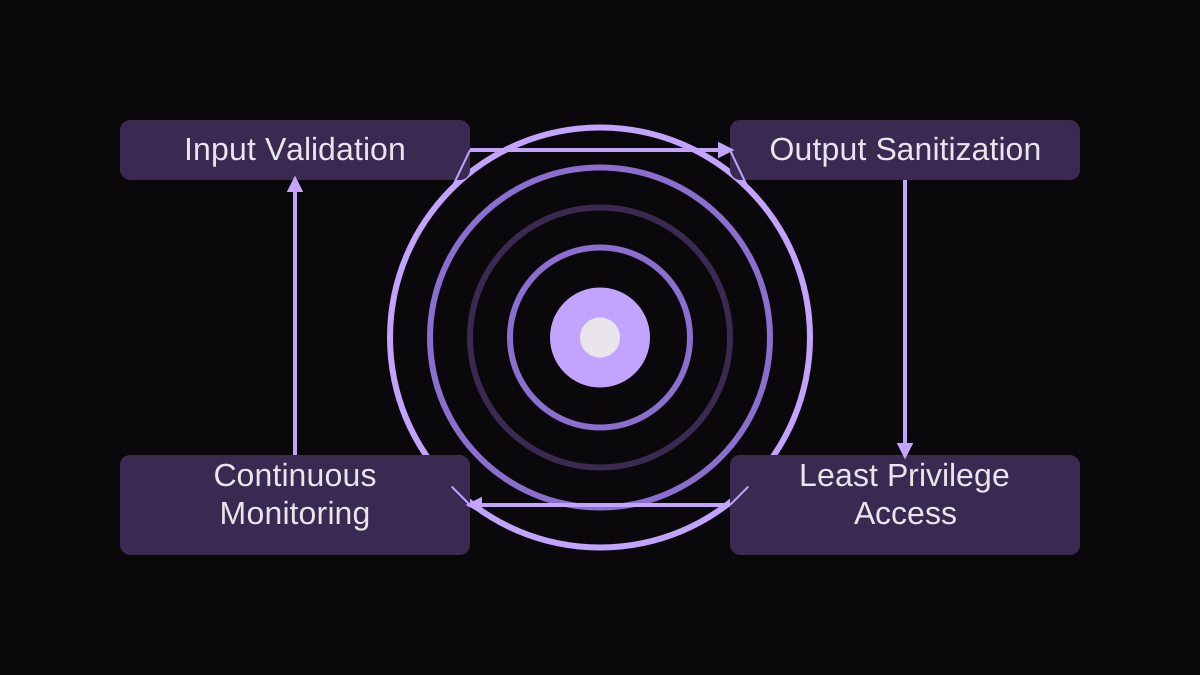
As AI agents become increasingly integrated into critical business processes, safeguarding them against vulnerabilities like prompt injection and data leakage is no longer an afterthought—it's a core product requirement. For product managers, this means embedding security into the agent's design from day one, focusing on robust input validation, output sanitization, least privilege access, and continuous monitoring. These proactive measures are non-negotiable for deploying trustworthy and resilient AI agents that uphold user trust and data integrity.
My 10+ years in product management, spanning high-stakes domains like fintech and healthcare, have repeatedly demonstrated that neglecting these security foundations leads to severe consequences. AI agents, by their nature, interact with diverse systems and data sources, amplifying the potential blast radius of a security breach. This guide is built from that experience, providing actionable strategies for product managers to navigate these complex security challenges effectively.
What is Prompt Injection and Why Should PMs Care?
At its heart, prompt injection is a form of attack where malicious input manipulates an AI agent's behavior, overriding its original instructions or causing it to perform unintended actions. Think of it as social engineering, but for an AI. An attacker might craft a prompt that tells the agent to ignore its safety guidelines, reveal confidential system prompts, or even execute unauthorized commands through integrated tools.
For product managers, the implications of prompt injection are severe and far-reaching. Imagine an AI customer support agent in fintech inadvertently processing an unauthorized transaction because of a clever injection, or a healthcare agent disclosing sensitive patient information. The risks include reputational damage, significant financial losses, data breaches, compliance failures, and a complete erosion of user trust. We, as PMs, are accountable for the security posture of our products, and ignoring prompt injection is a recipe for disaster. It's not just about preventing a hack; it's about maintaining the integrity and reliability of our AI-powered services.
How Can We Prevent Prompt Injection in AI Agents? The Defensive Design Rubric
Mitigating prompt injection requires a proactive, multi-layered approach that builds security into the agent's architecture, not just as an afterthought. I’ve developed a 'Defensive Design Rubric' that PMs can apply immediately to their AI agent projects. This isn't about finding a silver bullet; it's about creating robust, interlocking defenses.
- 1. Strict Input Validation & Sanitization: Every piece of user input must be rigorously validated and sanitized before it ever reaches the large language model (LLM) or agent's execution layer. This means checking for suspicious patterns, enforcing length limits, filtering out known malicious keywords or character sequences, and properly escaping special characters. Why it works: This acts as the first line of defense, catching many simple injection attempts. When it breaks: Over-reliance on regex or keyword lists alone is insufficient; sophisticated semantic attacks can bypass these, requiring deeper contextual analysis.
- 2. Clear Separation of Instructions and User Input: The agent's core system prompts and instructions must be clearly delineated and isolated from dynamic user input. User input should be treated as data to be processed, not as instructions to be executed. Why it works: This architectural separation makes it harder for malicious user input to overwrite or modify the agent's fundamental operating directives. When it breaks: If the agent's internal prompt construction allows user input to blend directly with system instructions without clear boundaries, it's highly vulnerable.
- 3. Principle of Least Privilege for Agent Actions: Ensure your AI agent only has access to the tools, APIs, and data it absolutely needs to perform its designated functions—and no more. If an agent's purpose is to summarize documents, it shouldn't have access to an API that can delete user accounts. Why it works: This limits the 'blast radius' of any successful injection. Even if an attacker manages to inject a command, the agent's limited permissions prevent it from causing widespread damage. When it breaks: Granting broad, undifferentiated permissions to an agent creates a significant attack surface, turning a minor prompt injection into a major security incident.
- 4. Human-in-the-Loop for High-Risk Actions: For any action that carries significant risk—financial transactions, data modifications, or sharing sensitive information—implement a mandatory human review and approval step. Why it works: This provides a final safety net, allowing a human operator to catch and prevent malicious or unintended actions that might have slipped through automated defenses. When it breaks: If the human review process is too slow, easily circumvented, or relies on fatigued operators, it becomes an ineffective control.
- 5. Output Guardrails and Validation: After the agent generates an output or executes an action, validate that output against expected formats, content, and safety guidelines before presenting it to the user or passing it to another system. Check for unexpected PII disclosure, malicious links, or out-of-scope content. Why it works: This prevents second-order attacks where the agent's output itself becomes a vector for further compromise (e.g., generating a malicious script). When it breaks: If output validation is superficial or only checks for syntactical issues, it can miss semantic attacks embedded in the agent's response.
Mitigating Data Leakage: A PM's Responsibility
Data leakage in AI agents occurs when sensitive or confidential information is inadvertently exposed to unauthorized parties, either through the agent's responses, its internal logs, or during its processing. This is a PM’s critical responsibility, especially when dealing with PII, financial, or health data. My experience shows that proactive data governance and technical controls are essential.
Let’s walk through a concrete scenario to illustrate how these principles apply. Imagine we're building a new AI agent designed to assist customers with their banking inquiries on a fintech platform. This agent will access account balances, transaction histories, and customer profile details.
Worked Example: Designing a Secure Fintech Customer Support Agent
- Step 1: Data Minimization. Before the agent even goes live, I’d ensure it only has access to the absolute minimum data required to perform its function. If it’s for balance inquiries, it doesn’t need full credit card numbers or social security details. We’d design APIs that return only aggregated or masked data by default. Why: Less data available means less data to potentially leak.
- Step 2: Granular Access Control. The agent’s access to internal systems and databases must be tightly controlled using role-based access control (RBAC). The agent's service account should have specific, audited API keys that can only call designated, secure endpoints. Why: Prevents unauthorized lateral movement if the agent's credentials are ever compromised.
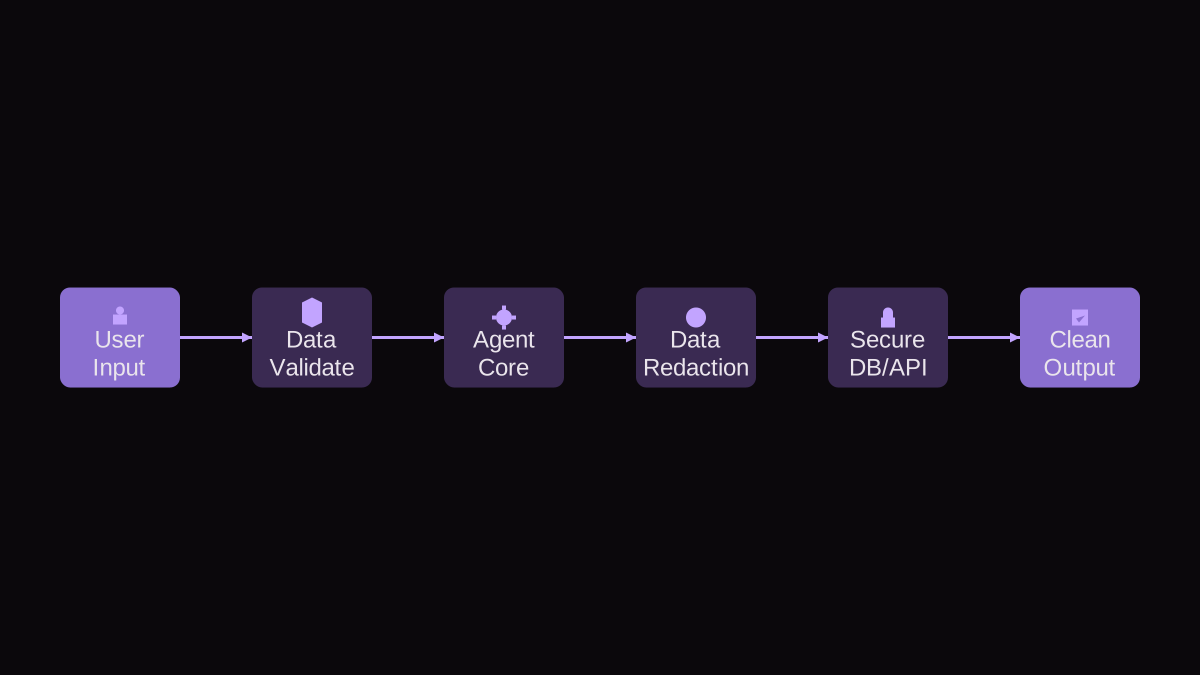
- Step 3: Automated Redaction and Anonymization. Implement a PII detection and redaction pipeline that processes all incoming user queries and all outgoing agent responses. Before any user input reaches the LLM, PII like account numbers or names are replaced with placeholders or masked. Similarly, before the agent's response is shown to the user, any sensitive data it might have generated (even if it shouldn't have) is redacted. Why: This dual-layer redaction acts as a crucial safety net, preventing both input-based and output-based leakage.
- Step 4: Secure Data Storage and Logging. Any data the agent processes or generates, including logs, must be stored securely. This means encryption at rest and in transit (e.g., AES-256 for storage, TLS 1.2+ for communication). Logs should be retained only for necessary periods and purged automatically. Why: Prevents data exposure from compromised storage or log access.
- Step 5: Regular Audits and Monitoring. Set up comprehensive logging and monitoring for all agent interactions, API calls, and data access patterns. Implement anomaly detection to flag unusual queries, excessive data retrieval, or unexpected responses. Regular security audits and penetration testing specifically targeting data leakage vectors are also critical. Why: Continuous oversight helps detect and respond to new leakage vectors quickly.
Common Mistakes in AI Agent Security & How to Avoid Them
Even with the best intentions, PMs often stumble into common pitfalls when securing AI agents. Recognizing these failure modes is the first step toward building more robust systems.
- Mistake 1: Over-reliance on Jailbreaking Prompts. Failure Mode: Many teams try to 'fix' prompt injection by adding more elaborate system prompts to prevent the agent from being jailbroken. This is a brittle approach; attackers will always find new ways around these prompt-based defenses. Detection: If your security strategy is primarily prompt engineering, you'll likely see a constant cat-and-mouse game with new injection techniques emerging. Avoidance: Shift focus from prompt-level defenses to architectural controls as outlined in the Defensive Design Rubric. Treat prompts as instructions, not as security mechanisms.
- Mistake 2: Insufficient Data Anonymization/Redaction. Failure Mode: Assuming the base LLM or agent won't inadvertently expose sensitive data. This often leads to PII, internal system details, or confidential information showing up in agent responses or logs. Detection: Conduct regular security audits of agent outputs and log files. Implement automated PII scanning tools on agent interactions. User reports of sensitive data exposure are also a clear signal. Avoidance: Implement automated, pre-processing and post-processing redaction pipelines for all data entering and exiting the agent. Prioritize data minimization at the source.
- Mistake 3: Broad Agent Permissions. Failure Mode: Giving an AI agent more access or capabilities than it strictly needs. If an agent with broad permissions is compromised, the attacker gains control over a wide range of systems, turning a prompt injection into a catastrophic breach. Detection: Audit agent service accounts for excessive permissions. Look for unusual API calls or actions in agent logs that are outside its defined scope. Avoidance: Strictly adhere to the Principle of Least Privilege. Define precise, granular scopes for every tool, API, and database the agent can interact with, and regularly review these permissions.
- Mistake 4: Neglecting Continuous Monitoring & Feedback Loops. Failure Mode: Treating AI agent security as a one-time setup rather than an ongoing process. New attack vectors emerge constantly, and static defenses quickly become obsolete, leaving vulnerabilities undetected. Detection: A lack of security incident reports related to the agent, or a reliance solely on manual checks, indicates a gap. Absence of anomaly detection alerts for agent behavior is another red flag. Avoidance: Implement real-time monitoring of agent interactions, anomaly detection, and a robust incident response plan. Schedule regular penetration testing and red-teaming exercises specifically for AI agents, and establish clear feedback loops to continuously improve your security posture.
Key Takeaways
- Prompt injection and data leakage are critical vulnerabilities requiring proactive, architectural-level security measures, not just reactive fixes.
- The Defensive Design Rubric provides a framework for building secure AI agents: strict input/output validation, clear instruction/input separation, least privilege, human-in-the-loop, and output guardrails.
- Data minimization, granular access controls, and automated redaction pipelines are essential for preventing data leakage, especially with sensitive information.
- Implement security as a layered defense, not a single point solution. Each control strengthens the overall posture.
- Avoid common mistakes like over-relying on prompt engineering for security, insufficient data anonymization, overly broad agent permissions, and neglecting continuous monitoring. Security is an ongoing commitment.
- As product managers, we are the first line of defense. Integrating security into the product lifecycle from concept to deployment ensures trustworthy and resilient AI agents.