Metrics
A/B Testing AI Features: Why Classic Experiments Break
A/B testing, the bedrock of product iteration for decades, often falls short when applied directly to AI-powered features. The core reasons are rooted in the fundamental differences between static UI changes and dynamic, evolving AI models: non-deterministic outputs, complex feedback loops, continuous data drift, and the challenge of establishing a clear ground truth. For AI Product Managers, this means abandoning the 'set it and forget it' mentality of classic experiments and instead embracing adaptive designs, blended metrics, and a deeper understanding of how AI interacts with users over time.
My 10+ years in product management, particularly across streaming, fintech, and healthcare, have shown me that ignoring these nuances leads to misleading results, suboptimal feature launches, and ultimately, a distrust in data-driven decision-making. We need a new playbook, one that accounts for the unique characteristics of AI systems to ensure we are truly measuring impact and driving meaningful user value.
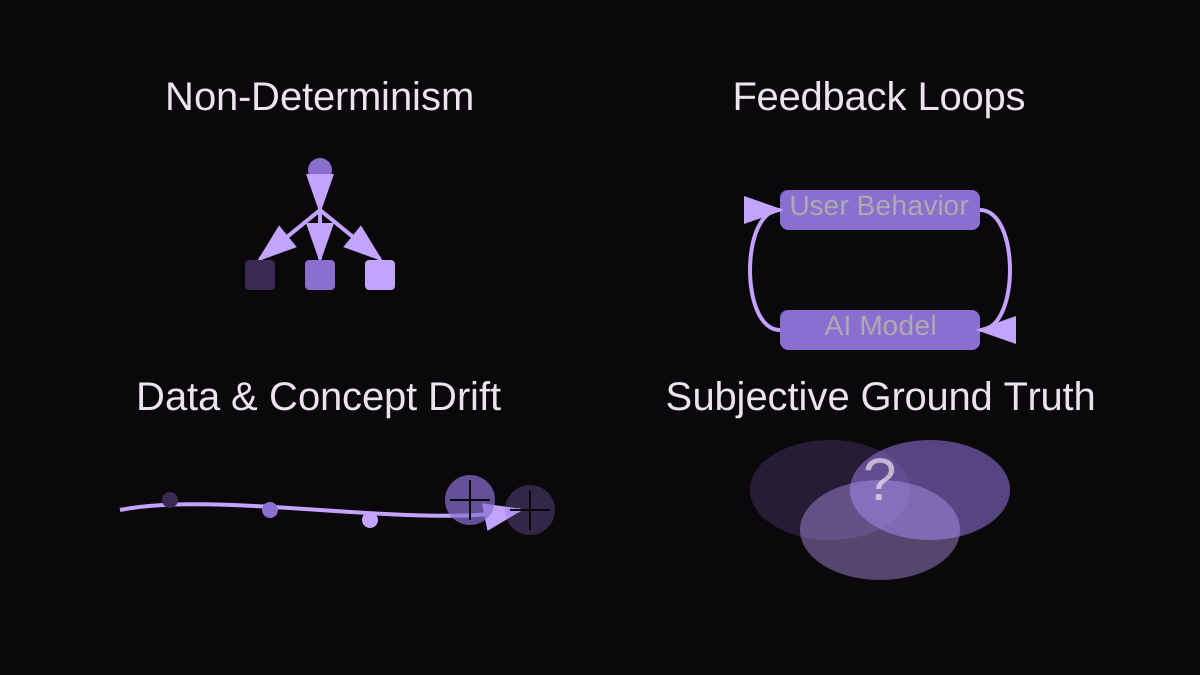
Why Classic A/B Testing Breaks for AI Features
The traditional A/B test assumes a static treatment: Feature A is exactly Feature A for all users in Group A, and Feature B is exactly Feature B for all users in Group B. With AI, this assumption crumbles. Let's break down the key reasons why:
- Non-Determinism: Unlike a button color change, an AI model's output isn't always the same for identical inputs. Think about a generative AI feature suggesting content or personalizing a feed. The output can vary slightly or significantly, even for the same user over time, or between users with similar profiles. This inherent variability makes it difficult to attribute changes solely to the 'feature' versus the model's natural range of outputs.
- Feedback Loops: Many AI models, especially recommendation engines or personalization algorithms, learn and adapt based on user interactions. When you expose users to an AI feature, their behavior changes, which then feeds back into the model, further changing its behavior. This creates a dynamic, moving target. Group A's model might evolve differently from Group B's model simply because of the users exposed to it, making a direct comparison of static 'features' impossible. The experiment itself influences the models being tested.
- Data and Concept Drift: The real world is not static. User preferences, trends, and underlying data distributions change over time. An AI model trained on historical data can become less relevant as these changes occur – a phenomenon known as concept drift. This means an AI feature that performs well at the start of an A/B test might degrade or improve differently in each group over the test duration, again invalidating the static comparison. The 'control' might be decaying while the 'treatment' is adapting, or vice versa.
- Challenge of Ground Truth and Subjective Quality: For many AI features, especially in creative or personalized domains, there isn't a single objective 'correct' answer. Is one subject line truly better than another, or is it merely more engaging for a specific segment? User satisfaction with AI outputs can be highly subjective and hard to quantify with simple click-through rates. This lack of clear ground truth makes it difficult to define what 'better' even means in an experiment, let alone measure it accurately.
How Do You Define Success for AI Features?
Given the complexities, defining success for AI features demands a multi-faceted approach, moving beyond simple conversion rates. We need to blend traditional business metrics with AI-specific performance indicators and a keen eye for user perception.
- Blended Metrics: While business metrics like conversion, retention, and engagement remain crucial, they often aren't sufficient on their own. We must pair them with AI-specific metrics such as model accuracy, precision, recall, latency, fairness, and the diversity of outputs. For a recommendation engine, the goal isn't just clicks, but also the relevance and novelty of recommendations. For a content generation tool, it's not just usage, but the quality and utility of the generated content as perceived by the user.
- Proxy Metrics for Long-Term Impact: Sometimes, the true impact of an AI feature is long-term and indirect. For example, a new AI-powered anomaly detection system might not immediately boost revenue, but it could reduce operational costs or prevent future fraud. In these cases, identify strong proxy metrics – leading indicators that correlate with the desired long-term outcome. This requires deep domain knowledge and careful validation.
- User Perception and Qualitative Feedback: AI features often have a significant impact on user experience, beyond what quantitative metrics can capture. Does the AI feel helpful, intrusive, or creepy? Is it intuitive? Qualitative feedback through surveys, usability testing, and sentiment analysis becomes invaluable. This can help uncover issues like bias, lack of transparency, or simply a poor user experience that might not surface in traditional A/B test metrics.
The Adaptive AI Experimentation Rubric: Choosing the Right Test
To navigate the complexities, I've developed the Adaptive AI Experimentation Rubric. This framework helps you assess your AI feature's characteristics and choose the most appropriate experimentation strategy. Before you even think about A/B, consider these five criteria:
- 1. Model Determinism (High vs. Low): Is the AI's output largely consistent for similar inputs (e.g., a simple classification model) or highly variable (e.g., a large language model generating creative content)?
- - High Determinism: Classic A/B testing is more viable, but still consider other factors.
- - Low Determinism: Pure A/B testing will struggle. Consider multi-armed bandits (MABs) for continuous optimization, or sequential A/B tests with frequent model retraining/refreshing.
- 2. Feedback Loop Strength (Weak vs. Strong): Does user interaction significantly and rapidly change the model's behavior, or is the model largely independent of immediate user feedback?
- - Weak Feedback: Traditional A/B is more forgiving. Focus on clear control/treatment groups.
- - Strong Feedback: Avoid long-running A/B tests where groups diverge. Opt for MABs, interleaved experiments, or very short-duration A/B tests with frequent re-randomization or switchbacks.
- 3. Feature Impact Scope (Isolated vs. Pervasive): Does the AI feature impact a narrow, specific part of the user journey or does it have widespread effects across the entire product experience?
- - Isolated: Easier to define a clear test group and measure direct impact. May allow for simpler A/B.
- - Pervasive: Requires careful consideration of network effects and spillover. May need cluster-based randomization or a pre/post-analysis across all users with careful segmentation.
- 4. Ground Truth Availability (Objective vs. Subjective): Is there a clear, measurable 'correct' answer for the AI's output (e.g., fraud detection accuracy) or is success highly subjective (e.g., creative content generation)?
- - Objective Truth: Direct metrics like accuracy, precision, recall are key. A/B can validate improvements.
- - Subjective Truth: Rely heavily on blended metrics including user satisfaction scores, qualitative feedback, and human evaluation alongside quantitative metrics. A/B tests might only tell part of the story.
- 5. User Interaction Modality (Implicit vs. Explicit): How do users interact with the AI? Is it passive (e.g., background recommendations) or active (e.g., conversational AI)?
- - Implicit: Focus on measuring downstream behavioral changes. Attribution can be harder.
- - Explicit: Direct user feedback (e.g., thumbs up/down, survey responses) is a rich signal and should be integrated into success metrics and possibly the model's learning loop.
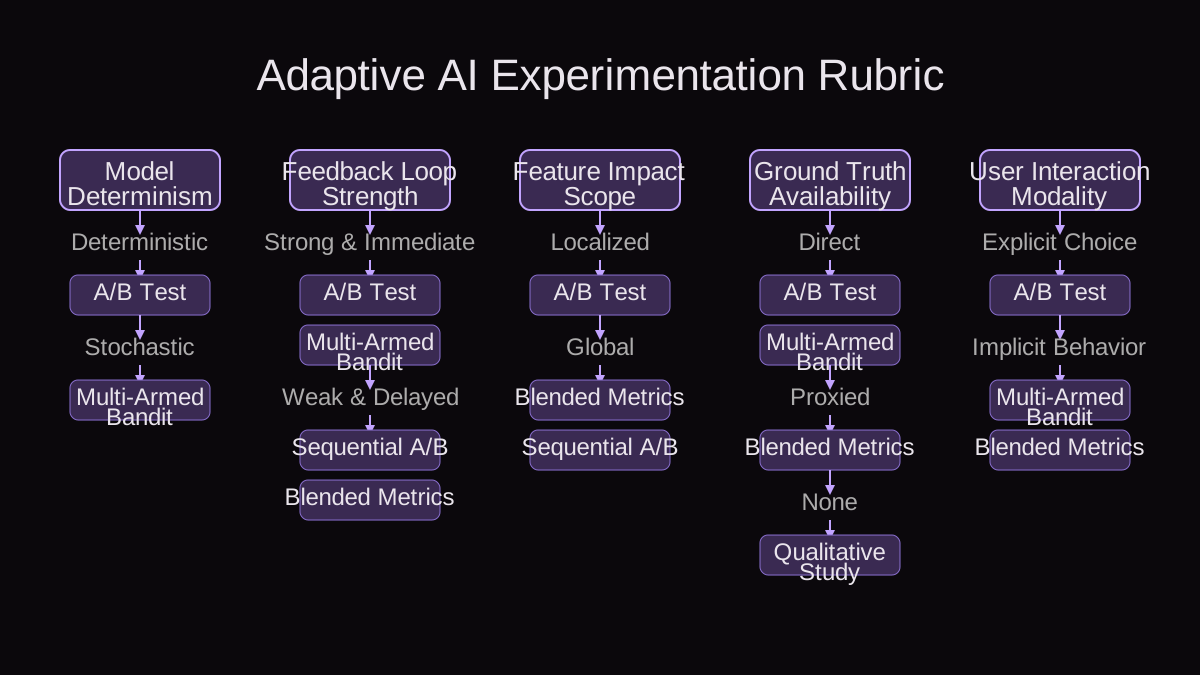
Worked Example: Testing an AI-Powered Personalized Subject Line Generator
Let's walk through a concrete scenario: You're an AI PM at a marketing tech company, and you've developed a new AI model that generates personalized email subject lines to improve open rates and click-through rates. How do you test it?
Initial Hypothesis: AI-generated personalized subject lines will lead to higher open rates and click-through rates compared to manually crafted or template-based subject lines.
- Step 1: Apply the Adaptive AI Experimentation Rubric.
- - Model Determinism: Low. The AI generates unique subject lines based on user profiles and email content, so outputs vary. This suggests MAB or sequential A/B.
- - Feedback Loop Strength: Strong. If users open more emails with certain subject lines, the model learns to generate similar ones. This could lead to a local optimum or bias, impacting long-term performance.
- - Feature Impact Scope: Isolated. It primarily affects email engagement, not the entire product experience.
- - Ground Truth Availability: Subjective. While open/click rates are quantitative, the 'quality' of a subject line is subjective and can lead to fatigue or unsubscribes if not balanced.
- - User Interaction Modality: Implicit. Users don't directly interact with the generator, only its output.
Rubric Conclusion: A classic A/B test is insufficient. A multi-armed bandit (MAB) approach, possibly with a human-in-the-loop component, is more suitable for continuous optimization and managing feedback loops.
- Step 2: Design the Experiment (Modified MAB).
- - Instead of A/B, you set up a MAB with three 'arms': Arm 1 (Control): Manually crafted subject lines. Arm 2 (Treatment A): AI-generated subject lines. Arm 3 (Treatment B): AI-generated subject lines with a diversity constraint (e.g., ensuring a variety of themes and tones to prevent fatigue).
- - The MAB algorithm dynamically allocates traffic to the arms that are performing best (e.g., highest open rate), while still exploring less performant arms to discover new optimal strategies. This naturally handles the feedback loop by continuously adjusting and learning.
- - Randomization: Users are randomized into one of the three arms for each email they receive. This ensures each email send is a distinct experiment within the MAB framework.
- Step 3: Define Blended Metrics.
- - Primary Business Metrics: Email Open Rate, Click-Through Rate (CTR).
- - Secondary Business Metrics: Unsubscribe Rate (to detect fatigue/negative sentiment), Conversion Rate from email links.
- - AI-Specific Metrics: Subject line diversity (e.g., using NLP metrics to measure semantic variation), Model latency (time to generate subject line), Human rating of a sample of generated subject lines (qualitative check for quality and brand alignment).
- Step 4: Address Challenges.
- - Cold Start: For new users with no historical data, the AI might perform poorly. Implement a fallback to template-based subject lines or a simpler, rules-based AI for these users until enough data accumulates. The MAB can also be configured to explore more for new users.
- - Personalization Bias: Ensure the AI isn't inadvertently creating subject lines that appeal only to a narrow demographic. Monitor performance segmented by demographics if possible, and integrate fairness metrics into the model evaluation.
- - Long-Term Impact: MABs are great for short-term optimization. To measure long-term effects, consider running a separate, longer-term holdout group where a small percentage of users consistently receive manual subject lines, allowing for a comparison of overall user retention or lifetime value.
By adopting this adaptive approach, we move beyond the limitations of classic A/B testing and gain a more nuanced, robust understanding of our AI feature's true impact.
Common Mistakes in A/B Testing AI Features
Even with an adaptive mindset, pitfalls abound. Here are some of the most common mistakes I've seen, along with how to detect and avoid them.
- Mistake 1: Treating AI features like static UI changes. Failure mode: Assuming the 'treatment' is fixed, ignoring model evolution and feedback loops. This leads to invalid comparisons as the underlying models in control and treatment groups diverge differently. Detection: Unexpected or inconsistent metric shifts, or if the model's performance metrics (e.g., accuracy, latency) differ significantly between groups. Avoidance: Adopt dynamic experimentation designs like MABs, interleaved experiments, or switchback tests. Regularly monitor model performance metrics in addition to business KPIs. Understand your model's learning mechanism.
- Mistake 2: Relying solely on short-term metrics. Failure mode: Optimizing for immediate gains (e.g., higher clicks) but missing long-term negative effects like user fatigue, unsubscription, or negative sentiment. An AI that's overly aggressive might boost short-term engagement but alienate users over time. Detection: Increased churn, negative qualitative feedback (surveys, app store reviews), or a decline in secondary metrics like retention or lifetime value. Avoidance: Always include long-term holdout groups, even small ones. Integrate qualitative research (user interviews, surveys) and sentiment analysis throughout the experiment. Define a balanced scorecard of metrics, including both leading and lagging indicators.
- Mistake 3: Neglecting cold start problems. Failure mode: New users, or users with sparse data, receive poor AI experiences, skewing overall results and potentially leading to higher early churn. The AI might not have enough data to personalize effectively for them. Detection: Segment your results by user tenure or data availability. If performance for new users is significantly worse in the AI group, you have a cold start problem. Avoidance: Implement hybrid approaches: start new users with a rules-based system or a simpler AI, then transition them to the full AI model as data accumulates. Design your MABs to explore more aggressively for new users or use a separate onboarding experience.
- Mistake 4: Ignoring ethical considerations and bias. Failure mode: The AI feature inadvertently amplifies existing biases in the data, leading to unfair or discriminatory experiences for certain user segments. This can erode trust and lead to regulatory issues. Detection: Perform segmented analysis of your metrics by demographic groups (age, gender, location, etc.). If certain groups consistently underperform or have a worse experience, investigate for bias. Conduct fairness audits on your model before and during deployment. Avoidance: Proactively audit your training data for bias. Implement fairness metrics (e.g., equal opportunity, demographic parity) as part of your AI model's success criteria. Ensure diverse representation in your test groups and qualitative studies.
Key Takeaways
- Classic A/B testing methods are often inadequate for AI features due to non-determinism, feedback loops, data drift, and subjective ground truth.
- Adopt adaptive experimental designs like Multi-Armed Bandits (MABs) or sequential A/B tests to account for the dynamic nature of AI models.
- Define success using a blended scorecard of metrics, combining traditional business KPIs with AI-specific performance indicators, diversity, and fairness metrics.
- Integrate qualitative feedback and user perception alongside quantitative data to understand the holistic impact of AI features.
- Utilize the Adaptive AI Experimentation Rubric to systematically choose the most appropriate testing strategy based on your feature's characteristics.
- Actively guard against common mistakes such as treating AI as static, over-relying on short-term metrics, neglecting cold start issues, and ignoring potential biases.